
Finance Beyond the COP: How India Is Rebuilding the Case for Global Climate Finance
As India hosts the BRICS leaders’ summit in September and the world heads to Antalya, Turkey, for COP31, India is making the case for why international climate finance must flow differently.
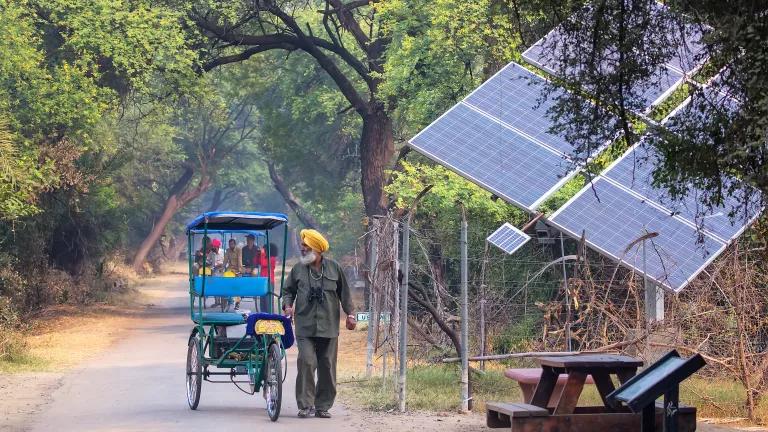
Solar panels in Keoladeo Ghana National Park in Bharatpur, Rajasthan, India

The world is going electric. The West Asia crisis has made it clear why this cannot happen fast enough. As conflict disrupts oil and gas flows through the Strait of Hormuz, countries in the Global South have been hit especially hard with rising fuel prices, food inflation, and constrained growth. The COP31 Presidency’s “35-by-35” electrification goal—raising the share of final global energy demand met by electricity from just above 20 percent today to 35 percent by 2035—is framed explicitly as an energy security measure as much as it is a climate one. But a higher electrification rate is not by itself a success. The question is not merely how fast the world goes electric, but who pays, on what terms, and who gets left behind? Finance remains the missing link. The rules determining how climate finance flows are being written not only at COP31 in Antalya, Turkey, this November but also by multilateral development banks in domestic capital markets, the G20, and at the BRICS leaders’ summit to be held in New Delhi on September 12–13, 2026. India sits at the center of all of it.
The crisis that changed the calculus
India’s vulnerability to the energy shock following the West Asia conflict is layered and immediate. The closure of the Strait of Hormuz has exposed India’s import dependencies on oil and gas, with the bulk of these goods transiting the strait. Disruptions to edible oil and fertilizer supply from the region are feeding directly into food inflation. The structural lesson is clear: Energy import dependence leaves India exposed not only to physical supply disruption but to long-term economic and security costs.
India’s clean energy transition is no longer primarily a climate story; it is an energy security imperative. India has already crossed 54 percent of installed power capacity from nonfossil fuel sources and hit a new milestone last month with renewable energy sources meeting more than half of the country’s electricity demand. Every gigawatt of domestic renewable capacity added is a safeguard from the next energy shock. These are not the actions of a country treating the clean energy transition as a distant aspiration.
What India’s mitigation finance numbers mean
Two documents released this year define the scale of finance needed—NITI Aayog’s report on Scenarios Towards Viksit Bharat (“Developed India”) and Net Zero and the latest Nationally Determined Contribution (NDC) submitted to the United Nations Framework Convention on Climate Change (UNFCCC). Together, they are not abstract planning documents but a budget sheet of the transition that keeps India on a clean growth trajectory.
If we think of India’s climate financing as a pie, India is already baking most of it itself. According to the latest Economic Survey, 83 percent of India’s mitigation finance and 98 percent of its adaptation finance currently come from domestic sources. It is here that India has begun to reassert its long-standing position of calling on developed countries to provide financial resources and access to technologies to enable developing countries’ climate actions—this time, with numbers.
The headline figure from the NITI Aayog report is a $6.5 trillion financing gap through India’s net zero horizon until 2070. But here is what it looks like when you break it down over the next two decades. By 2050, India’s total financing needs will be $8.05 trillion against $5.56 trillion in total available finance, thus underscoring the need for international climate finance to bridge the gap. Annualized across the next two decades, that financing gap works out to roughly $2.5 trillion or $100 billion per year.
That number deserves a moment. It is exactly the same amount as the goal of $100 billion per year that developed countries committed to all developing countries by 2020 but failed to deliver in time. India’s net zero needs across the core sectors of power, transport, and industry requires as much annually as the entire developing world was once promised. Unlike previous asks, this one comes with a granular, sector-wise breakdown and a clear domestic cofinancing commitment alongside it.
While the NITI Aayog report does not specify an exact public-private split within the international financing gap, a realistic scenario sees MDBs, bilateral channels, and climate funds covering a meaningful share, with the remainder mobilized through international private investment and structured through blended finance and de-risking instruments. India’s ask is large. But relative to what is needed, and relative to what India is already doing itself, it is not extraordinary.
The adaptation gap: The finance the world is not sending
Mitigation finance, however, tells only half the story. There is another dimension where the gap is acute and neglected: adaptation. Global adaptation finance reached $64 billion in 2024, a fraction of the nearly $1.9 trillion in climate finance flows directed to mitigation. U.N. climate funds remain underfunded—as evidenced by the Adaptation Fund missing its $300 million annual fundraising target the last three years—underscoring the urgent need for increased global pledges dedicated to adaptation. India, which funds 98 percent of its own adaptation needs domestically, is a stark example of how the international finance system has systematically failed to price climate vulnerability and building resilience.
Adaptation is not a peripheral issue in India’s climate finance argument; rather, this is central to it. India’s position is that integrating adaptation and resilience into development plans is essential to building the foundation of a functioning economy in a warming world. However, the architecture underlying the ask for more adaptation finance globally remains uneven. The instruments, standards, and institutional pathways that connect global capital to community-scale, nature-based, and locally rooted resilience investments still need to be built. Adaptation needs to be made investable at scale; not just in principle but in practice.
The BRICS moment
With the U.S. G20 presidency having sidelined climate and energy, the BRICS Summit is fast emerging as the forum where the Global South’s real conversation on finance for resilience and the energy transition is happening. This year, India holds the BRICS Presidency under the theme “Building for Resilience, Innovation, Cooperation and Sustainability”—a prescient choice of words given this year’s tumultuous developments. Earlier this month, BRICS member countries agreed to deepen cooperation on climate adaptation while calling for greater international financial support. The meeting adopted four outcome documents, including principles for advancing climate resilience through people-centric and community-based adaptation built on traditional knowledge. The recent BRICS statement provides the strongest political case yet for the urgent need to make adaptation and resilience investible at scale, signaling also India’s clear intention to use its presidency to highlight adaptation within formal climate finance frameworks.
From New Delhi to Antalya
India has historically been the largest recipient of international public climate finance, receiving more than 10 percent of global flows. With the international finance architecture increasingly prioritizing the poorest and most vulnerable countries, India’s share of public climate finance is unlikely to grow. How does the system then mobilize $100 billion a year for a country whose energy demand is projected to grow faster than any major economy, even as it crosses 54 percent nonfossil power capacity and funds a majority of the costs of the transition domestically? India’s ask is not unrealistic; rather, it makes the case for finance to flow differently.
India’s long-standing position on climate finance at UNFCCC—and what it is doing across BRICS, G20, and MDB reform tables simultaneously—is building the evidentiary case and political coalitions to demand that international climate finance flow not just to India but to the parts of the world where it is needed the most and will make the most difference. New sources of finance (innovative revenue streams, new contributors, and South-South flows) can expand the overall pie rather than redistribute it. Framed against the new $1.3 trillion international climate finance goal, India’s $100 billion annual need represents about 7 percent of the total. It is a proportionate ask but one that will depend on private finance doing what increasingly constrained public budgets cannot deliver alone.
The BRICS leaders’ summit in New Delhi will be an important forum to watch before heading to COP31 in Antalya this November. The COP31 electrification goal and the BRICS’s focus on resilience are two sides of the same coin, and they both need the international finance architecture to deliver. Ambition without finance is aspiration, and finance without the framework is noise. If the architecture can mobilize private capital at scale for a middle-income economy like India, it builds the momentum smaller and more vulnerable developing countries will eventually need too.
This NRDC.org blog is available for online republication by news media outlets or nonprofits under these conditions: The writer(s) must be credited with a byline; you must note prominently that the blog was originally published by NRDC.org and link to the original; the blog cannot be edited (beyond simple things such as grammar); you can’t resell the blog in any form or grant republishing rights to other outlets; you can’t republish our material wholesale or automatically—you need to select blogs individually; you can’t republish the photos or graphics on our site without specific permission; you should drop us a note to let us know when you’ve used one of our blogs.
Related Blogs

Building Community Resilience Through Smarter Oil and Gas Revenue Policy

COP30: World Continues to Take Action on Climate
