
Electrification Is Having Its Climate Moment. Can the World Deliver?
The incoming COP31 Presidency’s 35x35 proposal could make electrification a central pillar of global climate action. Delivering it will require clean power, stronger grids, affordable finance, and a commitment to reaching underserved countries and communities.

A composite image showing the extent of nighttime electric lighting across the world.
NASA Earth Observatory

Electrification is having its climate moment, and for good reason.
At the June climate meetings in Bonn, Turkey, the incoming COP31 Presidency called for “raising electricity’s share of global final energy demand from just over 20 percent today to 35 percent by 2035” (otherwise known as the 35x35 electrification target). Soon after, governments—including Brazil (COP30 Presidency), Turkey, and Australia (COP31 Presidencies), Ethiopia (COP32 Presidency), Canada, the European Commission, the Philippines, South Korea, and the United Kingdom—and international institutions like the International Energy Agency (IEA) and International Renewable Energy Agency (IRENA) launched the Electrify Now initiative: a platform to accelerate clean electrification across transport, buildings, industry, and other parts of the economy toward the global electrification target.
That momentum reflects a deeper urgency. Repeated energy shocks have shown how dependence on volatile fossil fuel markets raises prices, threatens energy security, and leaves households and businesses vulnerable. At the same time, artificial intelligence (AI) and data centers are driving significant new electricity demand while hundreds of millions of people still lack reliable and affordable power.
Clean electrification offers a better path. Electric vehicles, heat pumps, renewable energy, batteries, and electric industrial technologies can reduce fuel costs and pollution, strengthen energy security, and meet many energy needs more efficiently than combustion-based alternatives.
But the benefits are not automatic. A higher electrification rate is not, by itself, a climate or development success. Poorly managed electrification could prolong coal and gas use, raise household bills, worsen pollution, and direct scarce grid investment toward powerful new users while communities remain underserved.
The 35x35 electrification target is worth pursuing, but how it is delivered will matter as much as the headline number. The world is going electric. The task is to ensure that electrification displaces fossil fuels and delivers cleaner, more affordable, and more reliable energy for everyone.
Five tests for a credible global electrification agenda
NRDC believes that a credible global electrification agenda must pass five tests:
- Will new electricity demand be met with clean power that displaces fossil fuels rather than simply adding to them?
- Will generation, transmission, distribution, storage, and end use demand be planned as parts of an integrated system?
- Will electrification expand meaningful access and improve reliability, affordability, and economic opportunity for ordinary people?
- Will large, new electricity users strengthen power systems and support the public interest rather than shifting costs, pollution, and infrastructure burdens onto communities?
- Will emerging economies receive the affordable finance, technology, and human capital support needed to plan, build, operate, and maintain modern electricity systems?
Progress should therefore be measured not only through the global electrification rate but also through the carbon intensity of electricity supply, fossil fuel displacement, investment in power systems and storage, affordability, reliability, productive use, and meaningful energy access. Otherwise, countries could improve the headline number while emissions rise, public costs increase, or underserved communities see little benefit.
What China and Europe teach us about electrification
Together, China and Europe show two different experiences in addressing the electrification challenge: how to build a coordinated electric economy at scale, and how to overcome the price, grid, and policy barriers that still slow the move away from fossil fuels.
China: Building the electric economy at scale
China offers the clearest demonstration that electrification is no longer a future strategy. It is already reshaping a major economy.
Electricity supplied about 30 percent of China’s final energy consumption in 2025. The government is now targeting 35 percent by 2030, five years ahead of the global 35x35 target. China is already electrifying faster than Europe and the United States.
China’s electrification push now reaches across transport, industry, buildings, and urban infrastructure. It has built the world’s largest electric mobility sector, deployed hundreds of millions of electric two-wheelers, expanded electric vehicle use rapidly, and begun electrifying parts of heavy transport.
This did not happen through consumer technology alone. Electric vehicles needed charging networks. Renewable energy needed transmission. New demand needed storage, flexible resources, and stronger distribution systems.
Over more than two decades, China built many of these pieces together. Public procurement, regulation, infrastructure investment, and industrial policy created large domestic markets for solar, wind, batteries, and electric vehicles. Scaling these technologies has also increased demand for transition minerals, underscoring the importance of diversified supply chains, recycling, resource efficiency, and strong environmental safeguards. Ultra-high-voltage transmission lines now move electricity from wind- and solar-rich regions in the west and north to major industrial and population centers in the east.
China’s experience also shows that electrification can serve economic and strategic goals. It has reduced exposure to imported oil, supported globally competitive clean technology industries, improved urban air quality, and strengthened resilience to international energy shocks.
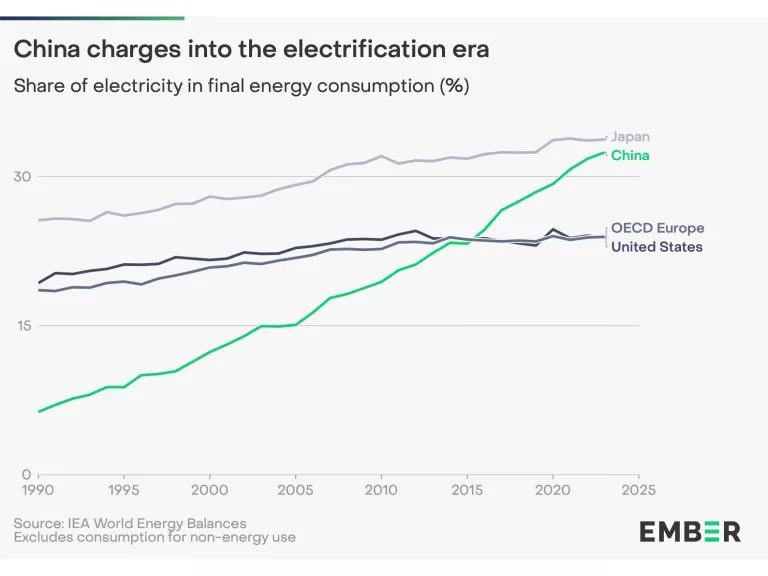
But China also illustrates the central limitation of any electrification target. Rapid electrification does not automatically translate into lower emissions. China’s power system still relies heavily on coal, underscoring the need to scale renewable energy, storage, flexible resources, and grid readiness alongside electrification so that clean power can meet new demand and increasingly displace fossil generation.
The lesson is not that every country should copy China’s policy or industrial model. It is that electrification succeeds when clean generation, grids, manufacturing, and demand are treated as parts of one system.
Europe: Accelerating the move from fossil fuels to electricity
The European Union (E.U.) has expanded renewable generation, reduced gas consumption, and improved energy efficiency. Yet electricity still accounts for only around 23 percent of final energy use, while transport, heating, and significant parts of industry remain heavily dependent on fossil fuels.
The pace of progress has consequences beyond emissions. Europe remains exposed to volatile oil and gas markets, high energy costs, and geopolitical disruption. In 2025, the E.U. spent €340 billion on fossil fuel imports, with imported fossil fuels supplying 57 percent of the energy it consumed.
The challenge is not simply to build more renewable energy. Electricity can cost roughly three times as much as gas, grid connections can take years, and businesses and households often lack sufficient incentives to switch. These barriers have kept Europe’s electrification rate largely stagnant, even as clean power generation has grown.
The European Commission’s new Electrification Action Plan is an attempt to change that trajectory. Unveiled in July 2026, the plan aims to raise electricity’s share of E.U. final energy use from 23 percent today to 46 percent by 2040 and make Europe the world’s first “electro-powered” continent. The commission estimates that achieving this goal could reduce fossil fuel import costs by €260 billion each year.
The plan treats electrification not only as a climate strategy but also as a matter of energy security, industrial competitiveness, and sovereignty. It proposes measures to narrow the price gap between electricity and fossil fuels; lower the up-front costs of heat pumps, electric vehicles, batteries, and other electric technologies; accelerate grid deployment; and invest in the skills and industries needed to support the transition.
The commission argues that the benefits for consumers could be significant: driving a battery-electric vehicle could cost up to 78 percent less than driving an equivalent fossil-fueled car while switching from a gas boiler to a heat pump could reduce average household heating costs by as much as 60 percent.
Europe is also connecting its electrification push with the growth of its digital economy. Its roadmap for digitalization and AI in the energy sector recognizes both sides of the challenge: Data centers can add large, concentrated loads, while AI tools can improve forecasting, grid balancing, renewable integration, and demand flexibility.
Europe’s experience shows why renewable energy deployment alone does not guarantee a faster move away from fossil fuels. Clean power must also be affordable to use, connected to the places where demand is growing, and supported by policies that make switching practical for households, businesses, and industry.
Electrification must reach those left behind
China and Europe are central to the global electrification debate, but they do not represent the full meaning of electrification.
In wealthier economies, electrification often means replacing an existing gasoline car, gas boiler, or fossil-powered industrial process with an electric alternative. For hundreds of millions of people elsewhere, it means reliable electricity must reach a home, clinic, school, farm, or business, sometimes for the first time.
Even access statistics do not tell the whole story. A grid connection is not the same as electricity that is reliable, affordable, and capable of supporting productive activity. Power that arrives only intermittently, costs too much to use, or cannot run essential equipment offers only a fraction of electrification’s potential.
Reliable electricity also expands the range of work and enterprise that communities can support. It can power irrigation, refrigeration, processing, digital services, workshops, and small businesses while improving the productivity of schools, clinics, and public institutions. But realizing those gains also requires investment in people: technicians, electricians, engineers, planners, utility workers, and local businesses that are able to install, operate, and maintain new energy systems. Electrification is therefore not only an infrastructure challenge but also a human capital and economic development opportunity.
Africa makes this imbalance particularly clear. The continent is home to roughly 19 percent of the world’s population but accounts for only about 3 percent of global electricity demand. Most people who still lack electricity live in sub-Saharan Africa, while many of those who are connected face unreliable service and very low levels of electricity use.
Africa’s electricity demand is growing faster than the global average, but clean power supplied only around half of the increase between 2020 and 2025. Meeting future demand primarily through new fossil infrastructure would create long-term exposure to volatile fuel costs, while faster investment in clean generation, grids, storage, and distributed systems could strengthen energy security and support development.
This is the broader test for any global electrification agenda. The world could raise electricity’s share of final energy demand through electric vehicles, factories, heat pumps, and data centers while still leaving large populations without dependable power. That would be more electrification on paper but not necessarily a just energy transition. A credible global agenda must therefore replace fossil fuel use with cleaner energy, extend access to people who remain excluded, and improve the affordability and quality of electricity for those who are connected but underserved.
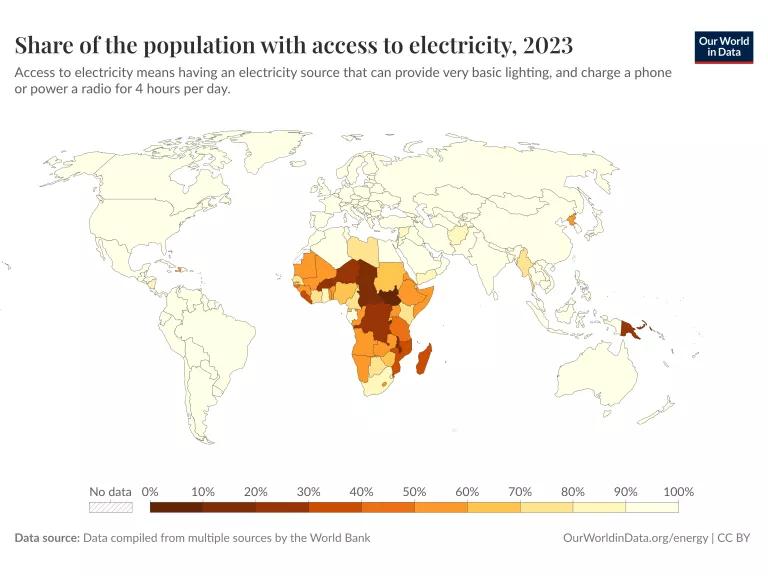
The pathway will not look the same everywhere. Coal-dependent economies such as South Africa face the challenge of replacing existing fossil generation, while much of sub-Saharan Africa, where electricity use and power sector emissions remain low, must rapidly expand reliable and affordable access. That will require a mix of stronger national grids, mini grids, and stand-alone renewable systems.
There are already signs of what this can look like. Since 2018, wind, solar, and geothermal power have met all of Kenya’s growth in electricity demand. Across the continent, falling costs for solar, batteries, efficient appliances, electric mobility, cooling, and clean cooking are creating new options for communities that cannot wait for conventional grid expansion.
But cheaper technology does not eliminate the financing challenge. High borrowing costs, weak utilities, limited public resources, currency risk, and shortages of technical capacity can still make clean infrastructure hardest to build in the places where it could deliver the greatest benefits.
International financial institutions and development agencies should help lower the cost of capital, absorb early-stage risk, and fund the project preparation needed to turn national plans into viable investments. National and regional development banks should also play a role in financing distribution networks, mini grids, storage, cooling, clean cooking, and other projects that may be too small or locally specific to attract conventional international capital.
Delivering that transition must also mean creating decent work, building local technical and institutional capacity, supporting locally rooted development, and assisting workers and communities affected by changes in existing energy industries. This is where Mission 300, the Electrify Now initiative, and the proposed 35x35 global electrification goal will be tested. Success should be measured not simply by how much infrastructure is financed but by whether electrification improves health, education, livelihoods, skills, and economic opportunity without creating new fossil fuel dependence. That will require stronger national institutions, practical financing packages, workforce development, and investment models tailored to local needs and development priorities.
AI is testing whether electrification will serve the public
AI and data centers are making the consequences of poor electricity planning harder to ignore. BloombergNEF has documented developers prioritizing “speed to power,” including through dedicated on-site generation, as grids struggle to accommodate rapidly growing demand.
The default response to digital growth cannot be to let some of the world’s most profitable corporations lock in new fossil fuel pollution or leave households and smaller businesses paying for the infrastructure required to serve them. Data center growth must come with transparent reporting of carbon, water, air quality, and land impacts, as well as clear responsibility for the costs it creates.
The U.N. Secretary-General’s proposed AI Environmental Transparency Initiative calls on major AI companies to publicly disclose those impacts and to power data centers with renewable energy by 2030. Communities, regulators, and grid planners need project-level information early enough to assess cumulative energy, water, land, pollution, and infrastructure impacts before projects are approved.
There is a better path.
Large technology companies can help finance additional clean energy, storage, and grid upgrades. They can locate facilities where clean power and water are genuinely available, provide demand flexibility, and support wider system improvements rather than competing with communities for scarce resources.
AI can also help improve forecasting, detect faults, integrate renewable energy, and manage electricity demand. The European Commission’s digitalization and AI road map describes AI and digital tools as ways to improve grid operation, flexibility, renewable integration, and efficient energy use.
Dedicated fossil generation described as temporary can remain economically attractive even after grid connections become available, creating a risk of long-term lock-in. Governments must therefore ensure that digital growth captures AI’s potential benefits without overwhelming electricity systems or extending fossil fuel dependence.
Grids are the foundation of the electric economy
Much of the electrification debate focuses on visible technologies such as electric vehicles, heat pumps, batteries, rooftop solar, and data centers. But the transition will succeed or fail largely on the strength of the power systems behind them.
Large-scale transmission is needed to move renewable electricity to cities, industries, and major demand centers. Distribution networks connect power to homes, schools, clinics, farms, and businesses, while mini grids and stand-alone systems may be the fastest and most affordable answer in places where national grids remain weak or distant.
Where grids already exist, electrification does not always require building from scratch. Grid-enhancing technologies, digital controls, advanced conductors, and better demand management can increase the usable capacity of existing networks and connect clean energy more quickly.
A data center or industrial facility may need a substation and major network upgrades, while a rural clinic or small business may need stronger local distribution, solar, and storage. Planning should reflect those differences and ensure that new investment improves reliability and affordability for existing users as well as new ones.
The IEA estimates that annual global grid investment must rise by approximately 50 percent from today’s roughly $400 billion by 2030. But the challenge is not only to spend more. It is to expand grids where necessary, modernize them where possible, and make better use of the infrastructure already available.
From a global goal to better energy systems
Electrification is gaining momentum because it offers something the current energy system increasingly cannot: a path to lower pollution, greater energy security, more efficient technologies, stronger economies, and wider access to modern energy services.
The opportunity now is to turn that momentum into better energy systems. That means connecting electrification to clean power and fossil fuel displacement; investing in transmission, distribution, storage, and distributed energy; and ensuring that large, new electricity users strengthen rather than strain the systems around them. It also means expanding affordable finance, building local technical and institutional capacity, and developing more resilient and responsible transition-mineral supply chains.
COP31 can help move electrification from broad ambition to a practical global agenda. The 35x35 global electrification goal can provide direction, but its real value will lie in the choices it inspires: cleaner electricity, lower energy costs, stronger institutions and workforces, greater economic opportunity, and reliable power reaching communities that have waited too long.
The world is going electric. Done well, this transition can deliver far more than a higher percentage. It can help build a cleaner, more secure, more productive, and more inclusive energy future.
Related Resources

Venezuela’s Oil Resources Are Vast (and Should Stay Underground)

U.S. 2035 Climate Target Is Ambitious, Achievable & a Call to Action
