People Behind the Transition: An Update on Workforce and Gender in India’s Renewable Energy Story
This new study assesses how India’s workforce is powering its renewable energy ambitions.

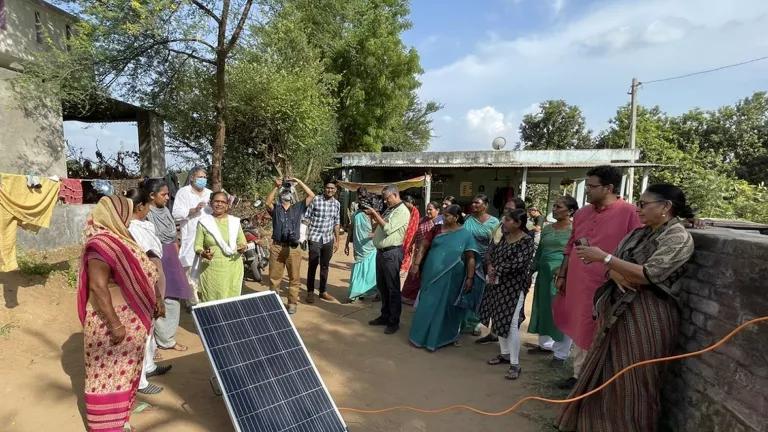
Workers placing a solar panel on the rooftop of a residence in Gurugram on the outskirts of New Delhi, February 20, 2024

Authored by Rana Pujari, lead, renewable energy, NRDC India, and Deepesh Tourani, renewable energy research associate, NRDC India
In one of the fastest-growing economies, growth is directly linked to energy: Demand in India continues to increase rapidly as economic activity increases, coupled with an equally rapidly expanding population. As the country continues to address this massive energy demand, it is not only about cleaning up power sources but also about navigating the ambition to include one of the biggest and youngest working populations in the world into this growth story.
The clean energy transition is often discussed in terms of gigawatts (GW) installed, emissions reduced, and climate targets achieved. Yet behind every solar panel installed, wind turbine manufactured, and bioenergy plant operated are people powering this transformation. As India advances toward its goals of becoming a developed nation by 2047, called Viksit Bharat 2047, and achieving net zero emissions by 2070, energy independence sits at the heart of these ambitions, where the clean energy sector is emerging not only as a climate solution but also as a powerful engine for employment generation, skills development, and inclusive gender-balanced economic growth.
Learn More

India has already demonstrated global leadership in this domain, with remarkable progress in its energy transition journey. In 2025, the country achieved its target of 50 percent of cumulative installed electricity capacity from non–fossil fuel sources—five years ahead of its Nationally Determined Contributions (NDC) schedule. Today, India ranks third among the world's leading renewable energy markets and is rapidly expanding its clean energy ecosystem across solar, wind, bioenergy, hydropower, green hydrogen, and other emerging clean energy technologies.
However, a pertinent question remains: Given India’s young population, where will the future jobs come from? The answer lies in the country’s ambitious renewable energy goals, as our study reveals.
This recent study, titled Driving Energy Transition: Workforce, Skills, and Gender in India’s Renewable Energy Sector,” by NRDC and the Council on Energy, Environment and Water (CEEW), under the guidance of the Ministry of New and Renewable Energy, provides one of the most comprehensive assessments of India's renewable energy workforce to date. Drawing on primary data from more than 250 companies across the renewable energy value chain, the study reveals an estimated generation of more than 4.4 million (44 lakh) jobs to achieve India’s target of 500 GW non–fossil fuel capacity combined with National Green Hydrogen Mission targets.
Key insights on the workforce
The analysis reveals that, in the past four years, India's renewable energy sectors added approximately 6.5 lakh full-time equivalent (FTE) jobs between fiscal years 2023–2026. The rooftop solar sector alone accounted for nearly 62 percent of this workforce growth, highlighting the strong employment potential of decentralized energy systems, backed by government financial assistance.
The study also demonstrates that not all renewable energy sectors generate jobs at the same intensity. Decentralized systems tend to be far more labor-intensive, given their distributed and small-scale nature. Rooftop solar, for example, generates 44.68 FTE job-years per megawatt (MW), compared to 1 FTE job-year per megawatt for utility-scale, ground-mounted solar projects. Thus, the number of jobs created by deploying 1 MW of rooftop solar projects per year is approximately 45 times more than that of a ground-mounted solar installation.
Similarly, biomass-to-power and small hydropower projects demonstrate high employment intensity, primarily due to the labor-intensive activities associated with feedstock collection, construction, commissioning, and operation of a biogas or biomass to a power plant. These findings underscore the importance of considering localized employment outcomes outside urban centers alongside energy generation when designing clean energy policies and investment strategies.
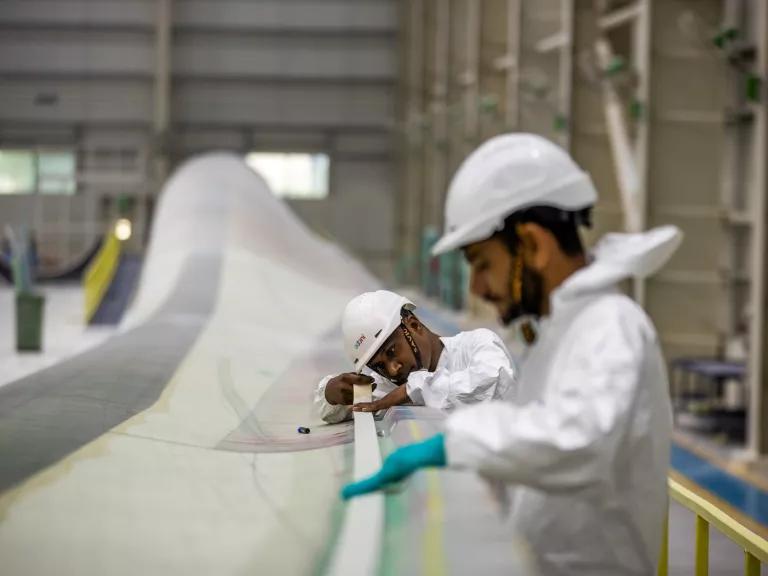
Workers inside a wind turbine blade manufacturing facility in Mundra, Gujarat
The skills imperative
As renewable energy technologies are deployed at a large scale and become increasingly sophisticated, workforce requirements are evolving rapidly. The study finds that around 60 percent of jobs in solar and wind deployment require semiskilled or highly skilled workers. In manufacturing, the share rises even further, with 80 to 90 percent of jobs requiring advanced skills.
The future workforce in renewable energy sectors will need expertise that extends beyond traditional engineering disciplines to keep pace with evolving technologies. Skills in business development, project management, system design, digital technologies, battery energy, and power electronics engagement are becoming increasingly important. This shift presents a significant opportunity for India's skilling ecosystem while highlighting the importance of public-private partnerships in workforce readiness.
Investments in vocational education, apprenticeships, reskilling programs, and continuous professional development will be critical to ensuring that India's workforce remains prepared for the demands of a rapidly evolving clean energy economy.
The gender imbalance challenge
While the renewable energy sectors promise new economic opportunities, the benefits are not yet being shared equally.
As per the study, women currently represent only 11 percent of the workforce across surveyed solar and wind deployment and manufacturing sectors. Moreover, nearly two-thirds of women employed in the sector are concentrated in nontechnical functions, such as human resources, administration, and accounting. This analysis mirrors the difficult national and global trends of low employment rates among women.
The findings suggest that substantial untapped talent remains outside of the sector's technical and leadership pipelines. Increasing women's participation in engineering, operations, project management, and executive roles can not only strengthen workforce availability but also improve gender balance and bring about an inclusive energy transition.
Creating more inclusive workplaces will require targeted interventions, including workplace safety measures, flexible work arrangements, mentorship opportunities, leadership development programs, and stronger pathways for women entering STEM careers. Encouragingly, around 44 percent of surveyed companies reported having at least one woman on their board, indicating a growing recognition of the value of diverse leadership.
Looking ahead
Though the study attempted to delve deeper into some of the key aspects—such as skills, gender, and broader workforce readiness—in India’s renewable energy sector, perhaps the most striking finding is also the scale of opportunity that lies ahead.
Importantly, approximately 120,000 of these jobs are estimated to be in manufacturing, operations, and maintenance activities—roles that provide long-term employment throughout the life of projects and facilities.
As underscored earlier, these projections reinforce the idea that clean energy is not merely an environmental agenda but a holistic strategy powering India’s economic growth and creating new career opportunities for millions of India’s youth.
The data reveals there is more to these stories. Achieving one of the most ambitious non–fossil fuel targets will require every sector in India’s entire renewable energy ecosystem to join hands and collaborate effectively to power solutions for one of the world’s renewable energy powerhouses and fastest-growing energy markets.
Building a workforce-centered energy transition
Along with large-scale deployment of renewable energy projects across various terrains and regions in the country, relevant stakeholders need to include workforce planning as an integral part of their renewable energy strategy.
Following cross-sectoral research and multi-stakeholder consultations, the study recommends three key actions to address some of the pertinent gaps discussed above:
-
Institutionalizing workforce data collection across renewable energy sectors in the country
-
Strengthening gender-inclusive initiatives across stakeholder groups
-
Expanding career advancement pathways and the latest skilling program through skills development and continuous learning
The study also notes that these measures can help policymakers and industry leaders make evidence-based decisions while ensuring that the quantity and quality of workforce growth keep pace with India’s rapid renewable energy deployment.
While India continues to celebrate its renewable energy achievements and key performances, realizing the goals is ultimately hinged on the people—the engineers, technicians, installers, operators, entrepreneurs, and innovators—who will build the energy systems of tomorrow. The clean energy transition is not only transforming how India produces power; it is going to reshape how India works, learns, and grows in the face of energy security challenges vis-à-vis a rapidly expanding economy.
This NRDC.org blog is available for online republication by news media outlets or nonprofits under these conditions: The writer(s) must be credited with a byline; you must note prominently that the blog was originally published by NRDC.org and link to the original; the blog cannot be edited (beyond simple things such as grammar); you can’t resell the blog in any form or grant republishing rights to other outlets; you can’t republish our material wholesale or automatically—you need to select blogs individually; you can’t republish the photos or graphics on our site without specific permission; you should drop us a note to let us know when you’ve used one of our blogs.
Related Blogs

For Import-Dependent Fossil Fuel Economies, Conflicts Force the Sacrifice of Long-Term Climate Progress for Immediate Survival

India’s Road To and From the Baku Climate Talks