For Import-Dependent Fossil Fuel Economies, Conflicts Force the Sacrifice of Long-Term Climate Progress for Immediate Survival
Global conflicts are forcing economies that are dependent on fossil fuel imports like India to trade climate progress for energy survival.

Long lines and panic buying have been reported by gas agencies in many cities—like here in Noida, India, where people are seen waiting to obtain an LPG gas cylinder for use in cooking—triggered by disruptions in the global energy supply linked to escalating conflict involving Iran, Israel, and the United States.

This blog was authored by Charu Lata, director, climate & energy, NRDC India, and Amol Kapoor, research associate, NRDC India.
As we approach the halfway mark of 2026, the planet’s climate is now “more out of balance than at any time in observed history,” with rising temperatures, ocean heat, deadly floods, and extreme weather threatening food systems, water security, and livelihoods globally. These developments are a reminder that the planet’s heat-trapping blanket is still getting thicker at the very moment when countries are struggling with war, energy instability, inflation, and policy uncertainty.
Since February, the U.S.-Israel-Iran war has spilled over to destabilizing global energy markets, leading to the closure of the Strait of Hormuz. This critical energy corridor typically handles roughly 20 to 30 percent of the world’s oil supply and 20 percent of its liquefied natural gas (LNG). In a matter of days, maritime traffic through the corridor effectively collapsed, with shipping halts reaching 92 percent and crude loadings dropping by 99 percent. Due to this blockage, the total oil shipments were restricted to just 3.8 million barrels per day, down from more than 20 million barrels before the war. But the deeper burden was not only on supply losses or the rise in fuel prices due to blockage. The crisis was compounded by an “invisible blockade” of soaring logistical costs. War-risk insurance premiums reportedly skyrocketed by more than 700 percent, and as a result, shipping and insurance costs, which normally account for roughly 4 to 5 percent of the price of oil, tipped to nearly 18 percent.
This clearly shows how a single choke point has effectively sent shock waves through global energy markets, exacerbating inflation, straining trade balances, and causing migration miles away.
This crisis reveals a deeper reality: Climate vulnerability, energy insecurity, and geopolitical instability are no longer separate challenges but overlapping risks that increasingly reinforce one another—especially for countries like India that are heavily dependent on fossil fuel imports. The sections that follow explore how these interconnected pressures are unfolding across different regions and why they demand a far more coordinated and resilient response.
Why India and similar fossil fuel–importing nations feel the shock first
A conflict in one region can raise cooking fuel costs in another and make daily life more expensive for ordinary people. The impact is already visible across the world. In Southeast Asia, countries such as Thailand leaned on fossil fuels and ordered coal-fired power plants to operate at full capacity and maximize domestic gas production in the Gulf of Thailand to meet electricity demand. Meanwhile, the Philippines declared a national energy emergency while other countries in the region—including Malaysia, Vietnam, and Indonesia—encouraged the public to adopt energy conservation measures. In East Asia, Japan reinstated massive government subsidies (amounting to ¥800 billion or $5 billion USD) to artificially lower retail fuel costs for citizens while in South Asia, the Sri Lankan government imposed strict fuel rationing and raised fuel prices by nearly 40 percent.
Beyond Asia, in the African continent, Egypt asked all businesses to close early to conserve energy. Oil prices surged by 50 percent by late March, sharply increasing inflation risks across many African economies and resulting in the depreciation of currency in 29 African countries. Pacific Island nations, which rely heavily on imported fossil fuels, also saw triggering fears of fuel shortages, rising transport costs, and broader economic instability across the region.
India’s energy security stress test
India illustrates this vulnerability sharply: Closure of the Strait of Hormuz threatens nearly 50 percent of its crude oil and nearly 90 percent of its liquefied petroleum gas (LPG) imports. In addition to powering industrial and electricity systems, oil and LPG remain deeply embedded in the daily lives of millions of Indians. Oil continues to dominate the transportation sector through widespread vehicle use while LPG serves as a primary cooking fuel for households across urban and rural India, making energy price volatility and supply disruptions a direct concern for everyday livelihoods and household affordability.
The war immediately created pressure on household and commercial energy access, with delays in LPG deliveries and price hikes. The Indian government had to scramble to prevent panic, stepping in to strictly ration commercial LPG supplies and freeze cylinder prices for the most vulnerable households.
The panic also pushed the Indian rupee to a historic low of ₹96.90 against the U.S. dollar in May 2026. To shield consumers, since March, the government had to cut excise duties on petrol and diesel by ₹10 per litre, but each ₹1 cut costs the central exchequer around ₹16,000–₹17,000 crore, creating a heavy fiscal burden.
The shock also reached energy-intensive industries, with gas shortages forcing more than 170 ceramic factories to shut down in Morbi, Gujarat, leading to large-scale worker migration.
In order to prevent widespread blackouts amid these cascading disruptions, the Indian government was forced to direct the nation’s coal power plants to operate at maximum capacity. While leaning on domestic coal and rationing fuel kept the country running, it perfectly illustrates how global conflicts force emerging economies to sacrifice long-term climate progress for immediate survival.
Therefore, for fuel-importing nations like India, the pressure moves quickly from ports and shipping lanes to governments that begin scrambling to protect consumers, manage inflation, and prevent social distress. Every additional dollar spent on imported oil or gas is a dollar diverted away from public health, adaptation measures, and long-term clean energy investment.
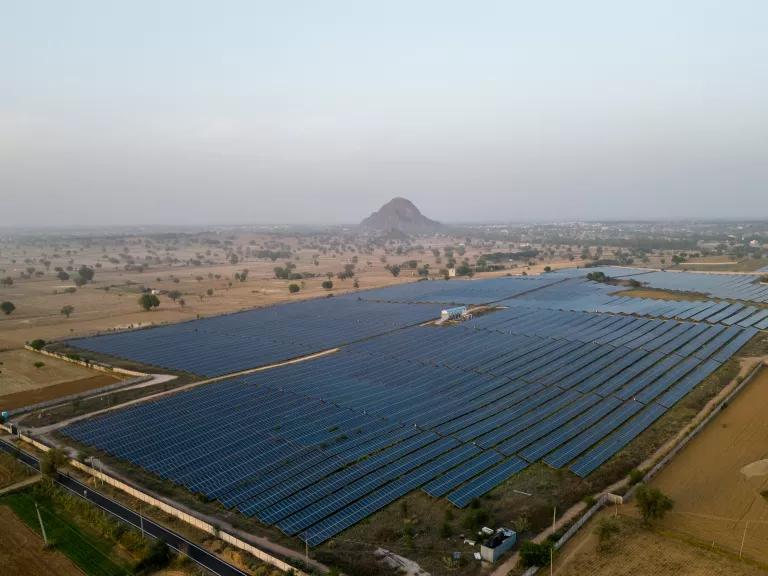
Solar arrays at a solar farm in Haryana, India, April 2026
Clean energy is economic insurance
The lesson from the U.S.-Israel-Iran conflict is clear that any country dependent on importing fossil fuels is never fully in control of its own energy future. Its domestic economy can be shaken by events far beyond its borders. Examples from across several fossil fuel–importing countries reinforce the fact that a fuel crisis quickly translates to energy crises, leading to higher transportation and food costs and directly impacting the most vulnerable across these nations.
It builds the case that the energy transition needs to be prioritized as an important arm of national security. Boosting clean energy infrastructure should be seen as an inflation management tool. Solar, wind, battery storage, energy efficiency, distributed renewable energy, public transport, and smarter grids all reduce the pass-through of global fossil fuel shocks into domestic prices. They create more predictable energy costs over time.
For India and other import-dependent fossil fuel countries, this matters because most internationally traded fossil fuels are priced in dollars. Developing countries therefore face a double burden: commodity price risk and currency risk. When oil prices rise and the dollar strengthens, imported fuel becomes even more expensive. Every unit of domestically generated renewable electricity reduces part of this exposure. Hence, investing in domestic renewable energy production becomes a small act of macroeconomic insulation.
The moment for a strategic shift
We are already in a moment where heads of state are announcing public austerity measures in response to the economic pressures triggered by ongoing conflicts in the Middle East. It is becoming increasingly clear that climate action can no longer be discussed in isolation from questions of energy security, economic resilience, and national stability. The global landscape has fundamentally shifted, and countries are now operating in a reality where securing reliable, affordable, and domestically resilient energy systems may become one of the defining priorities of the coming decade.
For countries like India that are heavily dependent on fossil fuel imports, large-scale energy imports create severe economic and geopolitical vulnerabilities. Energy price volatility directly affects household affordability, food systems, public health, industrial competitiveness, and social welfare. This makes investments in decentralized renewable energy, grid resilience, storage infrastructure, and clean energy manufacturing not just climate solutions but also strategic national safeguards. Countries also need to make clean energy cheaper to finance where borrowing costs are often high. Moreover, countries must prioritize stronger protection mechanisms, including strategic fuel and food reserves, safeguards for clean cooking access, and targeted financial support for vulnerable households during periods of price instability.
Equally important is the need for institutional preparedness. Climate impacts, geopolitical crises, and energy disruptions do not operate in silos, yet government responses often still do. Countries like India will increasingly need coordinated multi-stakeholder mechanisms that bring together energy, finance, health, climate, agriculture, labor, and welfare agencies to plan for and respond to cascading risks.
There are many successful examples of this coordination across countries. In India, the response to severe cyclones such as Cyclone Phailin in 2013 demonstrated strong coordination between the ministries of home affairs, defense, railways, power, and telecommunications. This integrated approach to disaster preparedness and response significantly reduced casualties, with deaths falling to 38 compared to more than 10,000 during the 1999 Odisha super cyclone. In Japan, the ministries responsible for energy, environment, disaster management, health, and infrastructure illustrated sharp coordination and planning after the Fukushima disaster in 2011. Following Russia’s invasion of Ukraine and the subsequent energy crisis, Germany established emergency structures involving its climate ministry, finance ministry, foreign office, regulators, utilities, and industry actors to rapidly reduce dependence on Russian gas.
Without integrated crisis planning, economic and climate shocks can rapidly deepen inequality, trigger displacement, strain public systems, and undermine long-term development goals. In this context, the energy transition is no longer only an environmental imperative—it is rapidly becoming a cornerstone of economic resilience, social stability, and national security.
Related Blogs

Women, Skills and Green Economic Growth in India

Hard Questions About the Permitting Bill