RGGI Is Funding Lower Household Bills as Data Centers Spike Prices
States are investing in clean energy and lowering electricity bills through the Regional Greenhouse Gas Initiative.


Demand for energy is growing in the Northeast and mid-Atlantic, spiking electricity bills and pollution in some states.
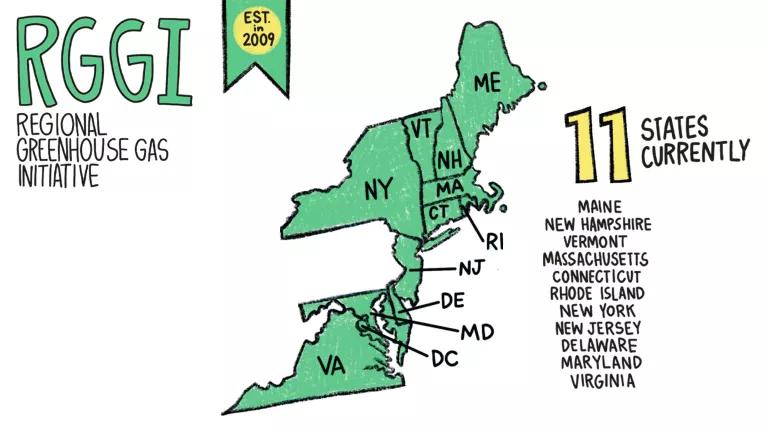
A recent report confirms that the Regional Greenhouse Gas Initiative (RGGI)—which sets a declining cap on carbon emissions from power plants and returns the program’s proceeds to fund energy and environmental programs—is serving as an essential stopgap for offsetting household electricity bills while reducing climate pollution.
States must stay on track with RGGI to protect these consumer benefits.
Several states are using larger amounts of program proceeds to provide households with bill credits or rebates that immediately lower monthly electricity bills, which means less investment in programs that provide long-term benefits. These types of bill credits can provide immediate temporary relief in the face of unexpectedly high electricity bills but should be retained for households that are most in need.
RGGI 101: Reducing pollution, creating jobs, and boosting local economics
RGGI works by setting a limit on greenhouse gas emissions from large power plants. Polluters must purchase permits that are equivalent to how much they emit. As the limit decreases, it becomes more expensive to pollute, making investments in clean energy projects more favorable.
The proceeds from RGGI permits are returned to participating states—based on their original levels of pollution—which then decide how to spend those proceeds.
These investments, paired with the compliance price signal, reduce pollution, create new jobs, and increase economic value. Between 2018 and 2020, RGGI created 7,874 new jobs in energy infrastructure development and energy efficiency. These projects are estimated to bring in $223 million in economic activity per year.
RGGI has also contributed to reducing harmful co-pollutants from power plants. For power plants covered by RGGI, carbon dioxide emissions declined between 27–31 percent and nitrogen oxide (NOx) emissions were reduced by 5769 percent through 2022. Exposure to NOx, which contributes to smog, is associated with short- and long-term health risks, including aggravated asthma symptoms and respiratory illnesses.
RGGI invests in lowering electricity bills
Since the start of the program in 2009, states have invested most of their proceeds from RGGI into lowering electricity bills, saving households and businesses a total of $23 billion off their bills.
Funding from RGGI in 2024 alone will reduce electricity bills throughout the region by $363 million every year. Most of those savings—about 69 percent of total lifetime bill savings—will occur due to investments in energy efficiency programs. Energy efficiency avoids additional utility investments in new generation, transmission, and distribution infrastructure that are needed for high-demand hours.
These bill savings translate into real-world social support. As one example, Connecticut’s 2024 RGGI proceeds provided rebates to a senior independent living and memory care community to install more efficient heating and cooling systems, saving costs for both senior residents and other electricity customers.
Faced with rising electricity bills, states pivoted to rapid relief. Bill assistance should be concentrated on households in need.
In the last few years, states have been spending larger shares of their RGGI proceeds on direct bill credits or rebates to reduce monthly residential electricity bills. States directed 23 percent of RGGI investments to credit electricity bills in 2024, as compared to 10–19 percent in past years. States are prioritizing immediate bill relief even more for environmental justice communities, with spending on bill assistance increasing to 39 percent in 2024.
States are also re-examining who receives bill credits and how. New Jersey shifted its bill credits to high-usage electricity months and provided extra credits to customers at risk of having their service cut off. Virginia increased the percentage of proceeds going toward bill credits for households, small businesses, and churches and now requires the credit to be shown on bills so that the benefits of RGGI are more visible to customers.
Direct bill assistance from RGGI is a temporary solution to rising rates and must complement efforts to stabilize causal drivers of electricity rates. Proceeds from RGGI will likely decrease as the power sector decarbonizes, meaning less money may be available to lower customer bills. States can’t depend on these proceeds to reduce electricity bills in the long term.
Where states opt to increase RGGI-funded bill assistance, they should target households in need. More specifically, bill assistance should be retained only for low- and middle-income households, particularly those with higher electricity use and at risk of missing their bill payments.
Proceeds provide the greatest ratepayer cost savings if targeted to fund energy efficiency, beneficial electrification, and renewable energy. Energy efficiency and demand response programs reduce the need to build more electricity-generating infrastructure, the bill for which is borne by ratepayers. Directing more RGGI spending toward direct bill assistance takes away from funding these compounding longer-term savings. Higher future electricity prices discourage electrification of cars and building appliances, which is a key strategy to meeting state climate goals and reducing local pollution.
Although near-term bill relief is a priority today, maintaining flexibility with how to spend RGGI proceeds will put states in a position to more easily address future unknown challenges.
States should adopt updates to RGGI to increase stability and consumer benefits
This year, states are adopting updates to improve the performance of RGGI. The proposed model rule sets a trajectory for decreasing power sector emissions through 2037, limits future use of offsets for compliance, and expands two features of the market—the Cost Containment Reserve and the Emissions Containment Reserve—to avoid volatile RGGI prices.
States must adopt these changes this year to preserve the benefits of RGGI for electricity customers. After these changes are adopted, states will revisit the cap trajectory of emissions within the next two years, when the program’s operations can again be improved.
Over the last 17 years, RGGI has been reducing carbon emissions from power plants and increasing clean energy production while investing in lowering electricity bills and creating jobs. States should double down on RGGI, maximize the program’s benefits through smart investment, and stay on course by adopting the model rule.
This NRDC.org blog is available for online republication by news media outlets or nonprofits under these conditions: The writer(s) must be credited with a byline; you must note prominently that the blog was originally published by NRDC.org and link to the original; the blog cannot be edited (beyond simple things such as grammar); you can’t resell the blog in any form or grant republishing rights to other outlets; you can’t republish our material wholesale or automatically—you need to select blogs individually; you can’t republish the photos or graphics on our site without specific permission; you should drop us a note to let us know when you’ve used one of our blogs.
Related Blogs

Building Data Centers Without Breaking PJM

The Real Reason Your Energy Bills Are Increasing in PJM