
The Real Reason Your Energy Bills Are Increasing in PJM
Electricity bills in the mid-Atlantic may increase up to $30 per household due to new data centers, unreliable gas plants, and delays in building new clean energy, but solutions are within reach.

Solar arrays on an Indiana farm

Your energy bill may increase next month by $20–$30 if you live in one of the 13 states or Washington, D.C., that are part of PJM, the electric grid operator for the mid-Atlantic and Midwest. Last year, PJM’s routine but obscure “capacity auction” launched the grid operator into the spotlight when it resulted in a surprise $14.7 billion regional bill.
Let’s be clear: This sticker shock is the direct result of fossil fuel unreliability and PJM’s clogged interconnection queues. PJM must do everything it can to bring new clean energy online instead of turning toward gas and blaming states for their clean energy policies.
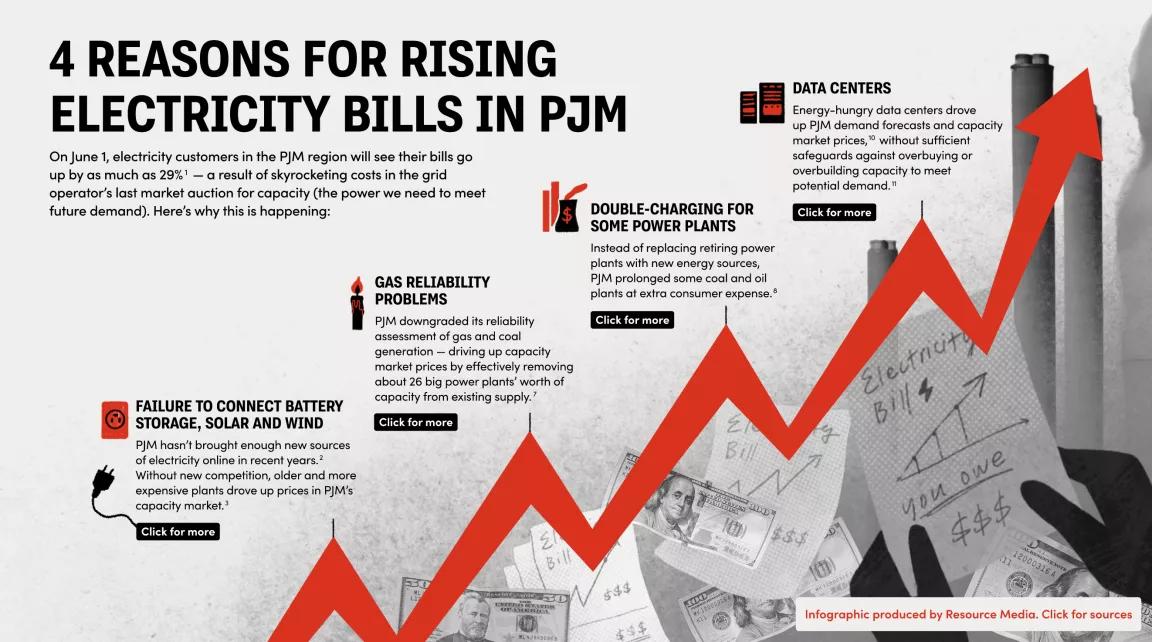
What happened?
As we described in a previous blog, the price spike was driven by four main culprits: fossil fuel unreliability; PJM’s interconnection queue backlog and other delays to new energy; data center–driven load growth; and double charging by some fossil power plants. PJM has since taken steps to fix the double-charging problem and made great strides to streamline processes to quickly get new power plants online and maximize the existing grid, but the other issues still persist.
Capacity auctions, which happen annually, ensure that power plants or demand response is available when the grid needs them most, typically on the hottest or coldest days of the year. As with most markets, when supply falls, prices rise, and we saw a dramatic supply constriction during the last auction due to PJM’s policy choices.
For years, PJM has been replacing coal power plants with gas-fired ones. Gas plants are prone to fail during extreme weather—such as Winter Storm Elliott in 2022—when their performance is critical. Since PJM did not account for fossil resource weaknesses in its previous capacity market auctions, customers paid for these plants as if they were reliable. That’s like buying a house only to realize the foundation is crumbling. It now turns out that the repairs are quite expensive.
On July 22, capacity prices in PJM Interconnection increased again to a record $16.1 billion, up 9 percent from the previous record of a year ago. Last year’s price spike increased electricity bills by about 30 percent for customers across the region; this auction could increase bills by another 5 percent.
Prices went up for two reasons: ever increasing demand from data centers and lower reliability from gas-fired power plants. The amount of available power decreased almost entirely because of gas plant reliability problems, not power plant retirements.
Renewable energy saved the day, and kept PJM from falling into an unacceptable risk of blackouts. More than 18,000 megawatts of renewables participated in the auction, up 75 percent from last year. This increase is due to new clean energy getting built, and changes to PJM rules to require all renewables to participate in the auction.
This auction cleared at $329/MW-day, the price “cap” negotiated by Pennsylvania governor Josh Shapiro’s office. This is a 9 percent increase over last year’s $270/MW-day. The average auction price in previous years was $85/MW-day.
There are almost 286 gigawatts (GW)—enough power for 45 million homes—of new clean resources waiting to come online in PJM’s interconnection queue, and another roughly 40 megawatts that are held up for other reasons. Even a fraction of these queued resources could significantly improve reliability and save consumers up to $7 billion, but PJM’s extremely slow processing means that resources have to wait for five or more years to connect to the grid. PJM’s slow interconnection processing will continue to cause problems as power plants are unable to “respond” to this high capacity auction price, which is meant to serve as a signal that the region needs more energy.
Has PJM solved these problems?
The short answer: Not yet. Instead of doing everything it can to get more clean energy online and lower prices, PJM is blaming states for their clean energy policies, calling to halt the retirement of polluting fossil resources, and letting gas plants cut in line.
Let’s be clear: States are not to blame. In fact, states like Pennsylvania, New Jersey, and Maryland have been champions for their ratepayers without backing off the energy transition. Pennsylvania pushed PJM to institute a price cap and floor for the next two auctions, which is intended to prevent prices from skyrocketing further in the short term.
Learn More

Luckily, the solutions for PJM are straightforward:
- Gas-fired power plants must perform when they’re needed. We’re paying for the equivalent of 20 new power plants to make up for unreliable gas generators. States and PJM need to take a no-excuses approach to gas winterization.
- PJM must comply with FERC Order 2023 to speed up queue processing and get new clean energy connected to the grid. PJM should also create a pathway allowing new generators to seamlessly replace retiring ones, avoiding expensive “reliability must-run” arrangements. PJM must be transparent about the source of delays that are outside of its control.
- States and PJM need to explore ways to better support battery storage, including examining and overcoming barriers to storage interconnection and ensuring storage is fairly compensated in PJM’s markets. Battery storage is fast to deploy, has similar reliability values to gas plants, and can provide flexibility to an increasingly decarbonized grid. In fact, PJM analysis found that, with the right amount of battery storage, PJM could reliably run on 93 percent clean energy.
- PJM should pursue long-term structural changes to the capacity market to maintain reliability through the energy transition. In the near term, PJM should explore a seasonal market structure to better capture power plant outage risk. In the long term, PJM should acknowledge that capacity markets lack the ability to plan for the future, and states should step up to play an increasing role in resource planning.
- PJM must comply with FERC Order 1920 and holistically plan for transmission to support the grid of the future, incorporating all state policies as planning inputs.
- PJM must work with states to enable clean energy policies. PJM can help states plan ahead for fossil retirements and serve as an independent expert advisor to policymakers.
Asking ChatGPT a quick question might feel innocuous, but you might end up paying for it in the long run. The massive data centers that are popping up around the country to support the AI boom are using up enormous amounts of energy and water and creating noise and air pollution. NRDC’s Ben Schaefer, senior manager of strategic communications, and Jackson Morris, director of state power sector policy, dive into how these centers can impact nearby communities and your energy bill.
Instead of pursuing these solutions, PJM is doubling down on gas power plants. In response to its tight capacity auction, PJM created the Reliability Resource Initiative (RRI), which allowed 51 resources—mostly new gas and gas uprates—to cut ahead of clean energy and storage in PJM’s queue. But precisely for this reason, the RRI will fail to deliver capacity when PJM needs it. The majority of selected capacity is scheduled to come online after PJM faces capacity shortfall risk due to AI-driven load growth in 2030, despite the fact that all of the storage resources that applied (and were rejected) could have come online much sooner. NRDC and its partners predicted this outcome and fought the RRI when it was first announced. Unfortunately, it looks like our predictions came true.

The vast majority of capacity (referred to in this chart as UCAP, or unforced capacity) from the RRI is scheduled to come online in 2030 or 2031, despite the entire purpose of the RRI being to get capacity online before 2030. All of this late capacity is from gas and coal projects: PJM only rejected 8 out of 47 gas project applicants. In contrast, PJM only selected 5 out of 31 battery storage project applicants, yet all but one project could have been online by 2030.
PJM Interconnection, Reliability Resource Initiative Results Summary, May 6, 2025, slide 10
PJM admitted that its interconnection queue and markets failed when it turned to the RRI, but instead of fully supporting solutions that would actually deliver capacity and proceed with an affordable energy transition, PJM is propping up the resources of the past.
PJM has shown us that when it puts its mind to something, it gets that done. We need PJM to put its full force behind solutions that will enable the clean energy transition while lowering customer bills.
This expert blog was originally published May 16, 2025, and has since been updated with new information and links.
Related Blogs

Building Data Centers Without Breaking PJM

Fossil Fuel Fearmongering at PJM Threatens to Waste Millions and Delay Renewables by Years