
Building Data Centers Without Breaking PJM
Unless data centers are required to bring their own capacity, the region faces declining reliability and billions in excess costs.

A data center under construction next to the Susquehanna nuclear power plant in Berwick, Pennsylvania
Data centers that power emerging AI technologies are driving a surge in electricity demand that hasn’t been seen since the 20th century. Absent sufficient guardrails, this new demand will raise power bills, increase the risk of blackouts, and create more air pollution. This all became very real this summer for the 67 million people served by PJM Interconnection, when they were hit with a $14.7 billion charge, mostly because data centers drove prices up. By comparison, in 2023 and 2024, this charge was $2.2 billion. Next summer, even more proposed data centers will raise it to $16.1 billion—a sevenfold increase in just two years.

LEARN MORE


But we’re only getting started. From a review of PJM’s forecasts, NRDC now estimates that unless something changes, PJM consumers will pay another $163 billion through 2033 as new data centers exceed available power supplies. By 2028, an average family in the region will be paying around $70 a month extra on their electricity bills because of forecasted data center growth. Virtually none of this rate hike will go to investments in new power plants and infrastructure. Instead, because most of the new power plants that are built in response to these high prices will not help until 2033 or later, almost all of it will be windfall payments to owners of existing power plants, which face no meaningful competition. Put another way, building brand-new zero-emission power and battery storage to cleanly power the data center boom could cost about as much as PJM customers are on track to pay old power plants.
Future reliability is also at risk. Simply put, the power grid in the region is full: Starting next summer, PJM will have just enough power to keep the grid reliable. But data centers take 18 to 24 months to build, while new fossil fuel plants take many years, so PJM will continue to fall further behind. If nothing changes, starting in June 2027, the region may fall below reliability standards. That means a greater risk of rolling blackouts, especially during winter storms and summer heat waves.
There is a much better option that will keep the grid reliable and energy bills more affordable: Data centers should be required to bring their own power. The idea is simple. New data centers and other large loads would only receive service on an “as-available” basis until they add enough supply (or reduce demand or add storage) to the grid to support themselves. Doing so would lower costs through 2032 by about $100 billion.
Asking ChatGPT a quick question might feel innocuous, but you might end up paying for it in the long run. The massive data centers that are popping up around the country to support the AI boom are using up enormous amounts of energy and water and creating noise and air pollution. NRDC’s Ben Schaefer, senior manager of strategic communications, and Jackson Morris, director of state power sector policy, dive into how these centers can impact nearby communities and your energy bill.
Fast-building data centers + slow-moving power grid = trouble
How we got here has been widely reported. To maintain a reliable grid, PJM arranges for power supply in advance. In July 2024, when PJM was securing capacity for June 2025 through May 2026, its markets were already growing tight and prices were poised to rise. Then, forecasts for data center growth shot up, raising costs by $9.3 billion. The trend continued in July of this year, when PJM purchased capacity for 2026–2027 and discovered that it will have the amount of supply it needs to keep the system reliable but with little to spare. PJM’s markets are designed so prices go up as supply gets tight, leading to the $16 billion bill for 2026–2027. Again, this increase was almost entirely due to forecasted data center expansion.
Where things go from here comes down to a race between data centers and new power supply. If data centers are built faster than power plants, prices will keep rising and reliability will be reduced. Reverse that, and prices go down. Right now, the race doesn’t even look close: PJM forecasts adding 5 to 7 gigawatts (GW) of data centers but only 2 to 3 GW of new supply every year from 2027 through 2032. And demand forecasts keep growing. Recently, PJM utilities doubled their forecasts of new large loads to 12 to 14 GW per year through 2032. Those new forecasts aren’t final yet, so this analysis still uses the current official forecast of 5 to 7 GW per year.

Given the expected speed of data center development, new power supply can’t come online fast enough to reduce prices. Between delays in connecting new power plants, long construction timelines, and PJM’s buying capacity in advance, it takes years before new supply can reduce prices. A new power plant that applied to interconnect the day after prices shot up in 2024 won’t help lower prices until late 2033 at the earliest (details below). The new supply for the rest of this decade was mostly planned in the last decade and will not keep up with surging data center demand. PJM appears to agree, recently publishing scenarios that show deep shortages in 2030.
New Power Plant Timeline
To see why it takes so long for supply to react to prices, let’s follow the path of a new power plant. Capacity prices in PJM first surged on July 30, 2024. Imagine that a fast-moving power plant developer saw this and had a new plant proposal ready to go the very next day. It would then learn that PJM won’t accept the application until its interconnection “Cycle #1” starts in April 2026. (PJM is currently working through a backlog from 2020.) If that cycle goes as planned, the new power plant would become eligible to bid into PJM’s auctions when it reaches “Phase III” in August 2027. PJM aims to hold its capacity auctions in May three years in advance, so the power plant would have missed the major price-setting auction (known as the Base Residual Auction) for 2030–2031, and the soonest it can start earning capacity revenues is 2031–2032.
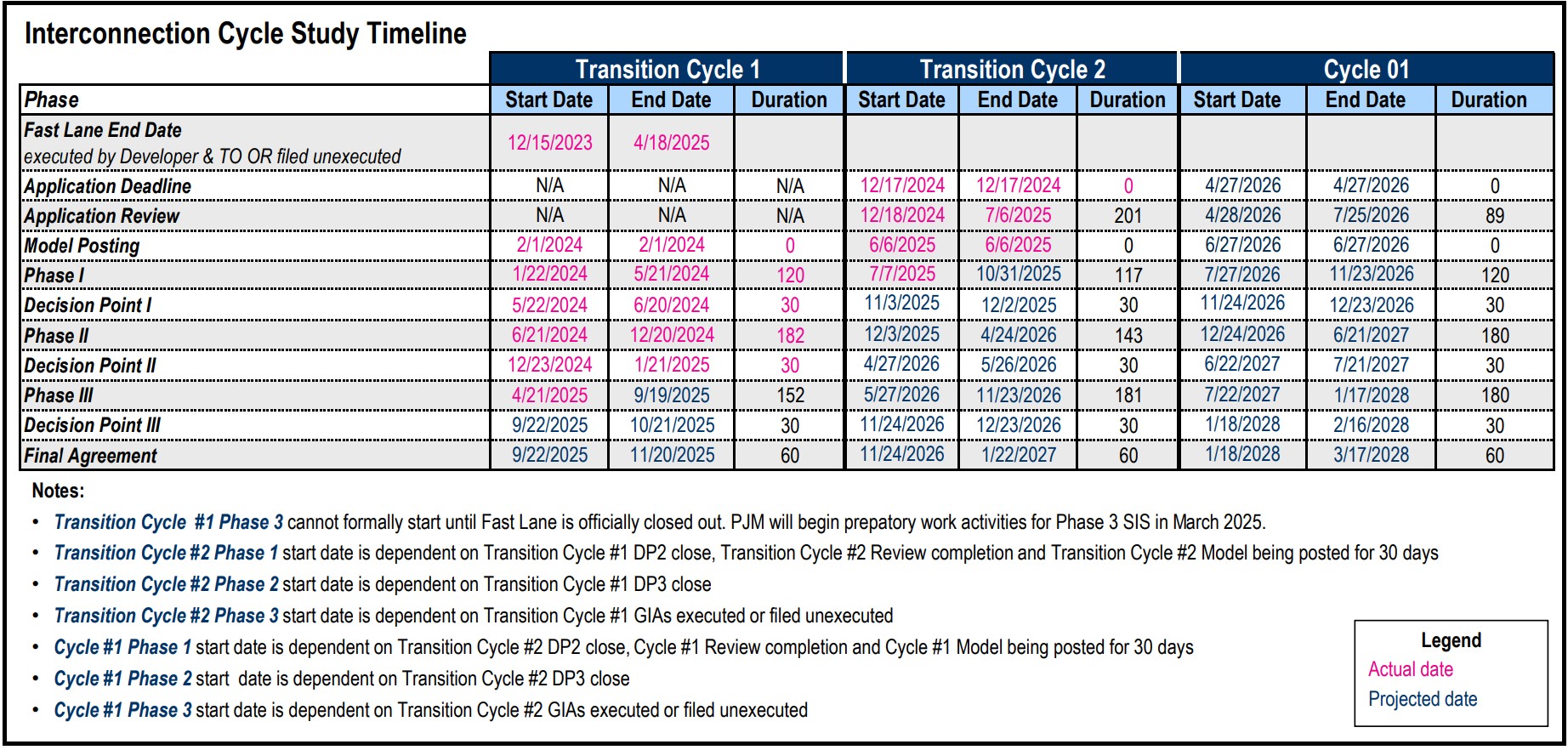
But that’s unlikely to happen. Suppliers who commit capacity from a planned plant but don’t complete construction in time are fined tens or hundreds of thousands of dollars a day. This means that almost no developers are willing to commit until their plant is nearly complete. For example, of the 46,500 megawatts (MW) of planned generation that was eligible to offer into the most recent auction, we estimate only 215 MW—less than half a percent—bid into that auction. For the typical power plant in PJM, it takes five years from approval to enter service. Even the fastest 15 percent take two to three years.
Our example power plant can expect to get final interconnection approval from PJM in the first quarter of 2028, about 42 months after the price increase that inspired it. That’s when it can begin construction, which takes two years for even the fastest builders. That means the new power plant, conceived the same day that prices shot up, won’t offer into PJM auctions until at least 2030. Since the auctions are held three years in advance, this will help lower prices at the earliest in the second half of 2033. All told, the fastest reasonable timeline has about 106 months between prices going up and a market response taking effect.
Thanks to short-term price caps negotiated between PJM and Pennsylvania’s Governor Josh Shapiro, costs in 2027–2028 will remain at about $16 billion. After that, the price cap will go up about 85 percent. We estimate that this will put the annual capacity bill at $27 to $30 billion per year, starting in the summer of 2028 and lasting at least until 2032, totaling $163 billion.
As a final twist of the knife, PJM residents will be on the hook for skyrocketing prices, even if these data centers don’t get built. Prices are mostly set when PJM buys capacity up to three years in advance. Once that happens, costs are locked in and can only be changed by an act of Congress. Since the consequences of overestimating data center demand fall on the public, developers and utilities have incentives to speculate wildly unless regulators set up guardrails. Even some power plant developers are calling current data center forecasts “unbelievable.” While PJM has to plan for what utilities say they need, there are policy solutions it could implement to protect residents from high bills.
Ensuring energy affordability and reliability amid data center energy demand
PJM must do better. We can protect affordability and improve grid reliability with the simple, commonsense approach that data centers should pay their own way. NRDC will present PJM with a simple alternative: Starting in 2027, PJM ratepayers should stop buying capacity for new data centers. Instead, data centers must bring their own capacity (BYOC). This could include new generation, resources such as battery storage, or demand response. NRDC estimates that with this approach, capacity costs will fall to $7 billion annually by 2030, with a total bill of $60 billion through 2032.
Power plant owners argue that prices need to remain high to provide a signal to build new power plants. This ignores the basic fact that there are huge barriers to new entry in PJM. Since new supply won’t be available for many years, high prices only serve to enrich the incumbent generators. Our proposal does not blunt needed economic signals but rather limits the deadweight loss from supply being unable to react to demand.
Our proposal puts risk where it belongs—on the data centers that are driving the need for large amounts of new generation. Data centers and utilities currently have little incentive to correctly forecast their needs, since any over-forecasting risk is paid for by the public. Once data centers have to BYOC, the forecast problem disappears entirely: Data center developers who need more power would have to build it without exposing anyone but themselves to the risk of unnecessary investment.
Data centers that don’t BYOC could still connect to the grid but might not be guaranteed power when supply is tight. Given the breakneck pace of data center demand, this is unavoidable. On the current path, PJM will have more demand than supply at some point in the next few years. That means that on challenging days (mostly during winter storms and summer heat waves), power cuts may be necessary. PJM understands this. It’s not a feature of our proposal; it’s a consequence of the laws of physics. Our proposal doesn’t change that reality—we wish it could—but it clarifies exactly how much power is at risk. Since states are ultimately in charge of deciding who gets shut off during emergencies, our proposal will let states plan in advance, helping them decide fairly if supply should be cut to data centers or the general public.
The BYOC concept not only protects regular consumers from rate hikes but also creates incentives for data center flexibility and gives them a clear and potentially fast path to firm service. The “capacity” in BYOC isn’t limited to new large power plants, which take years to construct. It also includes demand response programs that reduce energy during times when the grid is stressed; fast-to-construct distributed energy resources (DERs), such as rooftop solar and batteries located closer to end-use customers; and imported power from neighboring power grids. Flexibility—the ability to reduce consumption at key times—could allow the grid to support many more data centers quickly. Under our proposal, data centers can monetize their flexibility by providing demand response to PJM, partially or fully satisfying their BYOC requirements at the same time. The proposal also opens the door to creative solutions: Data center owners could build new transmission lines to bring in power from other regions or fund energy efficiency in homes to free up power for their own use.
DERs, especially battery storage, can quickly meet data center needs while transforming PJM’s grid for the better. DERs have a critical advantage: They don’t have to go through PJM’s multiyear process to connect to the grid, so they can come online quickly enough to keep pace with data center construction. Using DERs, data centers could receive firm power supply three to five years sooner than building new gas-fired generation at a net cost that’s as little as 20–30 percent higher. Since DERs are still connected to a larger grid, battery storage would be used to support the overall system, not run the data center directly. Thanks to this advantage, data centers can meet BYOC requirements by installing enough batteries to run their facility for about eight hours. Most important, storage is a critical component of a low-carbon grid. If data centers build storage now, they create a clear path to zero-carbon energy for themselves and for substantial carbon reductions and reliability benefits for PJM as a whole.
The choice is clear: Ratepayers are on a path to spend more than $100 billion, unjustly enriching owners of old power plants while still facing blackouts, and not getting a system that supports new data centers. Instead, PJM should require data centers to make the investments they need to support themselves. This will discipline speculation, save the public vast amounts of money, and ultimately improve reliability for the data centers that need it while rewarding the ones that can be flexible.
Governor Shapiro called 2025 capacity prices “the largest unjust wealth transfer in the history of U.S. energy markets.” If we don’t reform how PJM supports new data centers, that will unfortunately be just the beginning.
Stop data centers from polluting your air
For nearly 50 years under the Clean Air Act, major polluters have had to prove their facilities won't harm the air you breathe—before they break ground. Trump's EPA wants to illegally end that requirement for data centers, power plants, and other industrial polluters. Send a public comment to stop this proposal!
Related Blogs
Trump Wants PJM to Give the Gas Industry a Multibillion Gift to Supply Data Centers

The Real Reason Your Energy Bills Are Increasing in PJM
