
At the Crossroads: A Better Path to Managing Data Center Load Growth
Without responsible management of data center load, we put grid reliability, energy bill affordability, and our environment at risk.

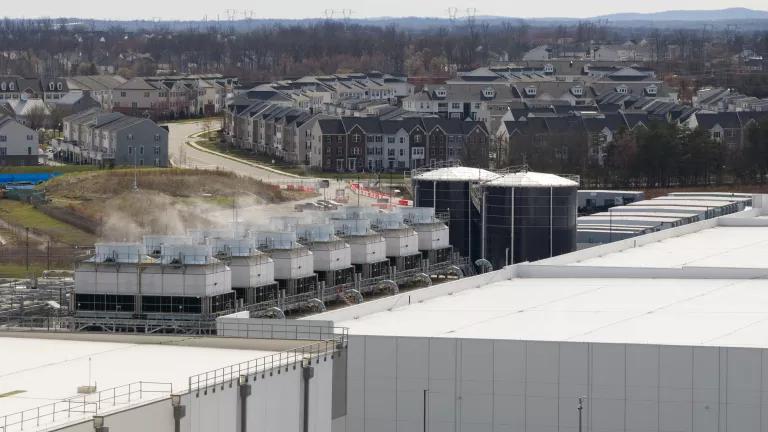
Data center campuses and construction sites adjacent to residential communities in Ashburn, Virginia

With an artificial intelligence (AI) boom underway, the future of our energy systems is at a crossroads. Data centers that power emerging AI technologies are driving a surge in electricity demand that hasn’t been seen in the modern era. This is a critical moment for states and regulators to shape a positive future for our energy systems, balancing the economic development opportunities of AI with responsible management, regulation, and consumer protections. Absent sufficient guardrails, unconstrained data center development is a race to the bottom that could lock in carbon emissions and air pollution for decades, threaten grid reliability, and raise energy bills for all customers.
A new report from NRDC provides a suite of solutions to manage data center electricity demand in ways that steer us away from these negative outcomes and closer to a cleaner, more affordable, and more resilient grid.
Growth in electricity demand isn’t inherently a bad thing. In fact, virtually all pathways to decarbonization have historically forecasted gradual increases in demand from electrification, met with increasingly clean electricity. But this was before the data center boom.
Asking ChatGPT a quick question might feel innocuous, but you might end up paying for it in the long run. The massive data centers that are popping up around the country to support the AI boom are using up enormous amounts of energy and water and creating noise and air pollution. NRDC’s Ben Schaefer, senior manager of strategic communications, and Jackson Morris, director of state power sector policy, dive into how these centers can impact nearby communities and your energy bill.
Shortly after significant advancements in AI in 2022, massive waves of data centers that use more electricity than ever before (some requiring the energy equivalent of a small city) have rushed to connect to the grid much faster than was expected. In accounting for data centers, even the lower bounds of projected demand represent a staggering paradigm shift.
Rather than pressing the brakes to examine, assess, and manage the risks of the overspeculative data center boom, state legislatures have instead rushed to attract these developments by enacting massive tax breaks on data centers. Around 36 states have implemented tax breaks for data centers that more often than not lack adequate regulatory guardrails or meaningful eligibility criteria.
Without regulation, data centers could lead to the following problems:
The need for reliable and affordable energy to serve data centers has been used to justify a rapid build-out of natural gas power plants and to extend the lives of the oldest, dirtiest, and most expensive coal and gas plants. Even though renewables are cheaper and faster to deploy than fossil fuels and are equally reliable and cost-competitive when paired with energy storage, new fossil fuels are being brought online with lifespans as long as 40 years. Across the United States, progress on climate action is caught in the data center cross fire as state climate targets are being put at risk.
Many large data center companies have environmental, social, and governance goals and corporate climate targets. However, when these companies are not committed to building additional clean energy capacity, voluntary private procurements of carbon-free energy can end up cannibalizing existing capacity. Electrical grids may then turn to new or existing gas resources to meet the remaining demand. This can lead to an increase in local emissions.
Electricity bills are already rising at alarming rates across the country as inflation, supply chain shortages, and import tariffs raise costs for utilities and as climate change and extreme weather events strain grid resources.
Absent transparent processes to develop consumer protections, data centers could shift their costs onto other bill payers, driving electricity bills even higher, as they already have in the PJM region.
Data centers are increasingly large, with some proposed developments demanding as much as 5 gigawatts, equivalent to the energy produced by five standard nuclear reactors.
These massive facilities are being developed in tight regional clusters, posing unique challenges to grid reliability. For instance, a cluster of data centers in Virginia disconnected from the grid instantaneously, almost triggering a widespread blackout.
Data centers significantly affect local communities, impacting water supplies, air quality, and land use, as well as contributing life cycle emissions and waste from equipment and building materials.
These impacts require careful assessment, management, and regulation. NRDC will be offering further guidance and discussion regarding these impacts in future bodies of work.
Learn More


What can regulators and legislators do?
State legislators, governors, state utility commissions, regional transmission organizations, and utilities can implement the following strategies to manage data center electricity demand with clean, affordable, and reliable energy.
Require data centers to pay their fair share
- Stipulate that data centers commit to their contracted capacity through up-front financial payments, collateral requirements, and minimum bills that cover their full costs; terms that should be implemented in a separate tariff class for large-load customers.
- Conduct studies to evaluate whether costs will increase for other customers and require data centers to mitigate these costs.
Ensure that data centers don’t increase emissions
- Defend and strengthen existing climate targets.
- Provide pathways for data centers to procure their own additional carbon-free energy.
- Require that clean energy funded by data center developers are adding to existing capacity and are actually supplying their data centers.
Improve forecasting, planning, and interconnection processes
- Weed out duplicative data center projects from forecasts.
- Require frequent updates to utility forecasts and adapt grid plans to account for uncertainty.
- Assess, plan, and build smarter energy systems with expanded and upgraded transmission infrastructure, battery storage, and renewables.
Require (or incentivize) best operational practices
- If data centers operate flexibly in key hours of the year, peak system needs could be reduced. To the extent this is possible, data centers should have requirements or incentives that reflect the true value of their demand response.
- Require data centers to engage with communities to mitigate their electrical system impacts by contributing to grid hardening, weatherization, energy efficiency and/or low-income assistance programs.
- Prioritize data centers that match their demand with additional, deliverable, zero-emission resources on an hourly, 24/7 basis.
Stop data centers from polluting your air
For nearly 50 years under the Clean Air Act, major polluters have had to prove their facilities won't harm the air you breathe—before they break ground. Trump's EPA wants to illegally end that requirement for data centers, power plants, and other industrial polluters. Send a public comment to stop this proposal!
Related Resources
Offshore Wind Can Power the Future (If We Just Let It)

The AI Boom Is Stressing the Grid—but It Doesn’t Have to Be This Way
