
The AI Boom Is Stressing the Grid—but It Doesn’t Have to Be This Way
There are ways we can avoid blackouts, sky-high energy bills, and climate backpedaling when powering AI data centers.

The xAI Colossus data center in Memphis, Tennessee, May 2025
Stephen Voss/Redux


In Port Washington, Wisconsin, residents near the site of the $15 billion Vantage Data Center’s Lighthouse campus complained of construction lights shining into their homes 24 hours a day. In Sterling, Virginia, some community members never get a break from the buzzing of the gas turbines powering a different Vantage facility—an increasing source of local air pollution. And in Abilene, Texas, a small city undergoing the construction of the massive Stargate data center, the housing crisis is worsening. Residents say the local economy can’t keep up with Stargate’s infrastructure demands.
As Big Tech races to build out the AI industry, communities across the map are experiencing firsthand what goes into powering up data centers—and what comes out. The amounts of fuel, water, and land they eat up. The noise and air pollution spewed into the atmosphere.
But the data center industry is not monolithic. At one end of the spectrum, companies like Google are showing that it is possible to power data centers with new, carbon-free energy. The company operates a geothermal-powered project in Nevada; solar and wind largely power a different project that it runs in Texas; and in Minnesota, it plans to deploy the largest battery in the world.
Then there are the developments like xAI founder Elon Musk’s 785,000-square-foot Colossus facility. Since opening in 2024, it’s become a top polluter in Memphis’s historically Black neighborhood of Boxtown. (The Southern Environmental Law Center and others are now suing the company.) Stargate’s proposed on-site power plant to feed its Abilene operations could be similarly detrimental to local air quality—it’s poised to emit more than 7.8 million tons of greenhouse gases per year. That’s as much as the pollution from about 2 million cars annually.
Across the nation, opposition to the AI boom is growing. A March report from Data Center Watch counted at least 75 projects facing community resistance during the first quarter of 2026.
As states begin to respond, environmental advocates believe this public backlash is crucial to spur changes in the right direction. “Community pushback is driving home the urgency for lawmakers to act before it’s too late,” says NRDC climate solutions fellow McKenna Beck, who helps shape state and regional policies to guide responsible load growth.
Asking ChatGPT a quick question might feel innocuous, but you might end up paying for it in the long run. The massive data centers that are popping up around the country to support the AI boom are using up enormous amounts of energy and water and creating noise and air pollution. NRDC’s Ben Schaefer, senior manager of strategic communications, and Jackson Morris, director of state power sector policy, dive into how these centers can impact nearby communities and your energy bill.
Setting AI off on the right foot
Indeed, faced with the stunning pace of growth, policymakers are racing to intervene. Earlier this month, Governor JB Pritzker paused data center tax incentives in Illinois and laid out a policy framework to help his state address consumer and environmental concerns. In New Jersey, Governor Mikie Sherrill recently proposed guardrails to protect residents and their water and electricity resources from the consequences of unbridled data center development. Same goes for Pennsylvania, under Governor Josh Shapiro, and the Michigan State Senate.
Lawmakers in Colorado have been especially concerned about the pressure on the state’s water resources, given the region’s quarter-century-long drought. Data centers rely heavily on cooling water being pumped through pipes that surround computer equipment; copious amounts of water also go into producing the electricity to power the facilities—significantly more for those powered by fossil fuels versus solar and wind.
While other state legislators consider similar regulatory actions, Big Tech isn’t slowing down. A recent NRDC publication featured a U.S. map speckled with dozens of green squares where companies have plans for more data centers. In the next two years, the facilities will consume more electricity than the combined total that California, Illinois, and New York consumed in 2023.
This is why lawmakers and regulators must recognize the industry’s benefits along with its potential real-world environmental and public health impacts and court such business accordingly, caution advocates.
“States are competing to attract data centers, and until recently, it’s been a race to the bottom,” Beck notes. A 2025 report she coauthored outlines ways to manage the rapid growth of data center electricity demands more sustainably.
Companies currently receive substantial tax breaks because their facilities are presumed to be economic engines, but authorities don’t often hold them responsible for their reverberating impacts on the power grid or residential utility rates. “Few data center tax incentives have any meaningful requirements,” Beck says.
The NRDC report finds that by providing the right incentives and requirements, states could generate local economic benefits with data centers while also bolstering their power grids, lowering pollution, and protecting their residents from rising electric bills.
Powering up the AI race
Data centers are nothing new. These oft-forgotten facilities house the computers that buoy our digital lives, making everything from data storage to video streaming possible. But the new generation of data centers built to power AI are decidedly different.
AI systems—like chatbots, summaries that now automatically sit atop search engine results, or prompt-generated photos and videos—are built upon and consistently fed vast amounts of data. This makes them computationally intensive to use, and computers, of course, run on electricity.
A single query to ChatGPT uses 10 times the electricity of a typical Google search, according to analysts from Goldman Sachs Research, though emissions can vary widely by AI model. In 2023, data centers accounted for nearly 4.5 percent of total U.S. electricity consumption. That percentage is expected to jump to 10 percent by 2029.
Tech companies are racing to build sprawling supercomputer warehouses capable of handling AI’s increased load—the largest of which use 50 to 100 times the amount of electricity of a traditional data center.

Stargate is OpenAI’s flagship campus, but the company, in partnership with Oracle and SoftBank, is planning to build several other multi-gigawatt data centers around the country, each of which could consume as much electricity as an entire city. (A gigawatt is about the amount of energy required to power 330,000 households.)
The country has long expected power demand to go up as we electrify our building and transportation sectors. But the sudden skyrocketing of this demand has hastened the timeline to meet the need sustainably—through improving energy efficiency and ramping up clean energy production.
“It’s now happening 15 years sooner and 10 times faster than we thought,” says Jackson Morris, the director of state power policy at NRDC. Further complicating matters, the Trump administration is attacking renewable power and energy efficiency investments, thus undermining efforts to counterbalance AI’s incoming strain on the grid and the climate. This makes the actions taken by states and tech companies on this front even more critical.

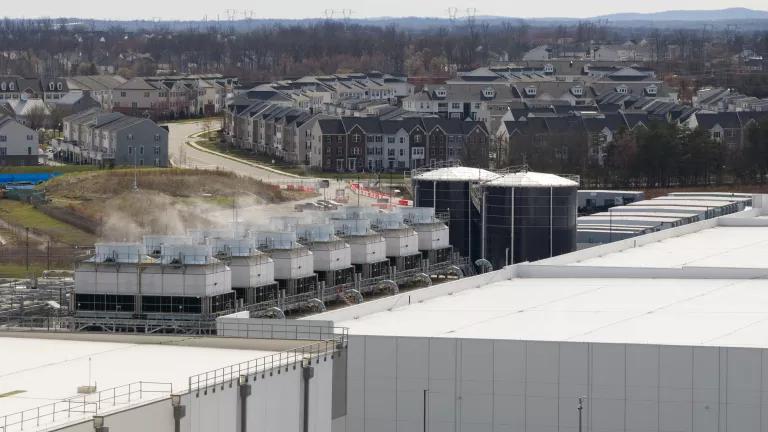
Data center campuses and construction sites adjacent to residential communities in Ashburn, Virginia, August 2025
Data Center Alley
About an hour’s drive outside of Washington, D.C., much of the hilly farmland and forests of northern Virginia’s Loudoun County have transformed over recent decades into what’s now called “Data Center Alley.” About 200 data centers scattered throughout the area make up 13 percent of global data center operational capacity, representing the world’s highest concentration of these facilities. And more are on the way.
Typically, the needs (and size) of residential areas and commercial centers dispersed throughout a region drive fluctuations in electricity usage and the relative strain on the grid. This demand ebbs and flows according to peoples’ daily usage patterns and outside factors like the weather.
By comparison, large data centers are massive, centralized loads that, for the most part, draw power around the clock. This constant, concentrated demand can strain or even overwhelm the grid and increase the risk of blackouts. Such outages also tend to happen just when people need power the most, like during heat waves or storms.
In the race to keep the supercomputers running, some utilities have asked to keep soon-to-retire coal-fired power plants online. They’ve also constructed, or plan to construct, new natural gas plants. In addition to worsening local air pollution and potentially raising electricity rates, such continued reliance on fossil fuels would put some states’ climate goals out of reach.
An AI boom—a clean energy boon?
When paired with fossil fuels, high electricity consumption comes with a staggering carbon footprint. But the AI industry need not rush down this road. As many major tech companies struggle to meet their stated climate goals, how they choose to power their AI could make huge differences in not only their emissions levels but also how quickly their data centers come online and how welcomed they are by local communities.
In 2024, Microsoft signed a 20-year contract with the clean energy provider Constellation to restart nuclear energy generation at the Unit 1 reactor on Three Mile Island in central Pennsylvania. The reactor had been closed for five years due to insufficient funding. “If it weren’t for that contract, that zero-emission plant wouldn’t be coming back online to help meet Microsoft’s data center demand in the region,” Morris says.
Google, meanwhile, has entered into a contract with NextEra to restart the Duane Arnold nuclear plant in Iowa, which could offer decarbonization benefits. And the company’s new Fervo geothermal power plant in Nevada seeks to eventually generate 115 megawatts of additional renewable energy. The plant plans to send this power back into the grid where Google data centers run.
This adding of low-emission energy sources is key to avoiding extra fossil fuel generation and the pollution that comes with it, Morris explains. Data centers need to fund new carbon-free energy production rather than relying on fossil fuels.
They also shouldn’t drain the renewable energy that’s already on the grid because “you haven’t added any new supply,” Morris says, and utilities might then turn to fossil energy to make up the difference. “Without adding new clean resources, electric bills will actually go up, and you’ve also increased your reliance on the dirty stuff,” he says.
What’s promising is that tech companies may be willing to invest big in clean energy infrastructure if it means their data centers will have faster access to a reliable and consistent power source.
“Essentially, how do we have large tech companies foot a significant portion of the [infrastructure] bill,” Morris asks, “because they’re the ones driving a lot of the need on the system.”
Currently, due to the sheer volume of requests for utilities to bring new data centers online, companies can sometimes wait years for their facilities to connect to the grid. But if new renewable energy generation becomes the fastest option to get their centers up and running, tech companies have the potential to speed up the larger transition to clean energy. And states courting AI companies should want to facilitate this incentive because, in the end, it benefits everyone.

Construction of Meta's Eagle Mountain Data Center in Utah, which is powered by renewable energy, primarily sourced from a utility-scale solar plant in nearby Carbon County
Data center flexibility
Tech companies could tackle emissions and electricity usage in other ways too. Developing more efficient AI models and training processes or managing data centers more dynamically could help lower their enormous power demands in the hours that matter the most. This concept, known as “data center flexibility,” appears more feasible than once thought.
In a 2025 Duke University study, researchers identified a promising solution: A facility could briefly stop or shift operations to data centers in other regions when overall demand is peaking. If adopted widely, this practice could allow the United States to accommodate 100 gigawatts’ worth of data center growth without needing additional power generation or infrastructure.
Some states and utilities are already taking steps to require more flexibility from large-load customers in order to get ahead of the potential negative impacts on residents, from blackouts to higher electric bills.
“Flexibility can shift demand to when power is abundant, cheap, and clean,” Beck says.
Last year, Texas passed a law requiring data centers and other large energy users to pause operations when demand on the grid is high, as well as to shoulder certain infrastructure costs associated with connecting to the grid. And PJM, the country’s largest regional transmission organization, recently proposed that data centers above a certain size that don’t supply their own new energy capacity could be “interruptible.” This would mean that grid operators could shut them off when demand is high to avoid blackouts for the rest of us.
To prevent residents from subsidizing the industry through higher electric bills, utilities across the country have proposed new electricity rates that would make data centers and other large energy users pay what they actually owe. Indiana Michigan Power Company and American Electric Power Ohio have received approval for such arrangements, as well as many other utilities.
These kinds of people-first protections and collaborations between residents, regulators, regional utility operators, and tech companies are one way to help ensure that expanding AI doesn’t derail climate goals, raise utility bills, impair grid reliability, or harm public health.
Advocates are encouraged by the various Big Tech–related regulatory initiatives emerging from state leaders. “Local action appears more promising than federal action on the issue,” Morris says, with state legislators increasingly willing to work together across party lines. “There’s increasing bipartisan attention to policy solutions at the intersection of energy infrastructure and technology growth.”
Collaboration is crucial as the AI industry continues along its dramatic growth path. Thankfully, the tech industry already has the tools to chart a smarter way, and policymakers have a window of opportunity to steer this growth in a sustainable direction.
This story was originally published September 29, 2025, and was updated on June 24, 2026, with new information and links.
This NRDC.org story is available for online republication by news media outlets or nonprofits under these conditions: The writer(s) must be credited with a byline; you must note prominently that the story was originally published by NRDC.org and link to the original; the story cannot be edited (beyond simple things such as grammar); you can’t resell the story in any form or grant republishing rights to other outlets; you can’t republish our material wholesale or automatically—you need to select stories individually; you can’t republish the photos or graphics on our site without specific permission; you should drop us a note to let us know when you’ve used one of our stories.
Stop data centers from polluting your air!
Trump's EPA wants to illegally end a Clean Air Act requirement for data centers, power plants, and other industrial polluters.
Stop data centers from polluting your air
For nearly 50 years under the Clean Air Act, major polluters have had to prove their facilities won't harm the air you breathe—before they break ground. Trump's EPA wants to illegally end that requirement for data centers, power plants, and other industrial polluters. Send a public comment to stop this proposal!
Offshore Wind Can Power the Future (If We Just Let It)
What Are the Solutions to Climate Change?
Decarbonization: Why We Must Electrify Everything Even Before the Grid Is Fully Green