Offshore Wind Can Power the Future (If We Just Let It)
Despite Trump administration policies to block renewable energy development, there’s more electricity coming from the wind than ever.

Wind turbine foundation components at the Revolution Wind construction hub at the Port of Providence in Providence, Rhode Island, June 13, 2024
Before the blades of an offshore wind turbine start turning and churning out clean and cheap electricity, its tower must stand firmly in the seabed. And for that to happen, you need pile drivers. Back in 2023, these workers were some of the first to arrive at the site of Vineyard Wind, one of the latest offshore wind farms to come online in U.S. waters.
Working from a ship named Orion about 35 miles off the coast of Massachusetts, the pile drivers began securing 62 turbine poles, each weighing 1,800 pounds, to the floor of the Atlantic Ocean. The bases reached as deep as 162 feet below the sea surface.
Like the turbines themselves, this workforce needed to be built. Back on land, pile drivers usually help construct buildings and bridges but their union “created a brand-new industry here from the ground up,” says John Dunderdale, business manager for Pile Drivers and Divers Local Union 56 in Boston. “The unions met the mark.”
To qualify for taking their skills offshore, the workers, about 150 of them, spent years pursuing additional physical and safety certifications and attending specialized training sessions. Among others, topics included working at heights, sea survival, and even how to escape from a helicopter that has crashed into the sea.
Learn More
The latter certainly sounds daunting, but as Dunderdal says, “The opportunity for our members to learn a new skill set…it's a game changer. Really.” Thanks to their stint with Vineyard Wind, some of the pile drivers were able to buy their first homes, and now that they have their sea legs, all are positioned well within an industry that’s growing rapidly around the world.
Last year, wind generation rose 40 percent, supplying more than 11 percent of global electricity demand. According to a recent report by the Global Wind Energy Council, by the end of 2035, there could be enough offshore wind capacity worldwide to power more than 450 million households.
NRDC’s offshore wind strategist, Pasha Feinberg, talks about wind power in the United States and the importance of moving this industry forward despite a resistant administration.
Here in the United States, however, the wind industry, both offshore and on, is facing severe headwinds. Head-scratching federal policies are attempting to squash this rising energy source—one that currently provides clean power to the homes of tens of millions of Americans at prices more affordable than fossil fuels.
“Now we have a viable workforce, but it’s going to be stagnant,” says Dunderdale of the team of pile drivers who took years to train. “It's a shame that that's happening,” he adds. Even so, their skills are still in high demand.
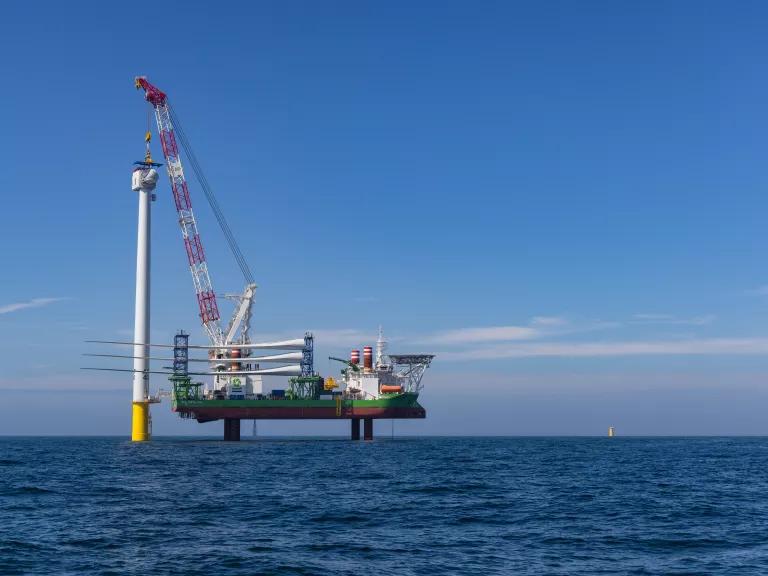
An offshore wind turbine tower and nacelle under construction at the Vineyard Wind site off the coast of Massachusetts, October 6, 2023
Taking the wind out of an industry’s sails
Vineyard Wind is currently generating power for New England customers, and it’s just one of five new offshore projects on the East Coast in this burgeoning industry that, in just the past decade, drove $25 billion in domestic supply chain and manufacturing across 40 different states. It also generated more than 12,000 jobs.
And yet, since its very first day, when an executive order froze wind farm permits and leases on federal lands and waters, the second Trump administration has been obstructing the wind industry’s development in myriad ways. It pulled back research funding. It issued stop-work orders for Vineyard Wind and the four other offshore projects under construction, declaring that the wind farms threatened national security—a claim the administration did not elaborate on and one that did not hold up in court.
More recently, the administration brokered deals that would use nearly $2.65 billion of taxpayer dollars to pay the companies TotalEnergies, BlackRock, and Invenergy to give up their leases to develop wind energy in U.S. waters. Meanwhile, on land, the U.S. Department of Defense (DOD) halted approvals on more than 100 wind projects—some on people’s private property, a source of income that many U.S. farmers have come to depend on.
“There's real intent from the federal administration to really thwart renewable energy development,” says Stephanie Francoeur, a communications staffer with Oceantic Network, a group that works to advance the offshore renewable energy industry.
Congress isn’t helping either. The so-called One Big Beautiful Bill Act eliminated tax credits for wind energy. A report, published by Princeton University’s ZERO (Zero-Carbon Energy Systems Research and Optimization) Lab, estimated that the act would prevent an additional 160 gigawatts of wind energy from going to the grid by 2035.

Wind turbine bases, generators, and blades sitting alongside support ships at the Portsmouth Marine Terminal that is the staging area for Dominion Energy Virginia, which is developing Coastal Virginia Offshore Wind, December 22, 2025
Defending wind in court and beyond
Yet wind energy developers, environmentalists, and state attorneys general are pushing back against this war on wind in court—and they’re often winning. Judges ruled that the administration’s implementation of President Trump’s order preventing wind energy permits and leases was unlawful, and the Trump administration has dropped its appeal. Judges also ruled against the administration’s stop-work orders, allowing all five offshore projects to move forward.
Many other cases continue to work their way through the legal system. Seven states recently filed a lawsuit against the administration over one of its deals with TotalEnergies. And in June, renewable energy groups sued the DOD over its delay in issuing permits for onshore wind farms.
“The bottom line is that agencies can't just stop processing permits. They have to make a decision—they have to say yes or no,” says Jared Knicley, a litigator for NRDC, which filed amicus briefs supporting the DOD and broader wind ban lawsuits. Though the administration may not prefer wind energy, that “alone is not enough under federal law to scuttle existing permits or to refuse to process permit applications for another project that's in the pipeline,” he adds.
Despite everything, the industry is delivering: Spinning turbines now punctuate the sea from New England down to Virginia, where another project is underway—a big one. Once complete, either this year or next, Coastal Virginia Offshore Wind will be the country’s largest offshore wind farm, with a generating capacity of 2,600 megawatts. For scale, that’s more than three times the capacity of Vineyard Wind.
“We have never had as much offshore wind as we have right now,” says Pasha Feinberg, an offshore wind strategist for NRDC. Indeed, these farms currently provide around 1,000 megawatts of energy to the grid, up from 174 megawatts at the start of 2025.
Offshore wind energy has the potential to generate even more, according to the U.S. Department of Energy—up to a whopping 4,000 gigawatts of energy. That would be enough for significantly more homes than the country even has, and nearly as much as the total amount of power coming from every major energy source in the United States combined. And the general public seems on board.
A recent poll conducted by the advocacy group Turn Forward found that nearly three out of every four voters surveyed in 13 coastal states say they are in favor of offshore wind energy in U.S. waters. And over the past year and a half, the percentage of people saying they want it off the coast of their own state increased nearly 10 percent.
“In a world in which no one agrees on anything, we’re all very concerned about having enough electricity and being able to pay for it,” says Erin McLean, a spokesperson for the group.
Reliable, homegrown power
As for right now, thanks largely to policies and laws passed during the previous administration, wind power is performing even better than expected, particularly during winter storms when demand surges. Batteries can store energy much more efficiently than in years past, allowing utilities to provide wind-generated electricity continuously and reliably.
Such advancements have come in the nick of time regarding both climate and affordability concerns. Demand and electric prices are rising as data centers—which require huge amounts of power to run—proliferate and force utilities to upgrade infrastructure. These circumstances make the Trump administration’s multipronged attack on the wind industry even more confounding because it is contributing to higher electric bills. More immediately, the war in Iran has also choked oil and gas supplies and pushed prices higher all over the globe. In the United States, an analysis by the financial services company Moody’s has found that the war has so far cost households as much as $450 in additional energy expenses.
While rising energy bills continue to shock U.S. consumers, the fact that wind energy often costs less than fossil-generated electricity has provided some relief. In fact, according to contracts that recently went into effect between utilities and Vineyard Wind, Massachusetts customers could save $1.4 billion over the next 20 years.
“The steel in the water is proving its own point,” says McLean. “We hear about data centers. We hear about electrification. We hear about advanced manufacturing. We hear all of these things that are going to require energy, and those electrons have to come from somewhere. People are looking increasingly toward offshore wind as the vehicle through which that is possible.”
And Dunderdale and the pile drivers will be ready for it. Not only is the wind industry good for jobs and keeping electric costs steady, Dunderdale says, but it’s also good in the fight against climate change, something he says he has better grasped since getting into the work offshore.
“If you look around Boston right now, they are looking at how to mitigate the tidal increase,” he says. “Ten years from now, a lot of our tunnels will be underwater. There's a lot of things changing, and I think the wind projects bring us a really sustainable energy resource.”
In the meantime, as the Trump administration seeks to deny, delay, and divert the industry and while the lawsuits play out in court, the workers are adapting. Some of the pile drivers are off to Scotland to set the foundations for new offshore projects there. Others hope to take their talents to Canada and Denmark, countries with governments and policies that see which way the wind is blowing. The United States would be wise to join them again.
This NRDC.org story is available for online republication by news media outlets or nonprofits under these conditions: The writer(s) must be credited with a byline; you must note prominently that the story was originally published by NRDC.org and link to the original; the story cannot be edited (beyond simple things such as grammar); you can’t resell the story in any form or grant republishing rights to other outlets; you can’t republish our material wholesale or automatically—you need to select stories individually; you can’t republish the photos or graphics on our site without specific permission; you should drop us a note to let us know when you’ve used one of our stories.
The AI Boom Is Stressing the Grid—but It Doesn’t Have to Be This Way
Venezuela’s Oil Resources Are Vast (and Should Stay Underground)
What Are the Solutions to Climate Change?