
Courts Blow Back the Trump Administration’s Offshore Wind Freeze
Current score = Offshore wind: 5, Trump administration: 0

A boat and construction platform at an offshore wind farm in the Atlantic Ocean


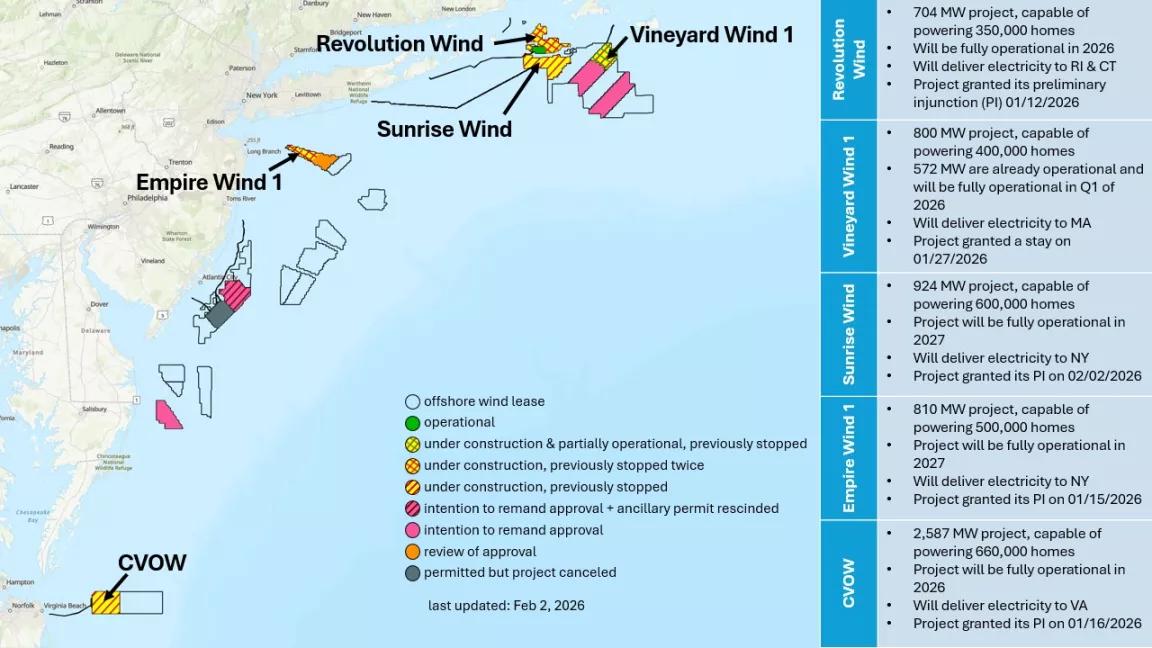
On Monday, a federal judge granted Sunrise Wind, an offshore wind project that was being built off the coast of New York, a preliminary injunction—blocking the Trump administration’s December stop-work order and allowing construction to resume while the case proceeds. Every fully permitted, under-construction U.S. offshore wind project was targeted by the administration with a stop-work order, and, as of today, they have all won emergency relief in court.
For those keeping score, that makes it offshore wind: 5, Trump: 0, at least for now. These court wins mean that construction can move forward for all five projects—some of which are more than 90 percent complete—which collectively have the capacity to deliver nearly six gigawatts of power to the grid, enough to power 2.5 million U.S. homes.
This is great news for consumers and for electricity reliability. This struggle is playing out at a time when electricity demand is growing across the United States and when huge swaths of the country are enduring a deep freeze from Winter Storm Fern that has claimed dozens of lives, challenged the reliability of the grid, and sent electricity prices climbing as gas plants fail. So even though the administration is treating energy like political football, these close-to-completion clean energy resources are badly needed in real time.
What happened—and why the courts stepped in
Just days before Christmas, the Bureau of Ocean Energy Management (BOEM) issued stop-work orders, abruptly suspending construction on five fully permitted large East Coast offshore wind projects that skilled workers were almost done building. The move threw a critical source of new electricity—and tens of thousands of jobs—into jeopardy. BOEM claimed this suspension was necessary based on unspecified national security concerns, purportedly supported by classified documents.
The affected projects—Vineyard Wind 1, Revolution Wind, Empire Wind, Sunrise Wind, and Coastal Virginia Offshore Wind—not only have federal approvals but have also spent years, along with billions of dollars, developing and constructing their projects. This includes environmental review, stakeholder engagement, and robust engagement with the U.S. Department of Defense to ensure that any potential impacts on national security were thoroughly mitigated. Vineyard Wind is already delivering electricity to the grid. These five projects represent tens of thousands of jobs, major port and manufacturing investments, and long-term pollution reductions—benefits already being realized.
After the stop-work orders were issued and conversations with BOEM proved unproductive, developers for each of the projects sued the Trump administration in federal district court, seeking emergency relief that would allow them to continue to construct the projects. (NRDC was not involved in any of these cases.) Judges in all of the cases have now granted preliminary relief. While each judge issued a separate order, the decisions shared two overarching themes:
- The developers each demonstrated that they would suffer “irreparable harm” absent an injunction against the stop-work orders. You can’t hit pause on a complex, multibillion-dollar, time-sensitive infrastructure project when it’s mid-construction without doing real damage. Specialized installation vessels are booked years in advance, seasonal weather windows matter offshore, supply chains are synchronized, contracts require power delivery by certain dates, and delays can snowball into an existential threat to the project. As one court after another recognized, the economic and logistical harm caused by the stop-work orders was likely existential, immediate and often irreversible, meaning that the balance of harms warranted injunctive relief.
- The offshore wind developers are likely to succeed on the legal merits of each case. Each developer argued that the stop-work orders violated federal law and were “arbitrary and capricious” because they were insufficiently supported by evidence. In each case, the judges found in their preliminary decisions that the developers are likely to succeed on these legal arguments. Although the government argued that they have broad discretion when there are national security concerns, it must still follow the law. Moreover, the judges—who were allowed to view BOEM’s classified national security report—did not find that the classified report justified stopping the construction of the offshore wind projects.
These five preliminary decisions aren’t the final word, of course. The district court judges still need to issue final decisions, and the federal government may still appeal the preliminary injunctions and appeal any adverse final decisions.
The road doesn’t end here. These stop-work orders against fully permitted and under-construction projects inject instability into the energy sector—offshore wind and beyond—and investments in American infrastructure. The courts are doing their job: preventing an unlawful, economically reckless halt while the cases proceed. But it’s still an uphill battle, and we all need to work together to make sure Congress and the administration understand the benefits of offshore wind to energy reliability and affordability, meeting energy demand, creating jobs, and supporting the clean energy future.
Families will be forced to pay billions to keep outdated coal and gas plants running.
The Trump administration is halting offshore wind projects, threatening clean energy jobs and raising utility bills. Congress must step in now to defend offshore wind.

Tell Congress to protect offshore wind—and our economy!
Instead of delivering affordable, reliable clean energy, the Trump administration is forcing families to pay billions to keep outdated coal and gas plants running—threatening clean energy jobs and raising utility bills. Congress must step in now to defend offshore wind.
Related Blogs
Renewable Energy on Federal Lands Brings New State and County Revenues
Uncovering the Secret Documents Behind the Trump Administration's Clean Manufacturing Cancellations
