
The President Is Putting Oil First and America Last
Instead, the government should be coming up with reforms that deliver projects—such as clean energy and infrastructure—that actually make life better for people and communities.
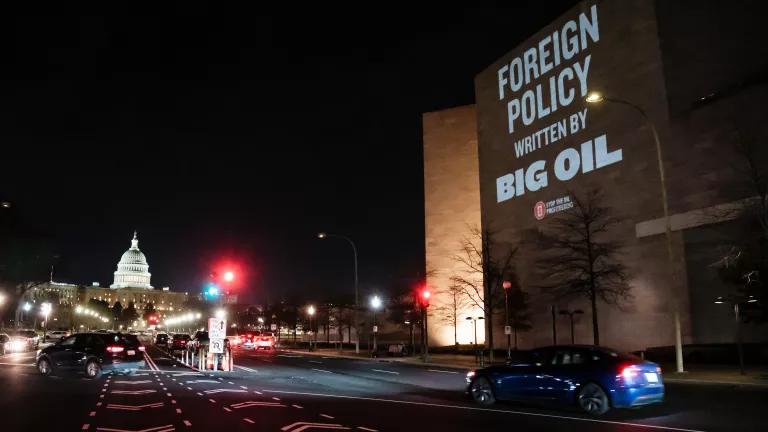
On the evening before President Trump was set to meet with U.S. oil executives to discuss Venezuela, activists staged a large-scale projection opposing oil-driven intervention and the use of U.S. taxpayer dollars to subsidize Big Oil in Washington D.C., January 8, 2026.

In recent weeks, President Trump has gone to extraordinary lengths to bandage up the oil industry’s aging grip on Americans’ wallets and the global economy.
Abroad, the president is deploying American military power for the explicit purpose—in his own telling—of seizing a foreign country’s oil. The president has expressed a willingness to do whatever it takes to help U.S. oil companies exploit Venezuela’s vast reserves, including reimbursing their costs with taxpayer money and sending American soldiers to guard their drilling operations, even though it will not meaningfully lower gas prices.
At home, the president’s policies are not designed to bring down skyrocketing energy bills or to promote American innovation and job creation. Instead, he is waging war against the oil industry’s most threatening rival: affordable clean energy. The president and his administration have stopped construction of wind farms off the East Coast, frozen solar projects on public lands in the West, obstructed new transmission lines in the Midwest, and torpedoed billions of dollars in private sector investment in clean energy manufacturing and technology.
Learn more


That is despite the fact that the cost of generating electricity from a new fossil fuel power plant is 50 percent more than from a new wind or solar facility—even without federal clean tax credits.
It sounds absurd, but it’s true: U.S. energy policy is now aimed at expanding our country’s dependence on foreign oil and destroying America’s own home-grown, clean energy production and jobs. There is only one explanation for the administration’s approach: The oil industry is terrified by the reality that market forces now favor clean energy sources over fossil fuels. And the president is pulling out all the stops to protect his benefactors.
Since 2010, the cost of solar power has fallen by 90 percent and is, on average, now roughly half the cost of fossil fuel alternatives. Consumers are turning to electric vehicles, renewables, and battery storage to bring their own energy bills down. And globally in 2025, clean energy is projected to have attracted roughly twice as much capital investment as coal, oil, and gas combined.
On one side, the oil industry and the politicians they helped elect are stacking sandbags against the rising tide of cleaner and more affordable energy. One the other side, for the rest of us—who want a stable climate, affordable energy, and healthier communities—the task is to unleash what the oil industry and the system that is weighted toward its interests are trying to hold back.
More clean energy generation. More transmission lines. More energy storage. More affordable and efficient housing. Storm-hardened communities. And so much more.
To build these good things at the scale and speed that are needed, we need to dismantle the barriers—at all levels of government—that were designed to favor polluting projects over clean ones. Oil companies, for example, have long been able to get a green light to drill on taxpayer-owned public lands in a matter of months. Wind projects are not afforded the same privileges and take years to navigate bureaucratic mazes.
Interstate gas pipelines have a federal agency that has the power to approve them. Transmission lines, on the other hand, must instead survive multiple state and local review processes and can be vetoed by any jurisdiction, often in the face of fossil fuel–funded opposition.
And at this very moment, the oil industry is pushing Congress to enact its vision for “permitting reform,” which entails slashing environmental protections and public input on polluting projects. Yes, America’s permitting and energy systems are, in fact, in dire need of reform. But the changes we need are far different from what the oil industry is proposing.
We need to level the playing field in energy markets so that cleaner and newer technologies can compete and win on their substantial merits. We need to reprogram the government to make it more responsive and capable of delivering outcomes that the public expects. And we need reforms that help deliver projects that actually make life better for people and communities: projects that deliver affordable energy, create good-paying jobs, and alleviate—not worsen—long-standing economic and racial disparities in how the costs and benefits of energy development and infrastructure are distributed. That means policies focused on helping to build the clean energy projects and infrastructure we need faster, better, and more fairly.
Policies that work to improve imperfect but promising technologies, including carbon dioxide removal. Policies that develop new ideas for domestic mining, reimagine environmental review processes, and revisit our approach to nuclear power. And proposals on topics that range from electric utility reform to community engagement and benefits.
Reform. Innovation. Pragmatism. These are the weapons our leaders must embrace if they are serious about lowering energy prices nationwide.
Because building clean here at home, not chasing foreign oil, is how we put America—and all our people—first.
Related Blogs

Trump's Attempts to Bring Back Coal Will Fail

Trump’s Shadow Ban on America’s Energy Future
