Trump's Attempts to Bring Back Coal Will Fail
Coal costs more, pollutes more, and offers less reliability.

Pacificorp's coal-fired Hunter plant in Castle Dale, Utah
George Frey/Getty Images
The Trump administration moved yet again to artificially prop up coal and gas. This flies in the face of common sense and benefits only the fossil fuel barons who backed Trump’s election. It will harm everyone else by increasing already expensive electricity bills and dangerous air pollution.
On September 29, the U.S. Department of Energy (DOE) announced a handout of $625 million to owners of old coal plants, while the U.S. Environmental Protection Agency (EPA) said it would delay rules to cut air and water pollution from those plants. Meanwhile, the U.S. Department of the Interior (DOI) communicated plans to boost coal mining on public lands by offering 13.1 million acres for lease.
These latest announcements follow President Trump’s earlier set of directives, issued April 8, seeking to reverse the decades-long decline of the U.S. coal industry. The first, Strengthening the Reliability and Security of the United States Electric Grid executive order (EO), created a process by which the DOE is able to favor fossil energy over renewable energy. The agency has used this emergency power several times, including to force the J.H. Campbell coal-fired power plant in Michigan to continue to operate after it had planned to retire, without offering evidence of any emergency or electricity shortage in the region. All this at a cost of $29 million in just the first five weeks—almost $1 million per day. (NRDC is currently part of a lawsuit challenging the DOE’s actions on Campbell).
NRDC’s director of policy analysis, Amanda Levin, explains how coal plant pollution surged across the country last year, thanks to Trump’s presidential exemptions, and how that has subsequently created billions of dollars in public health costs for local communities.
The second, Reinvigorating America’s Beautiful Clean Coal Industry, sought to restart coal leasing and expand coal mining on our federal lands, in addition to making these processes easier by offering loans and streamlining permitting. The third directive, Regulatory Relief for Certain Stationary Sources to Promote American Energy, creates another pollution loophole by exempting coal plants from complying with the EPA updated Mercury and Air Toxics Standards. And the fourth, Protecting American Energy from State Overreach, directs the U.S. Department of Justice to harass state and local governments by challenging climate, climate justice, and energy laws and policies.
If all this sounds familiar, it’s because Trump tried and failed to bail out the coal industry during his first term in office. Given the realities of the market, whatever he tries to do this time should fail as well. And the federal government has only a limited and indirect ability to decide what types of electricity will be used—that's the role of the states. But if Trump’s efforts to revive coal gain traction, it would mean higher bills for customers and more toxic air pollution harming our children’s health. Instead of trying to prop up the fuels of the last century, this administration should be working to build the grid needed for the 21st century.
Let’s first highlight the diminished position that coal finds itself in today. To put it lightly, it’s on the decline. And for good reason.
Learn More



Two decades ago, coal powered 50 percent of the U.S. power fleet. Now, cheaper generation options have pushed coal to the margins, where it falls behind nuclear, gas, and renewable energy in the electricity mix. In 2024, solar and wind power combined produced more electricity than coal-fired power. Nearly half of the coal-fired generation fleet has retired. The plants that remain are old and past their retirement age. No new coal plant has come on line in more than a decade; the average age of existing plants is 53 years.
Why? Because it can’t compete. Not on cost, not on speed to market, not on clean air, and not on health. At this point, a utility or state regulator that decided to spend money on coal instead of a clean resource like solar, wind, or storage would be throwing those dollars down the drain in favor of a political agenda and at the expense of everyday customers.
And coal is downright dirty.
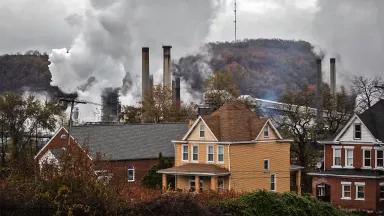
Coal power pollution was responsible for 460,000 deaths between 1999 and 2020. Of that, 390,000 (85 percent of the total) occurred between 1999 and 2007, before plants had to reduce their pollution and coal was a bigger part of the energy mix. One study found that coal pollution is costing us $13 to $26 billion a year in additional ER visits, more strokes and cardiac events, and a greater prevalence and severity of childhood asthma events.
Coal mining operations wash toxic runoff into streams, rivers, and lakes and dump vast quantities of unwanted rock and soil into streams—not to mention the mercury and other pollutants they spew into the air unless prevented. (Relatedly, the EPA is moving to repeal safeguards on mercury and other air toxins from coal plants.)
That has not stopped the Trump administration from repeatedly boosting this antiquated industry.
In 2017, then energy secretary Rick Perry directed FERC to issue a rule providing for assured cost recovery (including a return on equity) for coal and nuclear plants. This would have increased customers’ utility bills to help pad the profits of Trump’s donors in the industry. But, in a bipartisan and unanimous ruling, the independent FERC rejected the directive because the DOE did not show a need to bail out the plants and ignored the cost of doing so. FERC also noted that because the plan excluded other types of power that could provide resilience to the grid, it was unduly discriminatory or preferential, violating a legal bedrock of FERC’s actions. Any further attempt to prop up coal or other specific fossil resources by using FERC is similarly doomed to fail.
Under the law, states, not FERC or the DOE, play the primary role in generation choices. They make policy decisions that affect what generation gets built and control the siting and construction of generation.
Coal plants have been retiring in record numbers because they are old and uncompetitive. In layman’s terms, they’re too expensive to run. Political decisions aren’t changing this; in fact, three of the five years with the highest annual coal plant retirements were in the first Trump administration—an average of 12 gigawatts (GW) of coal retired a year between 2017 and 2020, compared to 8.9 GW during the Biden administration and 9.2 during Obama’s second term. And if the administration forces these old, expensive coal plants to stay open, it will increase electricity costs for everyday Americans at a time when we simply can’t afford that. The free market is choosing something else: clean energy. Last year, 93 percent of new electricity generation was solar, wind, or battery power because they produce clean, affordable energy. And that clean power is showing up to reliably serve electric customers.
Consumers prop up coal costs
Any action to preference generation from coal plants will ultimately increase American’s energy bills. Coal-fired generation has been on a long decline in the United States because it’s not competitive with cleaner generations. This isn’t because of regulation—it’s because coal is more expensive than newer, cleaner energy sources. A recent analysis shows that 99 percent of coal plants are more expensive to run than renewable energy.

Under FERC rules, markets are designed to ensure reliability at the lowest cost. Running coal plants when they are uneconomic costs consumers money. A 2024 analysis of coal plants in the Midwest that were run even when it was not economic to do so showed that consumers across the Midwest region have borne more than $1 billion in excess costs from the uneconomic dispatch of coal plants from 2021 to 2023. Any further action to prop up coal would just exacerbate this problem, to the detriment of American energy bills.
Moreover, studies have shown that renewable energy development drives significant investment in communities. One such study shows that this development could drive more than $589 billion of investment in energy communities across the United States—mostly in the red states.
We can reap this economic development and access more affordable power if the administration would just get out of the way. Right now, there is twice as much clean energy in line, waiting to get connected to the grid, than there is installed generation in the United States. The economics don’t lie—95 percent of queued capacity is wind (366 GW), solar (1086 GW), and storage (1028 GW). That shows that, by far, the most economically viable new generation is clean, and it is waiting to come on line.
Even utilities recognize the danger in requiring coal plants to run more than they currently do. A proposal in West Virginia would force the utilities to run their coal plants at 69 percent capacity—up from their current 40 percent. Two West Virginia utilities have raised concerns that this would raise consumer bills significantly. One of them, Appalachian Power, said that over the last 18 months, operating its three plants at this level would have cost customers an additional $240 million.
It simply makes no sense to run old, dirty coal plants at a significant cost to consumers and at the expense of economic development when there are clean, affordable alternatives available.
Learn More


Clean energy is reliable
Undoubtably, the administration will make specious arguments about needing to bring back coal generation for reliability. In particular, Secretary Wright, a former fossil fuel executive, has gone out of his way to boost fossil fuel production while attacking renewables—already contradicting himself in the process.
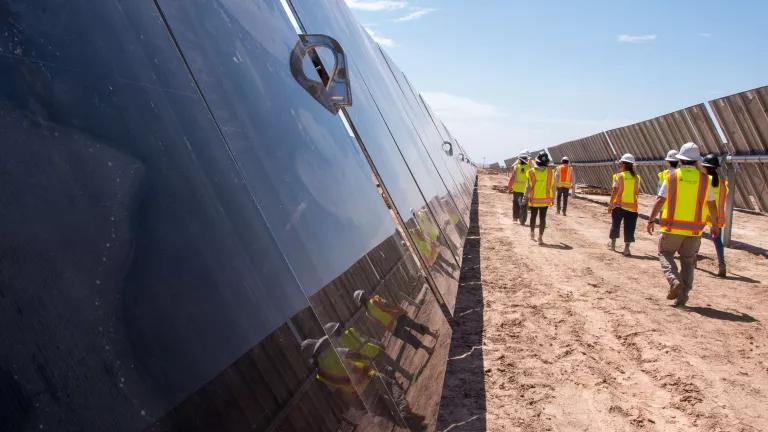
Time and time again, solar, wind, and battery storage have been showing up to keep the lights on and the heat and air-conditioning running. This was true this winter, when wind provided 10 to 45 percent of generation during January’s cold snap, and in summer 2023, when renewables showed up to meet record demand during the hottest summer to date.
The real solution for reliability is to ensure that we connect as much new generation as quickly as possible to the grid and expand transmission lines so that our grids are more dynamic and nimble.
Americans deserve healthy air and a clean environment
It is indisputable that coal-fired power plants are a danger to the health and well-being of Americans. By 2020, the deaths from U.S. coal decreased by 95 percent, thanks to burning less coal for electricity and environmental controls requiring coal plants to reduce deadly pollution. We cannot turn back this life-saving trend.
Using coal-fired generation also costs Americans billions in extra health costs per year. In total, between 2015 and 2023, RMI estimates that communities had to pay $236 billion in added health costs due to the uneconomic dispatch of coal. That’s $13 to $26 billion a year in additional ER visits, more strokes and cardiac events, and a greater prevalence and severity of childhood asthma events.
It isn’t just air pollution. A 2022 investigation by Earthjustice found that of the 292 coal plants reporting groundwater monitoring data, 91 percent of those plants were contaminating groundwater with toxic substances at levels exceeding federal safe standards. The report also identified 26 different sites across 14 states where coal ash ponds and other “fill” sites contaminated private drinking water wells.
And as organizations like Appalachian Voices have documented, mountaintop removal for coal mining has devastated communities and economies in central and southern Appalachia. Too many former coal miners are suffering from black lung disease and other health impacts. And negligence by coal executives have led to disasters in coal mining communities like the 2010 Massey Energy explosion in West Virginia that killed 29 miners.
The American people deserve better than to suffer the economic, health, and environmental impacts of increased coal-fired generation when there are clean, affordable alternatives readily at hand.
Ultimately, energy markets should work for everyday people, not fossil fuel execs. They should provide reliable power at an affordable cost. The data show that renewable resources are more cost-effective than coal-fired generation and the interconnection queue clearly demonstrates that market forces are choosing new, clean, affordable resources. The administration should not thwart these market signals by putting its thumb on the scale to favor fossil fuel generation.
This blog was originally published on March 31, 2025, and has been updated with new information and links.
Related Content

Trump Administration Readies the Axe for Nearly 45 Million Acres of Public Forests

The High Price of Diesel Pollution