
The High Price of Diesel Pollution
As the Trump administration weakens tailpipe emissions standards and puts the brakes on electric trucks, Americans pay the price with their health and their wallets.
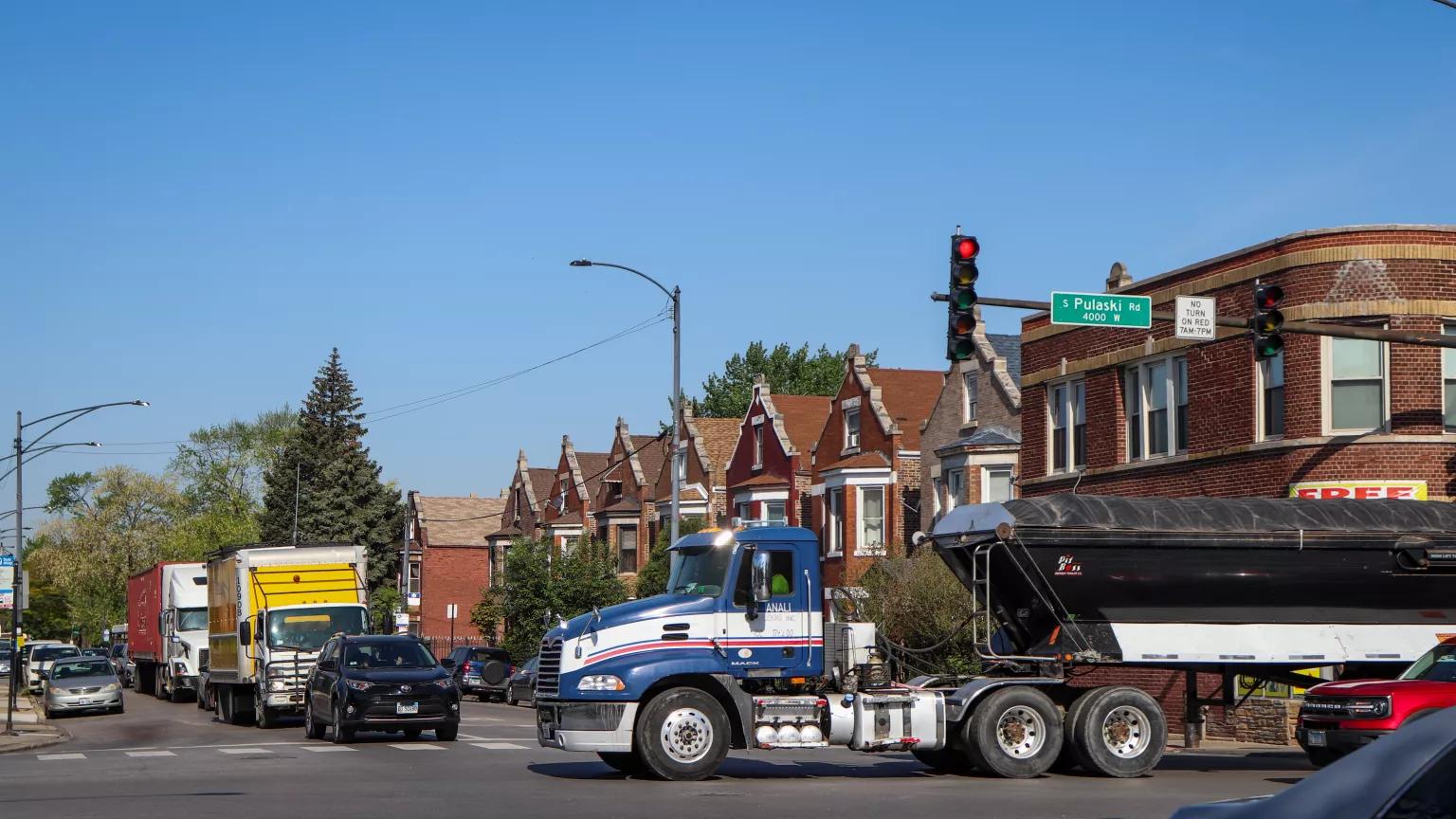
Heavy duty diesel-powered trucks driving through an intersection in the Little Village neighborhood of Chicago
Little Village, a primarily Latine neighborhood in Chicago, celebrated as the Crawford coal-fired power plant shut down. Finally, thought many residents, the air would be safer to breathe. That was 14 years ago. These days, however, on the very same property where the power plant spewed its thick smoke into the sky, now sits a Target warehouse. Around the clock, large, noisy trucks pull in and out as they make their way through town.
The distribution center is just one of many trucking hubs located around the city, which sees more freight activity than any other place in the country. At each one, heavy-duty vans, semis, and 18-wheelers come and go, day and night, belching volatile organic compounds, particulate matter, and nitrogen oxide (NOx) emissions. All of those pollutants can react with sunlight to create smog, which irritates lungs and makes breathing more difficult.
“Heavy truck traffic is a very real and measurable part of daily life in communities that experience environmental racism,” says Carolina Macias, a researcher for Little Village Environmental Justice Organization (LVEJO). “We’re seeing thousands of trucks and buses in a single 24-hour period. Over time, we're talking about potentially millions of trucks a year moving through these communities.”
So three years ago, LVEJO began documenting where exactly those trucks go and whose neighborhoods they are polluting the most by placing 35 cameras around Chicago. Last year, they added 10 more.
The group has been modeling emissions patterns, looking at potential health effects, and it’s planning to share its information with other environmental justice communities fighting against the freight industry. Many of them—like those within San Jose’s commercial hub in northern California and within the state’s “Inland Empire” to the south—are home to predominantly low-income residents of color.
Armed with data about the public cost of diesel pollution, LVEJO also hopes to shape citywide, statewide, and national policies. Until recently, the federal government had been on track to reduce the amount of trucking fumes that residents of frontline neighborhoods encounter daily, whether on walks to local stores and schools or even when just sitting at home with the window open. Newly strengthened standards would reduce heavy-duty tailpipe emissions by 80 percent, and they were scheduled to go into effect next year.
The Trump administration, unfortunately, had other plans. In July, the U.S. Environmental Protection Agency (EPA) proposed rolling back requirements that would have led to less pollution from heavy-duty vehicles. A number of organizations—including NRDC and the Union of Concerned Scientists—submitted comments to the EPA arguing against the proposed changes, which the agency intends to finalize later this year.
“This rollback will significantly increase pollution, and that disproportionately impacts communities living near ports, living near highways, living near other kinds of major warehouses and hubs for these kinds of heavy-duty vehicles,” says Atid Kimelman, a clean vehicles attorney at NRDC. “The pollution that they face is already unfairly high, and it is going to get a lot higher.”
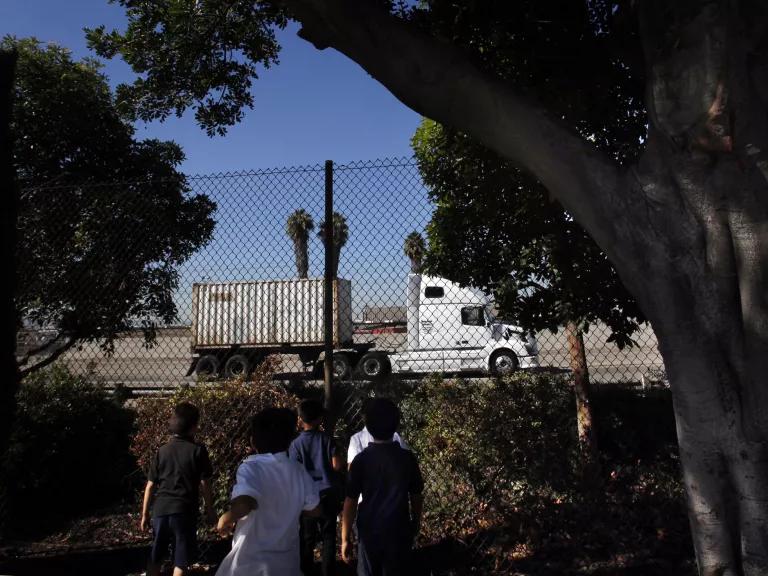
A semi-trailer truck passing on the 103 Freeway next to Hudson Elementary School while students have recess on the playground
Caution: Health hazards ahead
Just about everything we buy, from phones and lumber to food and clothing, hitched a ride on a truck at some point. These vehicles move more than 70 percent of the country’s freight each year. Trucks transport containers from cargo ships to warehouses. Trucks help stock stores and deliver goods to your home. And most trucks, at least at the moment, run on dirty, and increasingly expensive, diesel fuel.
The average price of a gallon of diesel rose to a record-breaking $6.53 in September, up from $3.75 a year ago. Companies often pass on extra trucking costs to their customers, making goods more expensive. According to a Brown University energy price tracker, rising diesel prices resulting from the war in Iran have so far cost U.S. households an additional $415.
Though people may not realize that the price of their groceries or T-shirt includes the higher cost of fuel, the bottom line is that pricey oil affects the cost of doing business. And burning diesel also exacts a steep price on public health.
In fact, even though heavy-duty trucks account for just 10 percent of vehicles on the road, they emit an estimated 45 percent of the entire transportation sector’s NOx emissions. This pollution is unhealthy enough on its own, but the dangers easily compound. During extremely hot weather conditions, for example, like what much of the country experienced this summer, heat domes can trap smog close to the ground, worsening air quality to dangerous levels and even triggering heart attacks, strokes, and heat-related deaths.
As many as 129 million Americans breathe in dangerous levels of smog every day, according to a report published in April by the American Lung Association. Inhaling smog is linked to heart disease, worsening asthma, lung damage, and premature death.
When the EPA enacted stronger standards for NOx emissions four years ago, it estimated the new rules could result in 2,900 fewer premature births a year, 6,700 fewer hospitalizations and emergency room visits, and 18,000 fewer cases of childhood asthma. With its rollbacks, the Trump administration is putting profit over people, further endangering communities like Little Village that sit along busy trucking routes.
Based on NASA satellite data of 150,000 warehouses within the United States, a 2024 study published in Nature Communications found that NOx emissions were 20 percent higher near the buildings. Corresponding with environmental justice concerns, the researchers also determined that higher concentrations of warehouses sit in or around low-income areas and communities of color. Another study published in GeoHealth the same year found that the air near warehouses contains higher levels of particulate matter, too, adding to the risks of breathing trouble, asthma, cardiovascular disease, and heart attacks.
“Diesel pollution and other greenhouse gas emissions that come out of diesel engine combustion are so detrimental to health and well-being,” says Isella Ramirez, executive director of Moving Forward Network, an organization that works with frontline communities. “It doesn't make sense to encourage the reliance on engines that we know kill people—that harm health. It is our job to be on the right side of history.”
The EPA’s rollbacks hit reverse on clean air
Two of the Trump administration’s proposed changes could particularly diminish air quality within communities close to trucking routes.
The first involves engine warranties. Longer warranties push manufacturers to create emissions control technologies that are more durable, because they are on the hook to make repairs to them over longer time frames. The current standard requires heavy-duty truck engines to incorporate emissions controls that can last for either 450,000 miles or 10 years, while the EPA now wants to cut that back to 100,000 miles or five years.
The second change would be to the technology that ensures an additive called diesel exhaust fluid (DEF) remains at levels sufficient enough in engines to limit NOx emissions. When a truck’s DEF levels get low, current tech carefully slows the engine down, which prompts the driver to comply with the emissions standard by adding more DEF, which is found at truck stops across the nation. But now the administration is proposing to modify this tech so that instead of an engine slowing, drivers would only see lights and hear sounds, cues that are far easier to ignore.
Again, the consequences for public health could be dramatic. When DEF falls to low levels in truck engines, NOx emissions soar. Without DEF, a single truck pollutes the equivalent of 99 trucks with adequate DEF levels. Analyses show that if just 2 percent of heavy-duty vehicles don’t use DEF, NOx emissions could increase as high as 4.3 million tons, or 38 percent, by 2055. This would lead to nearly $610 billion in additional health-care costs.
And sure, longer warranties and DEF may result in higher costs to manufacturers and trucking companies, respectively, but otherwise, the public pays a much steeper price for the pollution. In the end, these standards would prevent visits to the doctor, work and school days lost to illness, and the onset of respiratory disease.
“These rules are in place because the trucking industry isn’t forced to pay for all the adverse impacts,” says Dave Cooke, a senior scientist in the Union of Concerned Scientists’ clean transportation program. “Society is bearing a huge public health-care cost because of these trucks.”
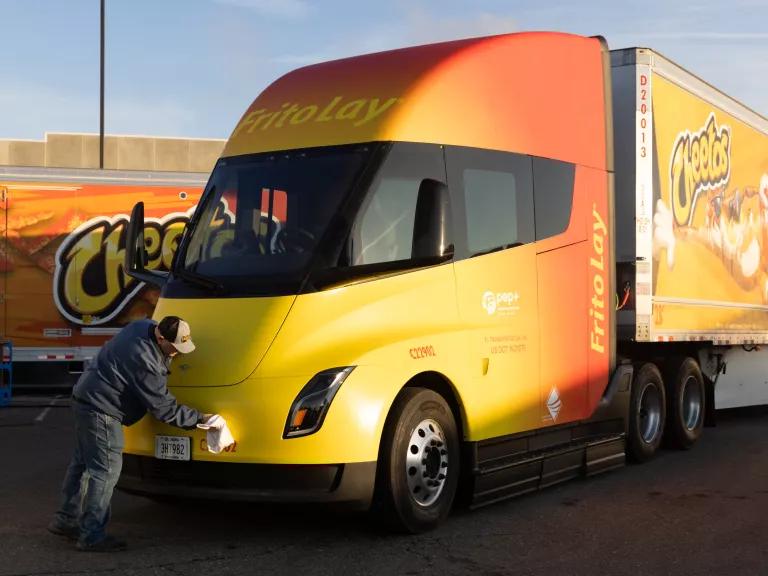
An electric semi-trailer truck outside the Frito-Lay manufacturing facility, which is replacing its diesel-powered freight equipment with zero-emission trucks, solar panels, and energy-storage systems at its plant in Modesto, California
Keep on trucking (by going electric)
While stronger tailpipe emissions standards are essential to curbing air pollution and improving public health right now, the long game for the trucking industry is to electrify its fleets. Heavy-duty electric trucks are, in fact, already on the roads, albeit they account for just a small percentage of the trucks out there, especially in the United States. The Trump administration eliminated tax incentives for commercial electric heavy-duty truck manufacturers and buyers last year, stymying the industry’s growth.
Globally, however, the adoption of heavy-duty electric vehicles is a different story. Electric truck numbers are rising in China and some European countries like Germany and France, says Yihao Xie, a senior researcher with the International Council on Clean Transportation. According to the International Energy Agency, the percentage of electric heavy-duty trucks sold worldwide grew from 3–9 percent just last year. And sky-high diesel costs this year are making electric vehicles even more attractive.
“[Yet] we're just such a fossil fuel–based economy, of which diesel is a huge part,” says Cooke.
And that must change. The growing affordability crisis, coupled with public health concerns, makes stronger rules for heavy-duty vehicles more important than ever, say environmental groups. Adding to the urgency, new heavy-duty trucks will likely go on to burn diesel for decades to come, locking in climate emissions as well as harm to neighborhoods like Little Village.
“We still need to move goods. We still need the freight system; it’s crucial,” says Macias. But we’re doing ourselves a disservice if we don’t defend policies that make it cleaner and more equitable, she says. “As long as the community sees this as an issue and continues to raise its voice and organize, we’re going to keep fighting for stricter standards that ultimately protect communities, our health, and the environment.”
This NRDC.org story is available for online republication by news media outlets or nonprofits under these conditions: The writer(s) must be credited with a byline; you must note prominently that the story was originally published by NRDC.org and link to the original; the story cannot be edited (beyond simple things such as grammar); you can’t resell the story in any form or grant republishing rights to other outlets; you can’t republish our material wholesale or automatically—you need to select stories individually; you can’t republish the photos or graphics on our site without specific permission; you should drop us a note to let us know when you’ve used one of our stories.
How EPA Rollbacks Will Cost Us—in Dollars and Lives
Can the Environmental Justice Movement Survive Trump’s Attacks? This EJ Warrior Says Yes.
What Is Congestion Pricing?