
Trump Wants PJM to Give the Gas Industry a Multibillion Gift to Supply Data Centers
Guess who’s paying?
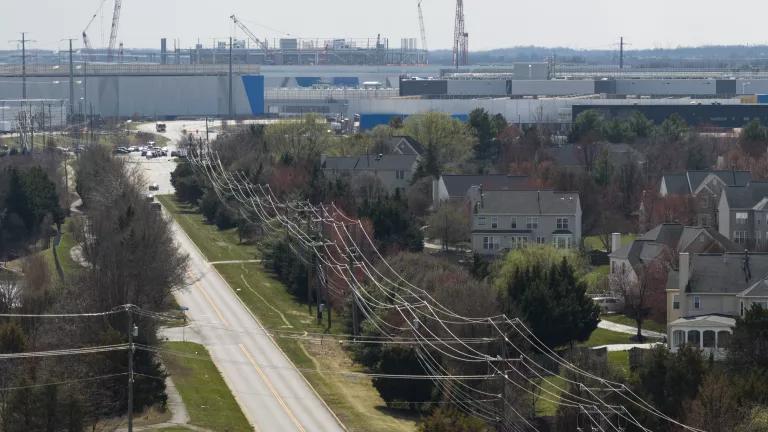
Power lines connected to a data center beside a residential neighborhood in Ashburn, Virginia
PJM, the country’s largest power grid operator, is in a tight spot. Thanks to the data center boom, there’s never been more demand for electricity, but years of delay in the interconnection queue has choked off new supply, and PJM’s laissez-faire approach to transmission planning has left us with a grid that needs expensive and time-consuming upgrades. This all adds up to soaring prices and declining reliability, with no end in sight.
Against this backdrop, the White House and governors of all 13 PJM states have pushed PJM to hold a so-called Reliably Backstop Procurement (RBP) to support new resources. The basic idea makes sense: Hold a one-time auction to fund new supply, mostly for data centers. Pay for that new supply at a generous guaranteed price but bill it to the companies that need power without raising prices for everyone else.
PJM stakeholders are in the middle of debating how this should work, and PJM’s board will make a decision at the end of June. Tens of billions of dollars and the region’s energy future are at stake. Fossil fuel cheerleaders in the Trump administration clearly see this as an opportunity to lock in fossil power at public expense through the 2040s. Anyone who cares about clean air or their power bill should be making sure they don’t succeed. That’s why NRDC presented an alternative proposal that protects consumers, gives clean energy a fair chance to compete, and simply has a better chance of getting the new supply that the system needs built.
To be successful, the RBP needs to accomplish two things. First, it needs to actually bring on new supply, which means addressing the problems that are blocking it: transmission delays, supply chain issues, siting, and permitting. Notice that money isn’t on that list. The tech companies clamoring for power have deep pockets, and any power plant that can get built these days should have no problem finding buyers and arranging financing. Second, the RBP needs to protect consumers. That means guaranteeing that the bill goes to the data centers that need the power, that there are no hidden costs, and that we can’t get stuck paying for obsolete power plants after they’re no longer useful. Sadly, under heavy pressure from the White House, PJM is putting out a proposal that does none of these things.
What’s going wrong?
PJM opened with a reasonable proposal that offered guaranteed payments for new supply and focused on getting data centers and power plant developers to make their own deals. As a last resort, PJM would buy power on behalf of utilities, but even then, only with the utility’s permission. This is critical: Anything that PJM pays for gets passed through to electric bills, so whenever PJM buys power, there’s a chance that the public ends up paying for it. The initial proposal also had commonsense consumer protections, like preferring deals with power plants that need shorter-term contracts. Since any power purchased through the RBP is probably going to be at a premium rate, shorter terms help keep costs down.
Learn More

Then, under direct pressure from the White House, PJM changed its tune. Now, PJM is proposing entering 15-year contracts itself and billing utilities later. It’s then up to those utilities to try and get the money back from data centers; if they fail, the bill goes to everyone. Besides the obvious risk that this ends up raising all of our electricity bills, it undermines the work that many states are doing to require data centers to pay their own way and bring their own power.
The proposal that PJM has on the table now has many features that seem custom-made to use public money to support major new fossil plants, possibly including some supported by the White House:
It’s rushed
Job number one here is to deliver new power supply that wouldn’t get built otherwise. To do that, there needs to be enough time for proposals to get developed, and PJM needs to select projects that it is confident will be able to get built. Even though the governors and White House initially suggested a September auction, it quickly became obvious that this is too soon for new projects to offer or for confidence that projects that do offer will get built.
Just as important, a September auction won’t help get new power plants online faster. The main cause of project delay that’s within PJM’s control is how long it takes to connect to the grid. Because PJM has neglected transmission planning for a long time, new projects are often told they must wait five or even eight years for transmission upgrades. Projects that are in the queue now will find out how long their delays are in November. In September, they won’t know anything new about how much it will cost or how long it will take to get connected, so the RBP will be run with suppliers who don’t have enough information to be sure they can deliver. Waiting just two months for PJM’s current queue cycle to finish would vastly improve RBP’s chance of success.
We see only two reasons to rush the auction in September: to hold it before Election Day or to funnel extra money to fossil fuel projects that have already been announced. Neither of those are good reasons. PJM should be designing an RBP to have the best chance of bringing new power onto the grid, not to deliver empty political wins or award contracts to favored projects without robust competition.
Public risk, private benefit
PJM’s prior proposal had an important safeguard: The data centers, or the utilities that supply them, would be the ones deciding how much power to buy. That’s important because it makes the companies claiming they need more power to be responsible for paying for it. “Put your money where your mouth is” is still one of the best ways to keep people honest.
PJM has now reversed course and will decide on its own how much power to purchase. After PJM sets the target, utilities—and thus, their customers—will be paying to build new power plants. Since those power plants will get paid whether the data centers get built or not, there’s no accountability for accurate forecasts, and ordinary ratepayers could easily end up footing the bill for speculative data centers. That’s a windfall for data center and power plant developers but not so much for the rest of us.
It’s a very long-term commitment
Originally, suppliers could ask for a term as short as two years, while PJM’s new proposal gives all winning suppliers a 15-year contract going out to 2043. This seems odd: Why would PJM want to commit to paying premium prices for any longer than necessary? (For the more financially inclined, PJM sweetens the deal by discounting offers at 9.5 percent, and because payments are backed by ratepayers, they are nearly risk-free.)
This is very unfriendly to those paying the bills, but it does benefit the gas industry, in particular. Groups like the National Petroleum Council and the Interstate Natural Gas Association of America have been beating the drum that gas-fired power plants need long-term contracts so they can finance pipelines and other gas infrastructure. Renewables and storage have no such needs, and any sensible auction would reward them for needing a less expensive price guarantee.
These contract terms also directly undermine state energy policies. Many PJM states have laws to reach 100 percent carbon-free electricity between 2035 and 2045. Fifteen-year RBP contracts could have consumers in those states paying for fossil fuel power plants through 2043, in violation of state laws and very much undermining state authority over power generation. In a way, the new RBP design “policy-proofs” fossil fuel plants by guaranteeing they’ll get paid, regardless of states’ clean energy policies.
Contracts this long risk sticking consumers with stranded assets—power plants that should be shut down but that ratepayers are still paying for. Nobody can predict what the energy landscape will be in the 2040s. After all, solar power has gotten 90 percent cheaper in the last decade, and there are lots of new technologies that might be on the same track. There’s certainly the possibility that power plants that look good now will become obsolete money losers by then. Long-term contracts place all that risk on the public rather than on the power plant investor. There’s an irony here in that power markets and organizations like PJM were created in part to protect us from exactly this risk.
It’s full of hidden costs
Inexplicably, PJM says it won’t consider the locations of the new power plants. Many of the transmission lines that move power across PJM are already at full capacity, so new power plants in the wrong place will require tens of billions of dollars in new transmission just to get the power to where it’s needed. PJM’s latest batch of transmission projects to move power to data centers will cost $11.8 billion, and that just scratches the surface. Those lines can take many years to build but, incredibly, PJM has proposed that the RBP pays power plants even before the transmission they’ll need is finished, literally giving them money when they do nothing to help the data centers they’re supposedly getting built to serve.
Most data centers are in eastern PJM territory, but the new fossil plants will mostly be in western PJM territory. Ignoring the huge additional costs to ship power across the country unfairly tilts the scale against resources that can be built closer to where they’re needed. Sensibly planning the system requires something called co-optimization, which is a fancy way of saying the costs of transmission and generation are considered together. There’s simply no way to make reasonable decisions while only looking at half of the problem; it’s like picking an apartment based only on the rent while not noticing that it’s in the wrong city.
New gas plants will also require new pipelines, which makes power from those plants more expensive. PJM will not consider that in selecting RBP winners. Instead, the cost to build those pipelines—no matter how high it is—will just get rolled into electric bills with little oversight. Not only is PJM promising new gas plants 15 years of premium pricing and publicly supported transmission, but it’s also offering the pipeline owners who supply them a blank check for fuel costs.
Clean supply like solar plus storage has some big advantages. It’s easier to build close to where it’s needed, it doesn’t need additional fuel delivery infrastructure, and once built, it supplies cheaper power. PJM has come up with an auction design that takes all of those advantages off the table. Even before considering environmental benefits, an auction that hides a good chunk of the costs of fossil fuels is a bad design.
The politics at play
Summing all this up, we’re looking at an auction that has terms custom-designed for gas plants, commits consumers to paying for natural gas with the price unseen, ignores the price advantages of clean energy, leaves the public on the hook if the data centers leave town, and might not even deliver the power we’re paying for. Not a great deal.
So why is PJM doing this? We hope it isn’t because of pressure from the Trump administration, which does seem to have an unusually focused interest in this auction. It’s certainly no secret that this administration is willing, even eager, to waste money on fossil-fueled power plants for ideological reasons. Strong-arming the nation’s largest power grid into a plan that locks in fossil fuel and sidelines clean energy would, sadly, be in keeping with its other actions.
An auction that gets new supply and protects consumers without locking in a fossil fuel agenda is possible. To do this, NRDC’s alternative design would have the RBP:
- Be on behalf of only willing buyers (like utilities and data centers themselves, not PJM) so the public is never stuck with a bill for data center power;
- Be timed to work with PJM’s interconnection queues so developers know their costs and schedule before making commitments;
- Consider location and only award contracts for supply that can be delivered to where it’s needed when it is needed; and
- Issue the shortest-term contracts possible.
Creating a dedicated auction to funnel data center money to desperately needed new supply is not a bad idea. But political pressure risks turning this into an expensive boondoggle that benefits the gas industry at public expense. PJM can do better. The region’s state governments and public need to make sure they do.
This NRDC.org blog is available for online republication by news media outlets or nonprofits under these conditions: The writer(s) must be credited with a byline; you must note prominently that the blog was originally published by NRDC.org and link to the original; the blog cannot be edited (beyond simple things such as grammar); you can’t resell the blog in any form or grant republishing rights to other outlets; you can’t republish our material wholesale or automatically—you need to select blogs individually; you can’t republish the photos or graphics on our site without specific permission; you should drop us a note to let us know when you’ve used one of our blogs.
Related Blogs

Building Data Centers Without Breaking PJM

The Nuclear Regulatory Commission Is Rewriting the Rules That Are Supposed to Keep Nuclear Safe
