
California Decides on Marine Protected Areas This Fall
State agencies differ on recommendations as Tribal communities weigh in.

A Pacific angelshark swimming through a kelp forest off the coast of Southern California

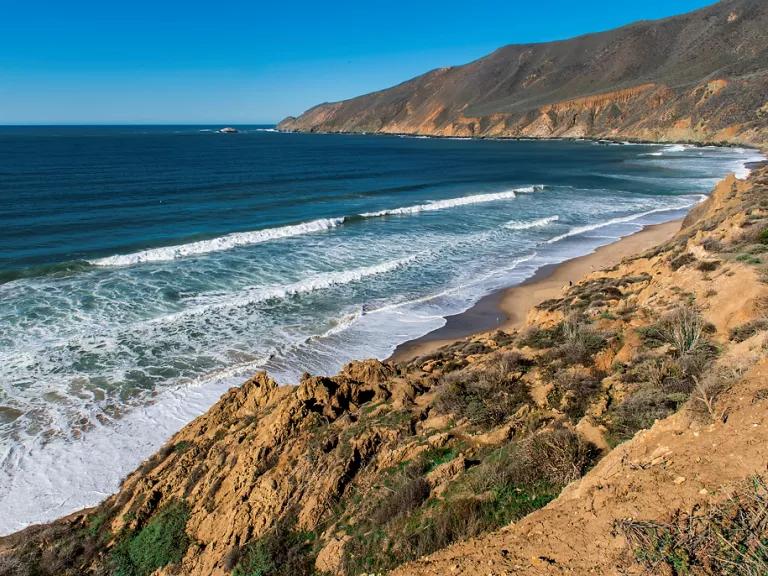
Between a Space Force base and a dune preserve on California’s Central Coast lies a stretch of vibrant water teeming with ocean life. Humpback and gray whales pass through on their migrations. Seabirds and sea lions crowd the face of Lion Rock. Sea otters play in the rocky shallows, and in the lee of the Point Sal headland, currents hold larval fish and invertebrates in place long enough for them to develop before they disperse, replenishing waters up and down the coast.
Point Sal is one of California’s healthiest remaining coastal landscapes. It is also within the ancestral homeland of the Chumash people and adjoins waters that hold deep cultural significance.
This October, California’s Fish and Game Commission (FGC) will decide whether this area will be protected from now and into the future.
Two agencies, two visions
On July 31, California’s two most influential ocean management agencies released their recommendations on 15 pending proposals to modify the state’s marine protected area (MPA) network. They do not agree.
The Ocean Protection Council (OPC) recommended establishing new MPAs, endorsing a path that would boost fish populations, protect kelp forests, and in some cases, formally share management responsibility with Tribes. The California Department of Fish and Wildlife (CDFW) recommended, in effect, that the state do nothing to enhance or strengthen its MPA network. At a moment when the Trump administration has restarted offshore oil drilling in federal waters off our coast, has reduced ocean protections from 26 percent to .01 percent of U.S. waters, and is questioning the state’s authority to manage its own coastal resources, it is time for California to lead.
On October 15 and 16, the five members of the FGC will decide which agency’s guidance to follow.
What we proposed and with whom
In 2023, NRDC, the Santa Ynez Band of Chumash Indians, and the Environmental Defense Center submitted a proposal for a new MPA called Mishopshno State Marine Conservation Area, named for the thriving Chumash boat-building village. Mishopshno would conserve a portion of a nearshore rocky reef that is home to one of the Central Coast’s most persistent kelp forests and a habitat that supports a thriving juvenile white shark aggregation. NRDC and the Northern Chumash Tribal Council cosponsored a proposal for a new MPA called the Point Sal State Marine Conservation Area. The Point Sal MPA would conserve the productive waters surrounding the Point Sal headland that include sacred Chumash cultural resources.
Other organizations, Tribes, and individuals submitted proposals that aim to conserve some of the state’s most persistent kelp forests, protect delicate rocky intertidal areas, and strengthen protections within existing MPAs. Four of the 15 proposals would weaken existing protections.
MPAs are ocean areas that are set aside for conservation, where ocean life can recover and thrive without pressure from harmful activities. People can dive, kayak, swim, and surf in these waters, but industrial extraction, such as oil and gas drilling and commercial fishing, is often prohibited so that the habitat and species that depend on these places have room to grow and recover. As OPC noted in its 2026 letter to the FGC, MPAs help restore depleted populations, conserve genetic diversity, keep food webs intact, and sustain larger wildlife populations. A large body of scientific literature from MPAs around the globe shows that these conditions help ocean ecosystems buffer climate shocks and rebound more quickly afterward.
The importance of this moment
California’s 124 MPAs were established to function as an ecologically connected network. Given that ocean conditions—and ocean threats—change, the law that led to the creation of the network, the Marine Life Protection Act, requires a periodic “adaptive management” process. The state is now four years into its first-ever adaptive management process, where the FGC has the chance to take proactive measures to respond to the state’s devastating loss of kelp and new industrial uses of the ocean and to make the coast more resilient to unprecedented warming and more frequent and intense marine heat waves.
The Mishopshno and Point Sal MPA proposals are significant because none of the state’s 124 MPAs is currently Tribally co-managed. Additionally, this is the first time in this network’s history that California Tribes have proposed additions to the MPA network. This is due in part to the fact that Tribes in much of the state were not appropriately or adequately engaged as sovereigns when the network was created more than a decade ago. Governor Gavin Newsom has taken important steps to recognize and correct for some of the harms that Indigenous Californians have suffered by committing the state to ancestral land return and Tribal co-stewardship. These proposals are direct requests to create Tribally managed MPAs and offer the state a chance to help fulfill Governor Newsom’s vision for land return and co-stewardship.
On October 15, 2026, California’s Fish and Game Commission will decide whether to create a new marine protected area called the Mishopshno State Marine Conservation Area. The Tribally led proposal is named for a thriving Chumash village renowned for building tomols—traditional plank canoes that connected mainland and Channel Island communities. The protected area would safeguard kelp forests, a 1.6 mile-long rocky reef, fish, spiny lobsters, white sharks, and rays.
What CDFW recommended
CDFW recommended full approval of only one of the five Tribal petitions and only one of the 10 other conservation proposals. The CDFW recommendations are out of step with what the state has already committed to. In 2020, Governor Newsom directed state agencies to expand ocean protections. In 2022, the legislature codified the groundbreaking goal to conserve 30 percent of California’s coastal waters by 2030.
Despite the state’s 30x30 initiative, of which this process is a part, and the state’s formal guidance for the legally required adaptive management process, CDFW has viewed this process extremely narrowly and appears determined not to recommend any regulatory actions that would increase ocean conservation or Tribal marine stewardship. This narrow interpretation of “adaptive management” overlooks the state’s own guidance, which says that during the state’s adaptive management cycle, it should consider “current and future ocean conditions.”
Denying the requests from Tribes to create new MPAs or expand existing onesis also inconsistent with CDFW’s own priorities for the adaptive management process. The department’s 2022 Decadal Management Review report recommended that the state “create a clear pathway to tribal MPA management,” and the appendices to that report underscore why Tribal MPA management is critically important:
“Indigenous peoples have inhabited the California coast since time immemorial. California Native American Tribes remain the original stewards of California’s coast and ocean despite a history of genocide, forced relocation, and systematic oppression…. Tribes have never ceded their inherent rights to harvest and gather from, or hold religious ceremonies in, the marine environment.”
Approval of the Tribally led proposals offers the state a pathway to realizing some of CDFW’s objectives.
What OPC recommended
The OPC took a different approach to developing its recommendations and considered whether a proposal offered the chance to improve the overall design of the network, offered unique biodiversity protections, and offered an opportunity to advance Tribal co-stewardship. This lens led the agency to recommend approval of the proposals to expand protections for persistent kelp forests at the Point Conception and Point Dume MPAs and to approve the Point Sal and Mishopshno MPA proposals. While OPC recommended denial of several conservation proposals, approving the conservation proposals that OPC recommended, including the Tribally led MPA petitions, would be a historic win for California ocean stewardship that would help lessen the impact of the many stressors that California’s ocean is experiencing, enriching the future for the millions of Californians who love and depend on the state’s magnificent coast.
Decisions made in October will impact California’s coast for at least a decade
California’s MPA network took 13 years to create. Outstanding and effective as it is, the pressures of climate change, industrial ocean uses like coastal desalination and offshore oil drilling, and increased shipping, have and will continue to compromise the state’s ocean health. Yet this October, the five FGC commissioners have the chance to support Tribal co-stewardship and safeguard some of the state’s most ecologically important habitats.
California has said it wants to protect 30 percent of its coastal waters and that it wants to support Tribal co-management of ancestral lands and waters. Tribes have now asked, directly and formally, to do exactly that in their own ancestral waters. FGC can and should say yes.
Whatever FGC decides in October will stand for the next decade and cement Governor Newsom’s ocean legacy. Approving the OPC recommendations, at a minimum, is the best way the FGC can invest in a healthy ocean future for all. California’s ocean does not have a decade to spare.
This NRDC.org blog is available for online republication by news media outlets or nonprofits under these conditions: The writer(s) must be credited with a byline; you must note prominently that the blog was originally published by NRDC.org and link to the original; the blog cannot be edited (beyond simple things such as grammar); you can’t resell the blog in any form or grant republishing rights to other outlets; you can’t republish our material wholesale or automatically—you need to select blogs individually; you can’t republish the photos or graphics on our site without specific permission; you should drop us a note to let us know when you’ve used one of our blogs.
Related Blogs

California Crab Fishery Leads the Way in Pop-Up Fishing

California on the Frontlines
