The Social Burden of PFAS “Forever Chemicals” in New York
PFAS-related health care impacts in the state are likely to cost billions of dollars unless swift and comprehensive actions are taken to reduce New Yorkers’ exposure.
Author


Media Contact
While the U.S. Environmental Protection Agency (EPA) announced in May that it plans to repeal standards for four of the six federally regulated PFAS (per- and polyfluoroalkyl substances) found in tap water and to delay implementation of the standards for PFOA and PFOS, New York is considering its next steps to protect public health and the environment from these toxic chemicals.
As the state moves forward, it is important to better understand the true health and economic costs of PFAS pollution to New York. This will provide a more complete picture on the benefits to residents, utilities, businesses, and the government of efficiently addressing the PFAS environmental health crisis. Quantifying all of the impacts of PFAS production, use, and disposal is challenging. However, some existing estimates at the federal and international level can be scaled to New York. While necessarily somewhat coarse, these analyses provide useful information, with the caveat that they represent only a portion of the burdens of PFAS.
PFAS in New York
PFAS are a large class of man-made chemicals, most infamous for their extreme persistence and harmful impacts to human health and the environment, which is why they are often referred to as toxic “forever chemicals.” While there are no large manufacturers of PFAS chemicals in New York, there are many sources of PFAS that continue to contaminate the state’s drinking water, air, land, and food. These sources include at least 1,213 industrial and manufacturing facilities that are likely releasing PFAS chemicals into the air and water; runoff of PFAS-laden firefighting foam used at airports, fire stations, and military sites across the state; PFAS-contaminated wastewater sludge spread on farmland; PFAS-contaminated landfill leachate; and consumer and personal care products.
New York has been an epicenter of the PFAS water contamination crisis, with communities like Hoosick Falls, Petersburgh, Newburgh, and so many others forced to face the devastating consequences of PFAS-polluted drinking water. According to recent data from the Environmental Working Group, an estimated 189 New York drinking water systems, serving more than 1.3 million people, have concerning levels of PFOA and PFOS, ranging from 4 parts per trillion (ppt) to 10 ppt between 2023 and 2024; this is in addition to the approximately 250 drinking water systems, serving approximately 300,000 people, that have concentrations above the state maximum contaminant level (MCL) of 10 ppt.
In addition, state investigations at inactive landfills have revealed that 68 percent of the groundwater wells (public and private) sampled near the vicinity of the investigated landfills have PFAS concentrations at or above state action levels. Landfills are concerning sources of drinking water contamination, particularly for New Yorkers who get their water from private wells. Several million residents, across more than one million homes throughout New York State, receive drinking water through private wells and are still in the dark about what is in their drinking water.
New York has not shied away from regulating PFAS and was one of the first states in the country to pass MCLs of 10 ppt for PFOA and PFOS. New York has also taken steps to address upstream uses of PFAS by banning or restricting PFAS in firefighting foam, paper-based food packaging, carpets and rugs, and apparel. While these actions are important, there is much more work to be done to turn off the tap on PFAS chemicals in order to make a dent in addressing the costs associated with continuing to allow PFAS to enter our environment, and ultimately, our bodies.
Adapting known PFAS cost estimates to New York
As New York considers its next steps in protecting the state from PFAS impacts, a more complete picture of the benefits to residents, utilities, businesses, and the government of efficiently addressing PFAS will be helpful. Here, we scaled existing international and federal cost estimates to New York and found that PFAS-related health care impacts are likely to cost billions of dollars unless swift and comprehensive actions are taken to reduce New Yorkers’ exposure; cleaning up just one route of exposure—e.g., drinking water—will likely cost an additional tens of millions of dollars per year.
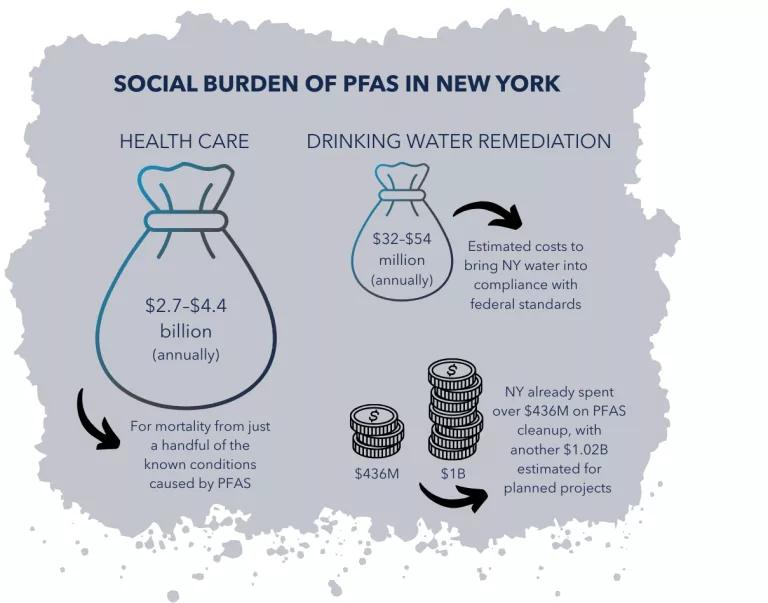
In 2019, the Nordic Council of Ministers estimated the socioeconomic costs related to the negative human health and environmental impacts from the use of certain PFAS. The report found the costs of inaction in the European Economic Area countries to be between €52–€84 billion (2018 EUR), due to various health impacts. The report used data specific to Nordic countries as well as other European countries, the United States, and Australia, where relevant. Scaling this analysis based on the population of New York, we estimate minimum health care costs for New York to be between $2.7 and $4.4 billion (2025 USD) annually, as described below.
In the Nordic Council report, annual health-related costs in the European Economic Area included the following well-studied impacts:
- Costs attributable to increased deaths due to kidney cancer from occupational exposure were estimated to be €12.7–€41.4 million, based on the “value of a statistical life” (an estimate of how much people are willing to pay to reduce the risk of death).
- Health costs for PFAS exposures in communities near manufacturing sites or with elevated levels of PFAS in their drinking water were estimated at €41–€49 billion, based on all-cause mortality.
- Health costs due to background levels of exposure from drinking water, food, or consumer products were estimated at €11–€35 billion, based on mortality due to hypertension.
Importantly, even though these estimates are larger than the 2024 EPA estimate of the benefits of the national drinking water standards—because the Nordic Council report considers additional health effects and exposures from all sources—its findings are still likely conservative. Due to data limitations, the majority of the quantified costs were based on exposure to just the two most widely studied PFAS: PFOA and PFOS. Additional health care costs would be incurred due to exposure to the many other PFAS in our environment. Notably, there are non-quantified health care costs associated with other conditions caused by PFAS exposure (e.g., liver damage, thyroid disease, decreased fertility, and testicular cancer).
In addition, the Nordic Council estimated that 3,354 cases of low birth weight per year would occur in impacted communities in the European Union, incurring additional medical costs and resulting in impaired child cognitive development. It also found that children experience 1.5 million additional days of fever due to PFAS immunotoxicity. Lastly, the health costs are based solely on mortality and the value of a statistical life and do not consider increased health care or insurance costs, loss of quality of life, or loss of productivity.
The Nordic Council had previously concluded that its estimates were generalizable to the United States (due to similar PFAS serum levels in the two populations); in a follow-up analysis, this health-related estimate was translated to the United States based on exchange rates and population differences, estimating the total equivalent cost as $37–$59 billion (2018 USD) annually. Taking inflation into account, this estimate would translate to $47–$75 billion today (2025 USD). Scaling the above cost estimates based on the New York population, which is 5.84 percent of the U.S. population, the health care cost estimate for New York is between $2.7 and $4.4 billion (2025 USD) annually for just the mortality impact from a handful of the known health impacts of just two PFAS.
Reducing people’s exposure to PFAS, through remediation and/or reduction in PFAS use, would lower the health impacts and related health care costs. However, this would only happen over a long period of time, due to the persistence and bioaccumulation of PFAS.
One of the most effective ways to reduce PFAS exposure is through drinking water remediation, since it is a major route of exposure and is technologically feasible. Based on known water contamination in New York and EPA cleanup cost estimates from 2024, providing safe drinking water to New Yorkers would cost a minimum of $32 million (2025 USD) each year, with a more likely estimate of $54 million annually (2025 USD).
Briefly, this estimate was calculated based on PFAS concentrations in drinking water from testing that was completed through March 2025 from the Safe Drinking Water Act’s Unregulated Contaminant Monitoring Rule (UCMR 5). We considered public water systems (PWS) to be detected in excess of the EPA’s 2024 federal drinking water standards if their average PFAS levels were above 4.0 ppt for PFOA or PFOS; 10 ppt for PFHxS, PFNA, or HFPO-DA; or a hazard index of 1 for mixtures containing two or more of PFHxS, PFNA, HFPO-DA, and PFBS.
The cost to come into compliance with the federal drinking water standards was based on the EPA’s 2024 estimates of the mean annualized costs to treat or change water sources (tables C-9 and C-13), based on the PWS source (groundwater or surface water), system type (community or non-transient noncommunity), owner type (public or private), and the size of the population served. Of note, the EPA’s 2024 cost estimates for coming into compliance are mean annualized costs that take into consideration the high up-front capital costs needed to build a water treatment facility and the lower, recurring costs that are required to keep the facility running over many years. The costs are presented as spread out, or “annualized,” over the course of the lifetime of the system, even if the initial capital costs are front-loaded.
Based on systems tested under UCMR 5 to date, New York would need to spend approximately $32 million (2025 USD) to remediate drinking water with known contamination exceeding the 2024 federal drinking water standards. If untested water systems are assumed to have the same likelihood of PFAS contamination as those already tested (16 percent), this would add a further $22 million (2025 USD) per year, for an estimated total value of $54 million (2025 USD) per year. Still, the true cost of providing safe drinking water for all New Yorkers is likely much higher. In particular, the 2024 federal drinking water standards cover just six of the many PFAS that have been found in New York drinking water. Additionally, this estimate does not include costs that could be borne by small, private wells or transient noncommunity water systems (e.g., water at camping grounds) that are not covered by the federal standards.
Another way to estimate PFAS cleanup costs for drinking water is by using water contaminant data from the New York State Department of Health. These data covered a larger number of New York water systems than UCMR testing but only included data on two PFAS—PFOA and PFOS. Water systems with concentrations of either or both chemicals at or above 4.0 ppt between 2020–2023 were considered to require treatment. Using the same EPA estimates of the mean annualized costs to treat or change water sources as in the above estimation, these costs totaled $38 million (2025 USD). If water systems without data provided by the Department of Health are assumed to have the same likelihood of PFAS contamination as those already tested (15 percent), this would add a further $9.5 million (2025 USD) per year, for an estimated total value of $47 million (2025 USD). This cost may be less than the estimate based on UCMR 5 data, $54 million (2025 USD), because it is based on the exceedances of two PFAS chemicals rather than five chemicals, plus the hazard index of a PFAS mixture.
Costs already documented within New York, summarized below, support these estimates, indicating that treating drinking water in New York will cost millions per year for decades to come.
Regardless of how the EPA proceeds in its attempt to repeal and delay PFAS standards—which would be an unlawful act under the Safe Drinking Water Act’s “anti-backsliding” provision—some states, like New York, have been moving to adopt the EPA’s 2024 standards in their own statutes or regulations. In New York, it is clear the current state MCLs of 10 ppt for PFOA and PFOS, while once nation-leading, are not protective enough to address the hundreds of systems with levels between 4 ppt and 10 ppt and those impacted by the four other PFAS. Stepping back further, the costs of complying with the EPA’s 2024 standards are an indicator of the costs of cleaning up PFAS in drinking water to protect public health.
Dozens of cities and water districts in New York, along with the U.S. Department of Defense and New York State itself, have already begun to address high levels of PFAS in drinking water by implementing water and environmental remediation projects, to the tune of more than $436 million, plus at least $1.02 billion in additional future costs. These early investments have jump-started New York’s cleanup efforts and helped to reduce future compliance costs, PFAS health harms, and associated health care costs.
These costs are onetime expenses for specific projects—money that has already been spent or allocated—and are not annualized, nor do they necessarily include ongoing maintenance costs. Rather, these costs represent a multiyear total of capital investment and capture the most expensive phase of each project. These costs may not be directly responsive to state or federal drinking water standards. So while these existing expenditures may overlap with some projected costs, they do not necessarily do so. What they do highlight is that significant costs are already being incurred in the state because of PFAS pollution, and this is consistent with what we expect from the above estimates of expected cleanup costs.
New York State has awarded grants to clean up PFOA- and PFOS-contaminated drinking water through its Water Infrastructure Improvement Act, totalling $365 million for 66 projects between 2018–2024. However, the additional costs for projects that were not awarded were estimated to be $282 million, along with $241 million in estimated costs for projects that were not funded by the state. Since 2017, $95 million (this amount is not included in the $436 million total) has also been spent on hazardous waste remediation for state Superfund sites—most of it for PFAS cleanup. Water districts in wealthier communities have brought projects online faster, while smaller, more under-resourced communities are largely waiting on grant allocations.
The ongoing annual operations and maintenance costs for the PFAS treatment plants can range from a few hundred thousand dollars to more than $2 million per treatment system, depending on the volume of water needing treatment. The majority of the cost likely comes from the replacement and disposal of the resin used to filter the water, which itself becomes PFAS-contaminated waste and may require additional treatment or special handling.
Separately, the U.S. Department of Defense has spent an additional $71 million on environmental investigations and cleanup at 21 military installations in New York, with at least $501 million more in spending planned in the coming years. This cleanup goes beyond just drinking water treatment, with additional work on soil remediation.
The costs of PFAS are enormous and support urgent action
Water providers and the Department of Defense have already spent $436 million and are planning to spend more than $1 billion to address PFAS in New York. But this is only the beginning. Health care–related costs in New York are very conservatively estimated to range between $2.7 and $4.4 billion annually, and the expected costs to meet federal drinking water standards are estimated to be $32–$54 million annually. The majority of these quantified costs are borne by the public, from costs associated with health harms to increased utility bills and the use of taxpayer monies for other priorities. And this is just the tip of the iceberg. There are many additional health care costs and societal burdens that flow from PFAS production, use, and disposal that have not yet been quantified.
The impact on society of the continued use of PFAS is staggering and should be a central consideration in future decisions on how to address this problem. Phasing out unnecessary uses of PFAS and incentivizing safer alternatives for the remaining uses is the most cost-efficient and health-protective approach to reducing harms from PFAS. Even then, New York will be dealing with the consequences of forever chemicals long into the future.
LEARN MORE: PFAS

The Social Burden of PFAS “Forever Chemicals” in California

The Immense Societal Burdens of PFAS “Forever Chemicals”

Toxic Drinking Water: The PFAS Contamination Crisis

“Forever Chemicals” Called PFAS Show Up in Your Food, Clothes, and Home
Related Content

Lead to Plastic: Are We Trading One Hazard for Another?
Advocates Decry NYS Assembly Leadership Inaction to “Turn off the Tap” on Toxics to Protect New Yorkers’ Health