
The BECCS Hoax
Using bioenergy with carbon capture and storage is a bad bet for the United Kingdom’s new zero-carbon goal.
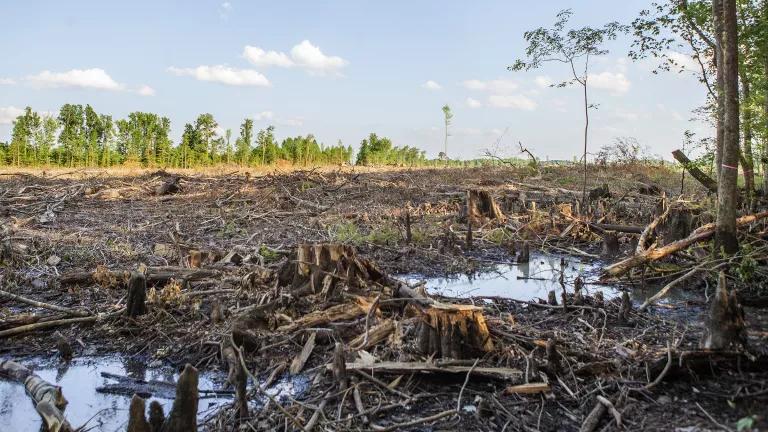
A clearcut forest along Potocasi Creek, a wetland and bottomland forest in North Carolina
Dogwood Alliance


New research by NRDC shows that the U.K. government’s plans to use bioenergy with carbon capture and storage (BECCS) to help meet its climate goals will actually increase greenhouse gas emissions and require the logging of millions of hectares of forest. Instead of being a climate solution, this would be devastating for our climate and the biodiversity crisis. BECCS is so bad for the climate that it could prevent the United Kingdom from reaching net zero emissions.
Industry experts claim that bioenergy, which includes burning wood as a way to produce energy, is a carbon-neutral energy source. Thus, they assert, if you add carbon capture and storage—capturing the carbon released at the smokestack and burying it—the entire process becomes carbon negative, removing more carbon from the atmosphere than it adds.
However, this is a false—and dangerous—premise.
In reality, BECCS increases carbon dioxide in the atmosphere in three ways:
- Even with the best CCS technology, at least 10 percent of the carbon dioxide released at the power station could escape into the atmosphere.
- Harvesting, processing, and transporting wood generates carbon dioxide that cannot be captured at the power station.
- The U.K. assumes that logging to produce bioenergy has no impact on forests and their capacity to store carbon. But this capacity is actually reduced for several decades until trees regrow, which must be counted as a positive emission.
Learn More
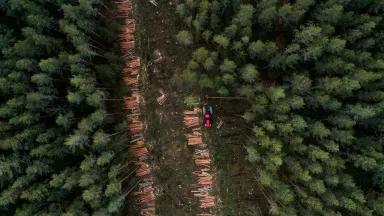

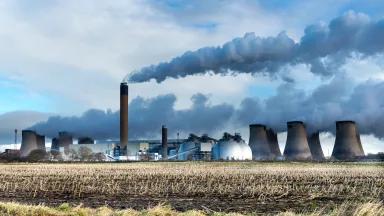
NRDC’s new modeling estimates carbon emissions under three different scenarios for procuring biomass, involving different levels of destructive clearcutting (high, medium, and no clearcutting). Even under the “no clearcutting” scenario, BECCS was carbon positive and contributed to climate change. In fact, when proper carbon accounting is employed, the cumulative emissions from BECCS alone could surpass the U.K.’s total emissions from all other sources by the late 2040s.
Moreover, providing biomass to feed projected U.K. demand through 2050 would require up to 18 million hectares of land. That’s more than half of all the timberland in the U.S. Southeast, where the vast majority of the U.K.’s wood pellets come from. Not only would this destroy crucial forest habitat for imperiled species, such as the chimney swift, but it is simply not realistic to think that the U.K. would ever be able access that amount of wood. This would leave the U.K. dangerously dependent on alternative fuel imports, further threatening energy independence.
Finally, the wood pellet mills needed to create biomass produce air and water pollution and harm already vulnerable communities—which would worsen if the U.K.’s BECCS reliance rose to current projected levels. In particular, in the U.S. Southeast, pellet mills harm the health of impoverished communities of color by releasing dangerous air pollutants into the air.
What does all this mean for the U.K.’s climate and energy plans? The new Labour Party government can draw some simple conclusions:
- BECCS is not carbon negative. The U.K. cannot pretend that it is on track to reach net zero using fictional negative emissions.
- The U.K. must not extend bioenergy subsidies past 2027. Bioenergy companies are asking for billions of dollars in extended subsidies to give them more time to develop carbon capture. The government must say no. To do otherwise would be a huge waste of public money and make it more difficult for the U.K. to reach its climate goals.
- In order to meet the Labour Party’s 2030 clean power goals, the U.K. government should instead direct funds to technologies that have been proven to cut emissions and reduce people’s energy bills. Research from the University of Oxford shows that the U.K. could power itself several times over from wind and solar alone (using battery storage) and does not need BECCS to generate enough electricity. Redirecting money that would be wasted on biomass could instead insulate more than 400,000 of the U.K.’s cold and drafty homes.
- The U.K. must invest in genuine pathways to net zero, including reducing greenhouse gas emissions in even the toughest sectors, like farming and aviation.
The world’s forests are rich in nature and carbon. The best thing for our climate is to leave them standing. Cutting them down, burning them, and capturing the carbon makes climate change worse.
Bioenergy with carbon capture and storage is a bad bet—one that would cost the British public billions and cost the new Labour government its reputation on nature and climate change.
Related Resources

United Kingdom Hands Billions More in Subsidies to Drax for Tree-Burning Bioenergy

Drax Coming for California Forests by Partnering with GSNR
