
Funding and Financing Voluntary Buyouts and Relocation: Going Beyond Federal Grants
This report describes several mechanisms that states or local governments could use to fund and finance home buyout programs to reduce risks from natural hazards, such as flooding, wildfire, and severe storms.
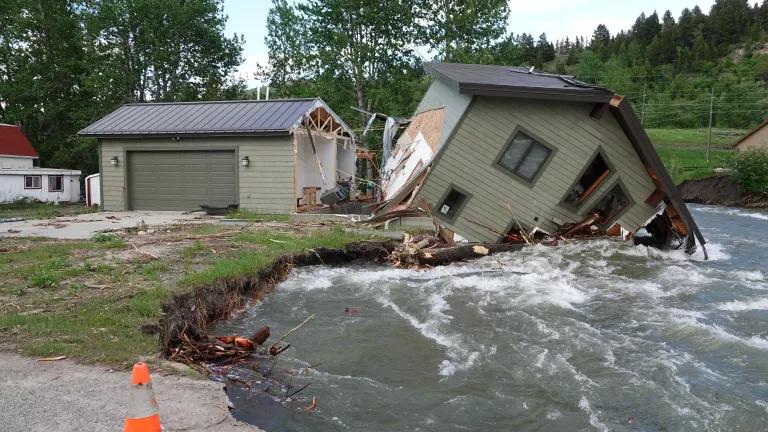
A home collapsed into a flooded creek in Red Lodge, Carbon County, Montana

Coauthored with Grace Rogers, manager of Climate Resilient Coasts and Watersheds, Environmental Defense Fund
As extreme weather events become more common and cause more damage, there is a growing realization that people may need to leave a home or a neighborhood that is particularly vulnerable (e.g., an area threatened by sea level rise, chronic flooding, or wildfires). Increasingly, communities and states are instead buying such high-risk homes and converting them into parkland and open space. These lands can then become an integral part of lowering risks from flooding, wildfire, or other natural hazards. We refer to such projects as “buyouts.”
While most buyouts in the United States have been associated with efforts to address flooding, they are increasingly being considered to assist people who are seeking to escape other hazards, particularly wildfire. And while historically, most funding for buyouts came from federal programs, there is rising uncertainty around the availability of federal funds for buyouts.
Given this, NRDC and Environmental Defense Fund (EDF) jointly authored a new report that highlights ways that local and state government can finance these buyout programs. The report, Funding and Financing Voluntary Buyouts and Relocation: Going Beyond Federal Grants, examines six funding and financing mechanisms that could be used to cover the broad suite of costs associated with buyouts.
“Buyouts are an increasingly important way to help people relocate to safer locations,” says Rob Moore, a director within NRDC’s Climate Adaptation division. “They not only allow high-risk property owners to move somewhere safer, but the newly acquired properties can become part of the community’s longer-term climate resilience plans.”
LEARN MORE


The funding mechanisms identified in this report could complement the use of federal grants (e.g., providing additional services to participants that federal grants may not cover) or even replace federal funds entirely. They could be used individually or in combination to provide a “financing stack” that can cover the costs to acquire hazard-prone properties as well as demolition, remediation, and ecological restoration of the acquired sites. Additional funds can also provide financial incentives to stay in lower-risk areas within the same community, assistance to cover moving costs or downpayment assistance on a new home, and other needs that buyout participants may have when relocating to a new home.
Funding and financing buyouts: Going beyond federal grants
While the majority of buyouts in the United States have historically been largely funded by grants from the Federal Emergency Management Agency (FEMA), the U.S. Department of Housing and Urban Development, and other federal agencies, the Trump administration has slashed funding from these programs and for climate resilience and hazard mitigation efforts more generally.
Even prior to the new administration, federally funded buyouts could be challenging to execute because of the long timelines involved in applying for and receiving funds; compliance with various federal requirements, reviews, and analyses; narrow eligibility criteria; and what can be a complex grant management process.
In the face of this uncertainty, communities and states should be considering how they might be able to offer buyouts to residents who need to relocate and how they might build these efforts into larger resilience planning and projects they are considering. This report from NRDC and EDF highlights six mechanisms that were identified as viable ways of financially supporting a buyout program that could complement federal funding or even replace federal funds entirely.
Municipal bonds can serve as a funding source for buyout programs by providing up-front capital to purchase disaster-prone properties and reduce long-term disaster risk. Bonds allow a community to raise significant funds relatively quickly, often at lower interest rates due to their tax-exempt status.
Fees of various kinds are used to fund local government programs and operations. Communities have used local fees and taxes to support a range of resilience, conservation, and other community objectives.
Parametric financial instruments could be used to secure fast and flexible dollars post-disaster to pay for buyouts and related expenses. These are financial tools that operate like insurance in that equivalents to premiums are paid each year and funds are released to the purchaser after certain qualifying disasters.
In 2022, Congress provided five years of funding to capitalize state-specific, low-interest revolving loan funds that support a wide array of flood mitigation and resilience project types.
Typically administered by state environmental agencies, Clean Water State Revolving Funds (CWSRFs) could serve as a source of financing for post-buyout land restoration, depending on the post-acquisitions plans for those parcels.
A property owner is typically most interested in relocating in the aftermath of a flood, fire, or storm that causes damage to their home. If the owner is entitled to an insurance payout from FEMA’s National Flood Insurance Program or a private insurance company, it may be possible for a buyout program to use the payout to offset the purchase price of the property.
This report is not intended to be a comprehensive inventory of all the ways that communities have funded buyouts or could fund buyouts. NRDC and EDF have identified funding and financing mechanisms that have been used successfully before (e.g., bonds, fees) and others that have yet to be deployed for buyouts (e.g., parametric products) but hold great promise for supporting such projects and related activities.
The reality is that climate change is causing people to rethink where they live, and most people do not have the resources to relocate without some level of assistance. To support residents with the costs of relocating, state and local governments need to use familiar tools in new ways or deploy new tools to generate a diverse set of funding and financing resources.
We hope this publication will help local and state governments looking for ways to financially support buyout programs to help their residents move out of harm’s way and to safer, more resilient locations.
Related Resources

The Insurance Affordability Crisis: Risks, Resilience, and Solutions
Occupational Heat Safety Standards in the United States