
Untangling the Way Forward for Responsible Offshore Wind Energy
This new report offers recommendations for reducing marine life entanglement risks.

A humpback whale breaching near Morro Rock in Morro Bay, California


Offshore wind is a key part of the U.S. clean energy transition, given the powerful winds off our coasts and their ability to generate power when solar sources are offline. Offshore wind will also play an important role in renewable energy portfolios around the world, with several countries in Europe and Asia making significant investments in the technology. Our recommendations aim to advance responsible offshore wind development: As more offshore wind is deployed, it is important that construction and operations be conducted in ways that do not endanger marine life.
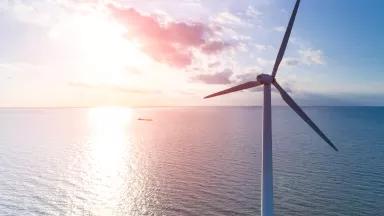
Wind energy is most abundant in areas with water depths greater than 60 meters; this will require floating offshore wind systems that use large cables to anchor to the seabed and transmit the captured energy to shore, as opposed to fixed foundations. These anchoring and transmission cables create the risk of entanglement with marine life, like whales and sea turtles.
Learn More
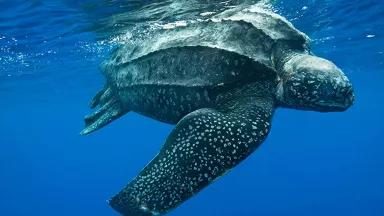
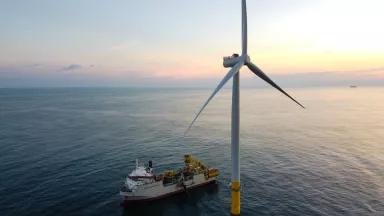
While there have been no documented cases of marine life entanglement in floating offshore wind systems to date, the entanglement risks posed by industrial activities using similar infrastructure suggest that the same risks will apply to floating offshore wind. For some protected species—like the endangered North Atlantic right whale or Southern Resident orca—entanglement impacts could have negative consequences on the whole population. It is therefore essential that all floating offshore wind developments include proactive measures to reduce entanglement risks and protect marine species.
Addressing entanglement risk has two essential components: monitoring and mitigation
Our report presents an overview of technologies that are currently available for monitoring entanglement risk. Effective real-time monitoring can detect entangled wildlife and alert response crews. Long-term monitoring can also provide valuable information on how, where, and why entanglements occur, and which species of wildlife are most vulnerable.
Presently, there are a range of existing technologies with the potential to support continuous and frequent monitoring for entangled wildlife and ensnared marine debris in floating offshore wind infrastructure. Existing monitoring technologies include:
- Load cell sensors, which automatically detect increases in weight or pressure on an underwater cable caused by an entangled animal or debris
- Cable inspection systems, which use small robots to inspect cables
- Sonar technologies, which use sound pulses to detect entanglements and marine debris ensnared on offshore wind infrastructure
- Underwater vessels, such as remote operated vehicles and autonomous operated vehicles, which are already in use and can be used to conduct inspections of underwater lines and other infrastructure
However, further research and development are needed to adapt these technologies for floating offshore wind systems.
Our report also recommends best practices for mitigating entanglement risk at all stages of floating offshore wind development, from the early phases of designing and planning through energy generation to the eventual decommissioning of turbines.
While we focus on the U.S. regulatory landscape, our monitoring and mitigation recommendations could be adapted to regulatory regimes in other countries.
Offshore wind development is needed to power the clean energy transition and prevent some of the worst impacts of climate change, but it cannot come at the expense of wildlife. By integrating monitoring technologies into offshore wind developments and committing to strong mitigation measures, we can ensure the responsible and sustainable development of offshore wind.
Related Resources

Setting the Record Straight About Offshore Wind and Whales

Administration Aims to Protect Right Whale, Advance Wind
