
7 Ways to Flood-Proof Your House
As floods become more frequent and severe with climate change, protecting your home becomes even more crucial. Here’s how to assess your risk—and make sure you’re prepared for the worst.

Storm clouds over a home near Meers, Oklahoma
Robert MacDonald/Associated Press
Rising sea levels, heavier and more frequent downpours, and a national landscape paved with asphalt are making homes more vulnerable to flood damage than ever before. In 2024, the United States weathered several record-breaking hurricanes originating in the Atlantic Basin, while major flooding events inundated parts of the Midwest and Northeast.
“Often, these are impacting areas where people think they’re safe from flooding,” says Joel Scata, senior attorney with NRDC’s Environmental Health program. That was certainly the case for Asheville, North Carolina—once branded a “climate haven,” the city was devastated by the torrential rains brought by Hurricane Helene last fall. “While not everyone lives in a high-risk area, everyone lives in a potential flood zone,” Scata says.
To make matters worse, a recent study found some of the largest cities around the country are sinking from pumping out too much groundwater, which could worsen flooding in already vulnerable areas.
Catastrophic flooding can rip homes from their foundations, but even relatively minor flood damage, like a wrecked hot water heater, can cost thousands of dollars to repair. Nevertheless community members and homeowners do have some ways to mitigate the damage.
1. Evaluate your risk
Homeowners and renters can begin gauging their current flood risk by visiting Floodsmart.gov, the website of the National Flood Insurance Program (NFIP). This federal program sets flood insurance rates using FEMA’s Flood Insurance Rate Maps, which show a community’s base flood elevations, flood zones, and floodplain boundaries. Any home within a so-called 100-year floodplain—an area with a 1 percent chance of flooding in any given year—is deemed at risk.
Learn More


But “FEMA maps should be a starting point, not an end point, in your research,” cautions Chad Berginnis, executive director of the Association of State Floodplain Managers. The maps haven’t kept pace with climate change, and “at best, FEMA has mapped maybe a third of the floodplains in the country,” Berginnis notes. But there are other sites out there with public data about the home or neighborhood you’re considering—use them to your advantage. For example, First Street Technology offers a free snapshot of projected flooding risks, among other climate risks, for properties around the country.
If you’re considering buying a home, as part of evaluating the overall climate risks, find out whether the property has ever been flooded. Some states require real-estate records to include that information (find out if yours does with NRDC’s flood disclosure scorecard).
Better yet, Berginnis says, “Ask the neighbors, especially if they’ve been there for decades, whether there’s been flooding in the area.” If so, proceed with caution: A new study commissioned by NRDC found that homebuyers who purchase a previously flooded home can incur on average $55,000 in flood damages over a typical 30-year loan period.

A home in Houston flooded by Hurricane Harvey, 2017
2. Buy flood insurance
If you live within a 100-year floodplain, flood insurance is a must. Anyone with a federally backed mortgage who lives in a flood zone is required by law to carry insurance. People in high-risk areas often assume that government-issued disaster assistance will cover the cost of damage from a flood. In fact, Scata says, emergency funds are seldom adequate, and standard insurance policies don’t cover water damage caused by extreme weather. Moreover, “there’s a false assumption that if you live outside a flood zone, you don’t need insurance,” he says. “But 40 percent of flood insurance claims are made by people who live beyond those zones.”
Berginnis recommends that everyone, including apartment dwellers, have at least enough flood insurance to cover the contents of their homes. It’s also important to note that this is a separate policy from most standard homeowners’ and renters’ insurance policies, which do not cover flood damages. You can use FEMA’s policy quoting tool to get a quote on flood insurance premiums, which can also give you a sense of the property’s flooding history.
3. Elevate your boiler and reconsider your ground-floor and/or basement decor
Utilities, boilers, central air-conditioning units, and other HVAC equipment normally located at the lowest level of a home are particularly vulnerable to flood damage. Consider bringing them to higher ground, either by building platforms, if your flood risk is minimal, or by moving them to another floor. Your insurance agent and a contractor can advise on logistics and cost.
It’s worth considering making other modifications, too, in the lowest level of your home to mitigate damage in the event that floodwaters do enter. A few ideas: Swap out any carpets with waterproof tile, vinyl, or rubber to prevent mold; change out your traditional drywall with paperless drywall, cement, or decay-resistant wood; and replace any wooden cabinets, doors, and window frames with ones made out of metal or other water-resistant materials.
Learn More

4. Install a sewage water backstop
Cities that deal with persistent and costly stormwater flooding, like Chicago, have various municipal programs to fund the installation of backflow prevention valves and other devices that keep overtaxed sewer mains from backing up into basements. If your basement floor drain backs up after heavy rains, consider installing one of these devices with help from a licensed plumber.
5. Change your landscaping
Porous outdoor surfaces and other types of green infrastructure help water seep into the ground instead of streaming toward your home. Consider digging depressions known as swales to channel stormwater runoff away from your house, or converting concrete or asphalt driveways to gravel or brick.
Try using absorbent mulch in your garden to help manage heavy rain and reduce potential flood damage. Even placing a rain barrel beneath a gutter downspout can allay basement flooding. (As a bonus, all of these tactics can also help reduce flooding and pollution of local waterways.) And remember to regularly clean out your gutters, drains, and ditches from debris buildup.

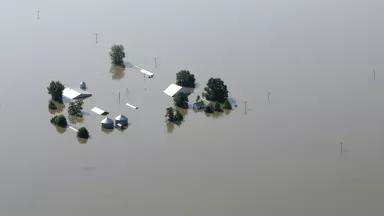
Flood damage in northeast Arkansas, 2017
6. Consider relocating
“It can be hard to contemplate moving, but sometimes it’s the best option, especially for people in coastal communities facing sea level rise,” Scata says. If you can move preemptively, you could save tens of thousands of dollars in repair costs, save on skyrocketing insurance costs, and avoid the trauma of repeated flooding and rebuilding.
If your home is vulnerable to flooding, check with your regional FEMA office to see if you’re eligible for a buyout program for repetitive loss properties. In some cases, the government will even buy a house for its pre-disaster market value. This helps move people out of harm’s way, reduces the drain on flood management resources, and prevents a new house from being built on that site in the future (the land is usually returned to a natural state).
7. Demand change
Even with the realities of climate change, government agencies are still looking to the past to predict the flooding of the future. “That’s like driving down a highway and mapping your route by looking in the rearview mirror,” Scata says. Contact your community or county emergency management office to urge local officials to support more sustainable development, including public landscapes with natural and water-permeable surfaces and smarter urban stormwater infrastructure. “There’s only so much one person can do alone,” Scata says. Our collective efforts are indispensable to making our communities more resilient.
This story was originally published September 28, 2016, and has been updated with new information and links.
This NRDC.org story is available for online republication by news media outlets or nonprofits under these conditions: The writer(s) must be credited with a byline; you must note prominently that the story was originally published by NRDC.org and link to the original; the story cannot be edited (beyond simple things such as grammar); you can’t resell the story in any form or grant republishing rights to other outlets; you can’t republish our material wholesale or automatically—you need to select stories individually; you can’t republish the photos or graphics on our site without specific permission; you should drop us a note to let us know when you’ve used one of our stories.
What Are the Solutions to Climate Change?
1.5 Degrees of Global Warming—Are We There Yet?
How to Find Relief During Summer Heat Waves in the City