
Climate Change Is Flooding Vermont—Who Should Pay for It?
In mountain valleys and riverside villages, residents bail out their homes and businesses—and hope that fossil fuel companies can help cover the costs.

Flooding in downtown Montpelier, Vermont, July 2023
The nation’s smallest capital, Montpelier, Vermont (population: 8,000) has always been flood-prone. A tributary flows into the Winooski River at the very center of this quaint New England town, and both waterways are fed by rain and snowmelt coursing down from the Green Mountains. When it’s stormy, local businesses owners almost expect to take on a little basement water. One retailer, Onion River Outdoors, has been welcoming volunteers into its cellar to shuffle skis and bikes safely out of pooling rainwaters since the early 2000s.
On the evening of July 10, 2023, though, Onion River co-owner Jen Roberts started hearing from volunteers who were panicking amid excessive rain. “The water’s at waist level. It’s still coming up,” they wrote in texts. “It’s higher now.”
That night, the water rose much higher than Roberts had ever seen in her 20-year association with the store. She wondered if the building’s ancient brick wall would collapse and crush the volunteers. “What’s in the water?” she asked herself. “Electrical lines? Sewage?”
The volunteers evacuated. The river inundated the basement, then lapped at the first floor of the store itself.
Residents are used to pulling together to help out their neighbors like Roberts, but they’re also increasingly frustrated with shouldering the costs for the consequences of climate pollution. Soon, though, it may be possible for places like Montpelier to get help from the fossil fuel industry in footing the bill—specifically for climate adaptation projects that would help communities protect themselves from the effects of a warming world.
LEARN MORE

Across the street from the outfitters shop, Wes Hamilton was terrified. Just a week before, the 46-year-old co-owner of the Three Penny Taproom had completed a $200,000 renovation of his swank bar and grill. The flood didn’t care. The water kept surging, and it was disconcertily brown—loaded, as Hamilton notes, with “whatever people had in their septic tanks, in the oil tanks in their basements.”
In the end, the floodwaters rose to more than three feet inside Hamilton’s bar and, days later, when they receded, they left behind a stinky silt. Everything in the Three Penny was ruined. “Dishwashers, ovens, refrigerators,” Hamilton recalls grimly. “Tables, chairs, food, napkins, paper towels, beer, wine, silverware, plates.”
Hamilton incurred losses of more than $300,000, as did Onion River. His flood insurance covered about $100,000, and he had to eat the other $200,000-plus. But he asked himself, “Why am I paying for this?”
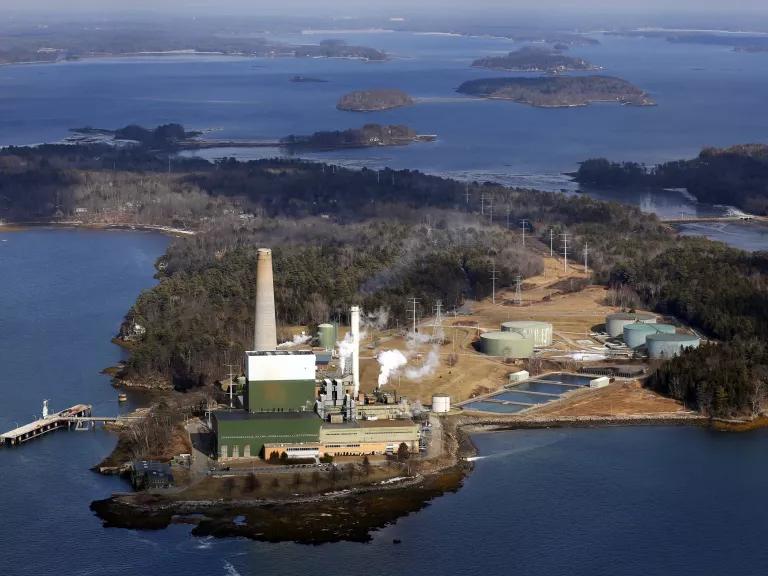
The fossil fuel–powered Wyman Power Station on Cousins Island in Yarmouth, Maine
Climate Superfund Act
Altogether, the 2023 disaster caused upward of a billion dollars in damages statewide, and Montpelier has flooded twice since then. In fact, the Northeast has seen the largest increase in extreme precipitation events in the United States, across all seasons. According to the Fifth National Climate Assessment, the number of such storms increased by nearly 60 percent between 1958 and 2022.
Peer-reviewed research has also made clear the cause: greenhouse gas emissions. Taking it a step further, an April paper in the journal Nature pins the climate crisis on more than 180 producers of fossil fuel and tallies how much each offender has cost humankind—for heat waves, flooding, and wildfires. The authors found, for instance, that from 1991 to 2020, Chevron alone very likely wrought between $791 billion and $3.6 trillion in heat-related losses.
In other words, the actions of the fossil fuel industry were roiling the Winooski and so many other waterways in a state defined by its steep mountain/narrow valley topography and bisected by more than 7,000 miles of rivers.
NRDC senior attorney Kimberly Ong connects her firsthand experiences of the climate crisis to her current work, both defending and helping to pass new laws in the United States that keep large oil and gas companies financially accountable for the local impacts of climate disasters.
In 2024, Vermont created a Climate Superfund law, which would require large fossil fuel companies with sufficient connection to Vermont (for example, doing business there) to pay into a state-managed fund that would be used to build climate adaptation projects, like flood-proofing the basements of Montpelier. New York State has launched a similar polluters pay program, and several other states are considering similar models.
So far, however, no state has gathered a single penny: Both the Vermont and New York laws require a years-long administrative process before asking fossil fuel companies to pay into the funds. Yet the carbon-intensive behemoths are already fighting in court, fearful that Vermont or New York could set precedent. Regarding the “Green Mountain State,” the American Petroleum Institute, a trade association for the fossil fuel industry, has partnered with the U.S. Chamber of Commerce to ask a federal judge to shut down the Climate Superfund law before it is implemented. (The Trump administration and a group of states led by West Virginia have also sued Vermont over the law.)
In response, the state of Vermont and lawyers from NRDC—representing two nonprofits, the Conservation Law Foundation and the Northeast Organic Farming Association of Vermont—have asked the court to dismiss the lawsuits and uphold the law.
NRDC attorney Addie Rolnick calls the fund “a simple exercise of state sovereignty.” Vermont, she says, “is just protecting the health and safety of its citizens. That’s what states do.”
The initial briefing in the Vermont case will conclude in early 2026, but the legal battle could grind on for years. The case may in time even reach the U.S. Supreme Court. This means that, without the adaptation projects the law would fund, thousands of everyday Vermonters—people like Hamilton—may have to keep shelling out for climate-induced destruction for the foreseeable future.
But many refuse to stay silent as climate change puts their homes, farms, businesses, and lives in harm’s way. In its legal filing to the court, NRDC included the written declarations of Hamilton, Allison Palmer, Andy Jones, and other Vermonters. Some of their stories, along with Peter Young's, are below.
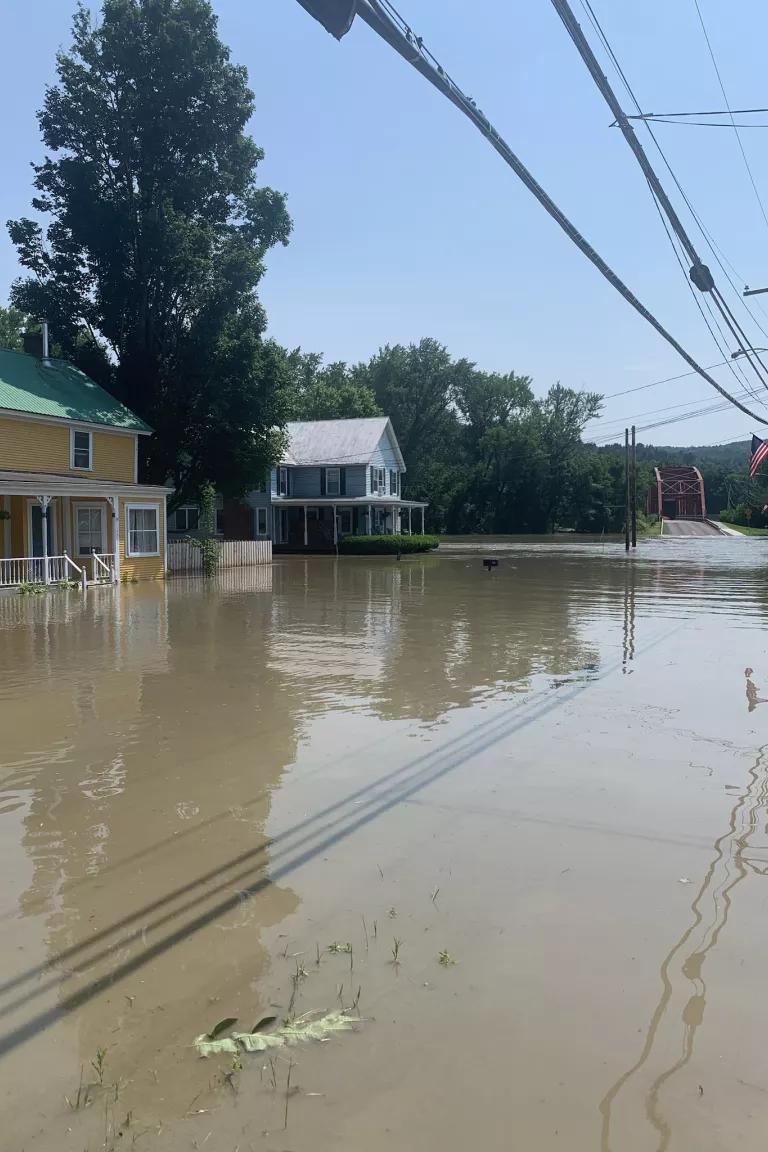

From left: Allison Palmer and her husband, Nate, had to evacuate their home (the blue one pictured on the left) on multiple occasions due to flooding in 2023; a flooded bridge over the Winooski River and the Richmond Village neighborhood in Montpelier, Vermont, where Palmer lives.
“We can’t sell the house.”
In 2022, as Allison Palmer and her husband, Nate, a mechanical engineer, looked for a home where they could grow their young family, a real estate ad caught her eye. The circa 1900 charmer was for sale “in the heart of Richmond village,” a famously tight-knit community that hosts Friday dinners that are open to all. It sat “bordering the Winooski River,” according to the ad, “with its own sandy beach. Enjoy kayaking, tubing, swimming, and fishing from your backyard!” When Palmer spoke to the home’s aging seller, he reported that his family had been there for 80 years and had experienced only one minor flood.
Ten months after her family moved in—and just days before Palmer was due to give birth to her second child—the July 2023 flood hit. She stood at the window watching water rise over a bridge on the river. Then it engulfed her basement and continued gushing up toward the first floor. At two in the morning, firemen arrived in boats to evacuate Palmer, Nate, and their two-year-old daughter. Ultimately, Palmer spent four days away from home—first at a hotel, then at a friend’s. When she finally brought her newborn son home, there still wasn’t any electricity or running water.
Then another flood hit five months later, in December 2023. This time, it was even scarier, as driving rain hit packed snow, melting it. Rain-on-snow events, which are also becoming more frequent in New England, severely complicate forecasts for flood levels.
As Nate obsessed over online reports from river gauges, it became clear that forecasters’ predictions were way off. The river was coming on fast toward their house and, Palmer says, “We had no concept of what was happening, and it was cold.” Again, the river swamped the basement, and again, they evacuated for days. Another flood came seven months later, throwing them out of the house a third time.
Nate recently built a hip-high retaining wall to stall river water on the lower side of the house, but it affords only minimal protection. By now, Palmer is certain that climate change has attacked her financial standing. After the December flood, her neighbors sold their house. They got only half of what they had paid for it.
“We can’t sell the house,” Palmer says. “We’ve decided to stay. But we do know that another flood could make the house unlivable. All we can do is hope.”

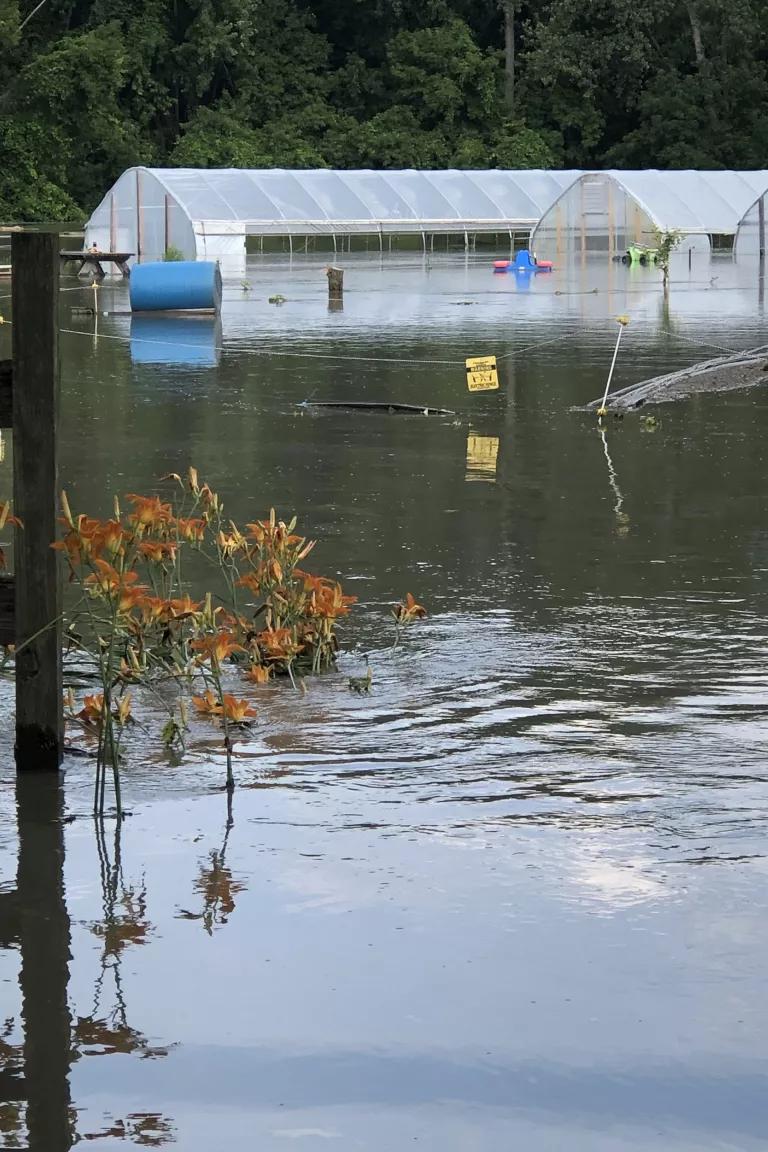
The 25-acre Intervale Community Farm, managed by Andy Jones, in Burlington, Vermont, was flooded in July 2023.
“The potential is there for us to lose everything.”
Farmer Andy Jones is a tall, lean man with a habit of pulling off his eyeglasses and wrinkling his broad brow, quizzically, whenever the subject at hand becomes nuanced. “We’re in the Winooski River floodplain,” Jones says of the 25-acre Burlington-based Intervale Community Farm, which he’s managed since 1993. “And there are great reasons to farm in a floodplain. It’s flat. It’s sandy. It’s stone-free, unlike a lot of New England soils. But of course, it floods here. It always has. What’s changed is the gravity of the consequences.”
When the first 2023 flood hit, it wiped out $200,000 worth of crops, about a quarter of the annual income for the farm, which shares its produce with subscribing members. Jones had never seen a flood do anywhere near that much damage. “Now,” he says, “the potential is there for us to lose everything—all of our crops, in the field and even in the greenhouses.”
In the hopes of preventing that outcome, Jones has spent about $100,000 on climate-specific infrastructural updates. There are now two production greenhouses that remove the crops from the weather, for instance. The farm crew also built a new storage structure, flood-proofing it with marine plywood, closed cell foam, and sheet metal; riprap envelops the building’s foundation.
Will this be enough? That, says Jones, “is the question that keeps us all awake at night—our workers, the members who buy our produce.” And together, he adds, “we can tell the story about the businesses and the people who caused climate change.” He pauses, explaining that he means the executives heading fossil fuel companies. “For so long, they worked day and night to bury the problem, to obfuscate, to deny. And that’s just wrong.”


Clockwise from top left: Debris and mud caused by flooding damage in a home in Great Brook, Plainfield, Vermont; mud covering the stairs of Peter Young's home in Great Brook, Plainfield, Vermont, after flooding in 2023; mud also damaged the lower level of Young's home.
“We’re on the edge of being a ghost town”
Great Brook, in Plainfield, is approximately 8 miles long, and on most days, it’s but a narrow trickle as it passes the home of Peter Young, a retired theater teacher. The stream makes for pleasant background music in a small village (population: 1,250) that boasts its own opera house, with live plays and jazz shows.
On the one-year anniversary of the 2023 flood, though, a localized rain squall welled up near the brook’s headwaters, on the slopes of nearby Spruce Mountain. Four inches of rain fell in just a few hours. The brook swelled and scoured its banks, freeing trees from their roots. Then a mobile home shook loose and began bobbing downstream.The trailer smacked into the bridge beside Young’s house. Before long, downed trees piled atop it, and the mobile home ruptured the bridge, releasing the pond that had welled up behind it. The gushing water slammed into a beloved eight-unit apartment building nicknamed the “Heartbreak Hotel.” A wall of the building soon tore free and floated away.
Three additional homes washed down the Great Brook that night. Twenty-seven more bore damages when the brook receded, leaving its sludge.
On a recent dry, sunny day nearly a year later, Young picks his way through the wreckage, pointing at the abandoned houses. “These people were our friends,” he says, “and they left. And”—he points at another flood-ravaged home—“they left as well.”
No one is out in the street. Chunks of concrete and the great, gnarled branches of uprooted trees still sit brookside. “We’re on the edge of being a ghost town,” says Young. “It’s depressing, and I don’t know if Plainfield can come back.”
Several homeowners, Young says, are awaiting buyouts from the Federal Emergency Management Agency, but those government checks could take years to materialize, if they ever arrive. And there are more immediate questions. “Who’s going to clean up the debris that the flood left around these houses?” Young asks. “Who’s going to tear down the houses that were wrecked? The town doesn’t have the money for that.”
This NRDC.org story is available for online republication by news media outlets or nonprofits under these conditions: The writer(s) must be credited with a byline; you must note prominently that the story was originally published by NRDC.org and link to the original; the story cannot be edited (beyond simple things such as grammar); you can’t resell the story in any form or grant republishing rights to other outlets; you can’t republish our material wholesale or automatically—you need to select stories individually; you can’t republish the photos or graphics on our site without specific permission; you should drop us a note to let us know when you’ve used one of our stories.
Introducing Polluters Pay Laws—a New Tool for Climate Adaptation
How EPA Rollbacks Will Cost Us—in Dollars and Lives
What Are the Solutions to Climate Change?