Introducing Polluters Pay Laws—a New Tool for Climate Adaptation
As states begin to pass “climate superfund” bills, here’s a closer look at what they do and why we need them.

Florida homes destroyed by Hurricane Ian—the costliest hurricane in Florida's history, with estimated losses of around $112 billion, October 1, 2022

We are all paying the price for climate change. In monetary terms, the National Oceanic and Atmospheric Administration estimated that last year’s 27 weather and climate disasters amounted to nearly $182.7 billion in damages. That figure doesn’t even touch costs associated with damages to the natural environment, health care, or supply chain interruptions—nor does it include how much it would cost to prevent, through climate adaptation efforts, such destruction from occurring again. After all, such events are increasingly commonplace, and the lengthy, expensive process of rebuilding in the aftermath, along with infrastructure improvements to abate future damage, currently falls on the shoulders of state and local governments and, of course, taxpayers.
That’s why several states across the country have introduced polluters pay legislation, also referred to as “climate superfund” bills.
These bills aim to hold large fossil fuel companies financially accountable for a share of the local costs of responding to the climate crisis. Modeled after the federal Superfund program that deals with toxic waste sites, they seek to establish state funds to pay for a variety of climate adaptation projects. In doing so, they would not only offer some physical protection but also ease the sizable financial strain that climate pollution puts on communities.
NRDC senior attorney Kimberly Ong connects her firsthand experiences of the climate crisis to her current work, both defending and helping to pass new laws in the United States that keep large oil and gas companies financially accountable for the local impacts of climate disasters.
How do polluters pay laws work?
These laws are not punitive. They instead seek to correct an imbalance where taxpayers and local governments too often end up paying for the financial consequences of climate pollution caused by fossil fuel companies.
Once collected, the money goes into a state-managed fund to be used for climate adaptation initiatives. Given the wide-ranging impacts of climate change, such projects could include restoring stormwater and drainage treatment systems that help control runoff or adding green spaces to urban areas that are prone to the heat island effect. They could protect coastal wetlands or elevate and retrofit older buildings. The idea is to proactively invest in community protection measures before the next disaster strikes, and thus, fend off some of the worst damage.
How do these laws affect climate policy?
They don’t. Polluters pay laws do not change, limit, or regulate how much climate pollution companies can emit. The current climate superfund laws address only costs for local adaptation efforts.


From left: A rally in New York to push for passage of the Climate Change Superfund Act, outside Governor Hochul’s office in Albany, November 29, 2023; activists delivering more than 127,000 petition signatures to Governor Hochul at her office in Manhattan, demanding she sign the Climate Change Superfund Act, September 24, 2024
Ayman Siam/Office of NYC Comptroller
; 2)Loren Matthew/AP Content Services for Fossil Free Media
Which states have passed polluters pay laws?
So far, only Vermont and New York have put these laws on the books, but 11 other states are working on similar legislation: California, Connecticut, Hawai'i, Maine, Maryland, Massachusetts, New Jersey, Oregon, Rhode Island, Tennessee, and Virginia.
Vermont became the first state to pass its version of the law, called the Climate Superfund Act, last year. The law applies to fossil fuel companies that are responsible for more than a billion metric tons of greenhouse gases, based on extraction and refining activities between 1995 and 2024, and that have sufficient connections with the state of Vermont (for example, selling their products there).
The program would require the state treasurer and Vermont’s Agency of Natural Resources to figure out what those emissions cost the state. The agency would also determine the amount of emissions attributable to each fossil fuel company and calculate what it would owe to the recovery program fund.
Governor Kathy Hochul signed New York's version into law just a few months later. While the laws of the two states are similar, New York, unlike Vermont, has already specified how much it plans to recoup from fossil fuel companies: a total of $75 billion—a fraction of the costs to the state. Just like Vermont’s program, New York’s law only concerns companies that had sufficient contacts with the state and that can be attributed with more than a billion tons of greenhouse gas emissions between 2000 and 2024. The first set of payments is scheduled to begin in 2028.
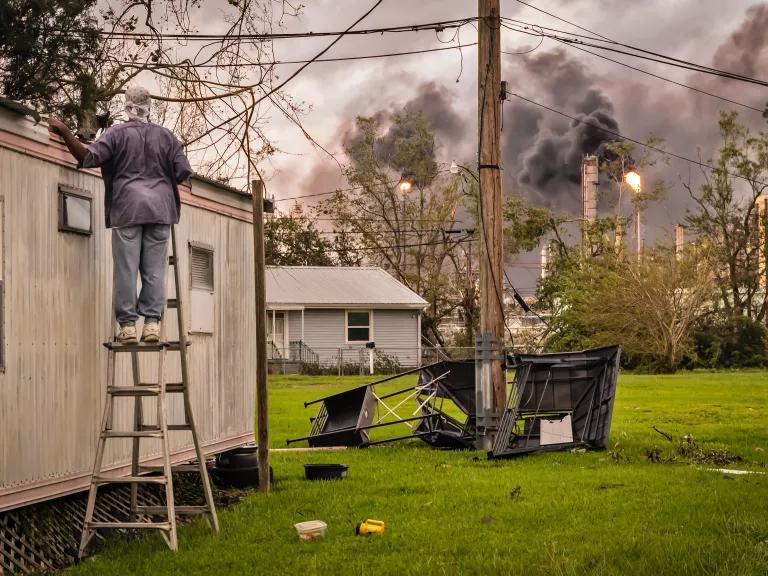
A resident repairing damage on a property in an area known as Cancer Alley in Baton Rouge, Louisiana, following Hurricane Ida in September 2021
Why do we need these bills?
Anyone who has ever had to pick up their lives after a climate disaster—be it from fire, water, or wind—knows just how arduous such recovery processes are. The high costs of improving infrastructure in order to lessen future damage can be a huge, and often unsurmountable, financial hurdle for local governments and residents.
Making matters worse, when communities are hit hard, businesses can be ruined, jobs are lost, and economic growth is stalled. One report found that the 2023 northeastern floods, a series of flash floods that hit New York and Vermont the hardest, caused $2.2 billion in damages. More than 800 businesses reported damage in Montpelier, Vermont, and the small capital city was still struggling to recover a year later. Overcoming from economic tolls like these, on top of the emotional trauma, can take communities years, if not longer.
States have a direct interest in working to protect the health, safety, and general welfare of their residents from climate disasters. A 2024 study from the U.S. Chamber of Commerce, the U.S. Chamber of Commerce Foundation, and Allstate calculated that every dollar spent on resilience-building and preparedness can save communities $13 in post-disaster cleanup costs and economic impacts. This could add up to billions of dollars saved per climate disaster. Looking at 25 models of different disaster scenarios, the researchers found that early investments can significantly decrease cleanup and recovery costs—no matter the type of weather event, its size, or the size of the city.

The Marathon Petroleum–owned Tesoro oil refinery in Carson, California
What obstacles do polluters pay laws face?
Mainly lawsuits. Vermont is involved in two legal challenges: one from the U.S. government, the other from the U.S. Chamber of Commerce and the American Petroleum Institute, in which 24 Republican-led states have intervened. Meanwhile, New York faces three separate cases: one from the U.S. government; another from the Chamber of Commerce and American Petroleum Institute; and a third from a group of 24 Republican-led states.
One argument that the lawsuits share is a claim that the polluters pay laws intrude into federal affairs. Yet, as stated before, these state laws do not, in fact, regulate emissions; they only allocate some of the costs of funding local infrastructure to large fossil fuel producers and do not conflict with federal air pollution laws. The courts have long recognized the traditional power of states to enact laws that protect the health, safety, and financial well-being of their citizens.
The fossil fuel industry is also lobbying against polluters pay bills by pushing the narrative that they would raise the cost of living. “The fossil fuel industry is working really hard in every state to perpetuate this story when that’s just not how the market works,” says Kimberly Ong, a senior attorney at NRDC. The oil and gas market is largely dictated by global supply and demand, neither of which the legislation would influence. There are also antitrust laws in place to help regulate pricing and prevent companies from manipulating the market.
What happens next?
Advocacy groups are working to defend both states’ polluters pay laws in court. Earlier this month, NRDC lawyers representing the Northeast Organic Farming Association of Vermont and the Conservation Law Foundation intervened to help Vermont defend against the challenges to the law. NRDC is also representing local groups seeking to intervene in the New York cases. Finally, NRDC is working to help other states pass similar laws.
On the national front, representatives Jerry Nadler, from New York, and Judy Chu, from California, introduced a federal version of the polluters pay bill in the House of Representatives in February. The bill would require the largest U.S.-based fossil fuel extractors and refiners to proportionately pay into a $1 trillion fund. While the odds of this legislation passing in the current political climate are slim, state-level progress may eventually lead to nationwide action addressing the growing costs of climate change. As it stands, the most recent National Climate Assessment found that extreme weather events cost the country at least $150 billion each year in direct damages—and that doesn’t account for climate adaptation and public health costs, the destruction of ecosystem services, or the loss of life.
For now, NRDC’s Ong likens the polluters pay movement to a bamboo plant: “In the first four years after you plant it, it doesn’t look like it’s doing anything, but in the fifth year, it shoots up to 9 feet tall.” Before reaching for the sky, the giant bamboo must set down roots to support itself. “We are in that rooting phase right now,” she says. “So this will be something really exciting to see unfold.”
This NRDC.org story is available for online republication by news media outlets or nonprofits under these conditions: The writer(s) must be credited with a byline; you must note prominently that the story was originally published by NRDC.org and link to the original; the story cannot be edited (beyond simple things such as grammar); you can’t resell the story in any form or grant republishing rights to other outlets; you can’t republish our material wholesale or automatically—you need to select stories individually; you can’t republish the photos or graphics on our site without specific permission; you should drop us a note to let us know when you’ve used one of our stories.
How EPA Rollbacks Will Cost Us—in Dollars and Lives
What Are the Solutions to Climate Change?
Yes, Climate Wins Are Still Happening! Let’s Keep It Up in 2026.