
A Consumer Guide to the Inflation Reduction Act
Here’s how to save on electric vehicles, solar panels, heat pumps, and more via tax credits and rebates—before they run out.

iStock

For most consumers, Congress’s new “big beautiful bill,” enacted this summer, will be a direct hit to our pocketbooks—not to mention our climate, health, and well-being. To fund tax cuts for the wealthiest, the law makes deep cuts to a wide range of critical public services. And it guts many incentives for clean power, electric vehicles (EVs), and various energy-saving home improvements.
There is still some time, however, to take advantage of federal tax credits that defray up-front costs for home improvements you’ve been considering—be it buying a new energy-efficient appliance such as a heat pump or electric stove, adding a solar setup to your roof, or simply bringing in a professional to conduct a home energy audit. And given that all of these upgrades can save you money on energy bills over the long term, in addition to empowering you to help fight climate change, they remain worthwhile investments.
Here’s how to take advantage of those savings.
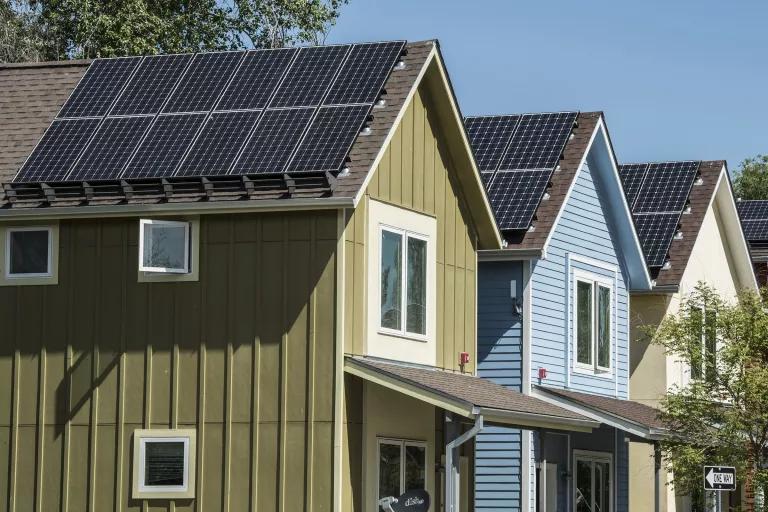
Rooftop solar panels on houses in Boulder, Colorado
Dennis Schroeder/NREL, 45218
Solarize your roof or update other home renewable energy options
Though the price of rooftop solar has dropped more than 70 percent in the last decade, it still costs about $20,000 on average to install. The Inflation Reduction Act (IRA) helped make this upgrade more affordable for more people and shortened the time it takes for families to see a return on their up-front investment.
- What the Residential Clean Energy Credit covers: You’ll get 30 percent back on what you pay for new household clean energy systems—like solar, wind, battery storage, or geothermal heat pumps—as well as the labor to install them.
- When it ends: The credit can be claimed next year when you file your 2025 taxes for systems installed by December 31, 2025.
- Who qualifies: There are no income or location restrictions to apply for this tax credit.

Energy-efficient double-paned windows
Marcela Gara/Resource Media via EE Image Database, CC BY-NC 4.0
Invest in sustainable home improvements
Many smaller, more low-tech upgrades can go a long way toward shrinking your carbon footprint, which is why the IRA has rewarded residents who make all manner of climate-friendly renovations.
-
What the Energy Efficient Home Improvement Credit covers: Consumers get 30 percent back, up to $1,200 per year, for energy-saving renovations like adding insulation or swapping out exterior windows that better keep cool air out in the winter and inside in the summer. It also incentivizes the purchase of certain electric, energy-efficient appliances like heaters, AC units, and boilers. On top of the $1,200 limit, you have an additional $2,000 of credit limit per year covering items like über-efficient heat pump air conditioners, heat pump water heaters, and boilers. Labor costs for installing these improvements are included, as are various related electrical upgrades you may make, such as replacing your panel, adding a subpanel, and changing certain wiring.
If you’re unsure which improvements to focus on, the new law also offers a $150 tax credit per household for a home energy audit. But note that you must choose an auditor under one of the certification programs recognized by the U.S. Department of Energy. As an added bonus, you may be able to combine the credit with utility or state incentives as long as you coordinate the costs. Generally, you reduce the costs claimed by the utility rebate or the HEAR/HER rebates described below. See more information here.
- When it ends: You can claim the credit on your 2025 taxes when you file them. The tax credit applies to improvements installed by December 31, 2025.
- Who qualifies: As long as the improvements were made to a home you reside in, you qualify. If you’re a renter or living in a multifamily building, you qualify too. For windows, doors, insulation, and home energy audits, the home must be your primary residence and not a second home.

A Veterans Green Jobs worker working on insulating a wall of a home in Lakewood, Colorado
Dennis Schroeder/NREL, 17963
Take advantage of rebate programs for energy efficiency upgrades
While tax breaks help incentivize climate-friendly renovations and appliances, high up-front costs can put them out of reach for many families. Thankfully, two rebate programs established under the Inflation Reduction Act are still intact in various states. And they direct a significant portion of the benefits to low- and moderate-income families. An important note: You cannot claim the same renovation project twice.
-
What these rebate programs cover: The Home Electrification and Appliances Rebates (HEAR) offer low- to medium-income families as much as $14,000 per year in point-of-sale discounts for electrification projects—including up to $8,000 for a heat pump for space heating and cooling, $840 for an electric or induction stove, and $1,600 for an insulation project.
The Home Efficiency Rebates (HER) get you cash back by shrinking your overall home energy use through weatherization renovations, like adding insulation, or by installing more efficient appliances, like heat pump clothes dryers. The amount you get back depends on how much energy you’ve saved and your household income. Save more energy, get more cash—up to $8,000 if you cut energy use by 35 percent and up to $4,000 if you cut energy use by 20 percent. Low-income earners can qualify for the highest rebate amount.
- When and where they start and end: The rebates are run by individual states. According to a map of state progress maintained by Atlas Public Policy, both HEAR and HER funding are currently available in District of Columbia, Georgia, Indiana, Michigan, North Carolina, and Wisconsin. Meanwhile, Arizona, California, Maine, New Mexico, New York, Colorado, and Rhode Island offer just HEAR. Check your state’s website for further information on how to apply; for example, eligible New Yorkers can apply for rebates through the state’s EmPower+ program. Most of these programs are expected to run until September 30, 2031, or until their original $4.5 billion funding runs out.
- Who qualifies: For the High-Efficiency Electric Home Rebate program, families must make less than 150 percent of their area’s median income. For the HER program, everyone qualifies.

Workers at the Ford Electric Vehicle Center in Dearborn, Michigan
Ford Motor Company
Get a tax credit for electric vehicles
EVs in the United States emit about a third of the greenhouse gases of gas-guzzling cars, on average—making this switch a smart one for the climate. But even with the release of more affordable models, EV prices continue to be a roadblock for many shoppers. The IRA helped diminish this hurdle, with consumers collectively saving more than $2 billion within just the first three months of the program’s rollout. And absent the IRA tax credits, an EV may still be cheaper to drive over the long run when compared with a gas car—get more information on how to break down the costs in our explainer.
-
What the EV tax credit covers: The law renewed a $7,500 Clean Vehicle Credit for new EVs and plug-in hybrids, which expired at the end of 2022. It also added a 30 percent tax credit (capped at $4,000) for used EVs and plug-in hybrids. You may also see promotions for EV and plug-in hybrid leases through September 30, 2025, as a tax credit for lessors also ends then. And if you need to install an EV charger at home, a separate tax credit covers 30 percent of the cost (up to $1,000 of credit) if you live in a qualifying census tract.
Check out FuelEconomy.gov for a list of vehicle models that may qualify. Speak to the dealer to confirm that the specific vehicle qualifies.
- When it ends: To claim the Clean Vehicle Credit for new and used vehicles, you must purchase the vehicle by September 30, 2025. However, tax credits subsidizing home EV charger installations don’t end until June 30, 2026.
- Who qualifies: There are income limits. For the new car credit, single taxpayers making $150,000 or less, heads of household making $225,000 or less, and households filing jointly making $300,000 or less qualify (you may use your 2024 income amounts from the previous year rather than 2025). For the used car credit, single taxpayers must make $75,000 or less; heads of household must make $112,500 or less, and households filing jointly must make $150,000 or less (you may use your 2024 income amounts from the previous year rather than 2025). For used cars, the sale price cap to qualify is $25,000.
Bottom line
Act soon to take advantage of the IRA’s expiring consumer benefits. And don’t forget to save your receipts and any other relevant records as you go so that you can accurately account for your purchases when you file your taxes.
This story was originally published July 31, 2024, and was updated on July 28, 2025 with new information and links.
This NRDC.org story is available for online republication by news media outlets or nonprofits under these conditions: The writer(s) must be credited with a byline; you must note prominently that the story was originally published by NRDC.org and link to the original; the story cannot be edited (beyond simple things such as grammar); you can’t resell the story in any form or grant republishing rights to other outlets; you can’t republish our material wholesale or automatically—you need to select stories individually; you can’t republish the photos or graphics on our site without specific permission; you should drop us a note to let us know when you’ve used one of our stories.
What Are the Solutions to Climate Change?
How to Ditch the Biggest Fossil Fuel Offenders in Your Life
How You Can Stop Global Warming