
What Is an Induction Cooktop?
A closer look at the health benefits and energy savings—and why it’s time to replace your gas stove.
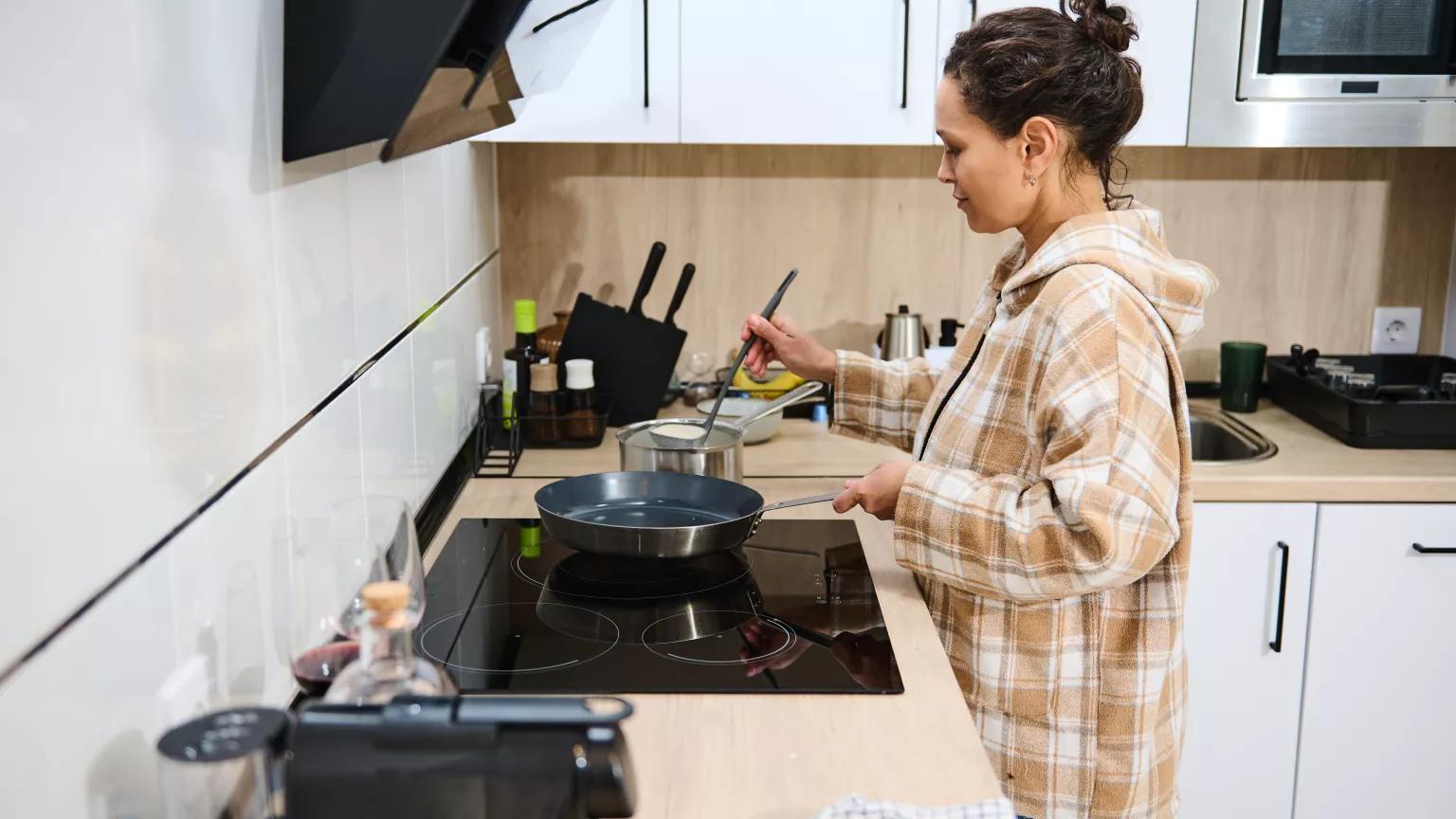

If you’re thinking of updating your kitchen, take a closer look at your stove. They may be the centerpiece of so much home cooking, but traditional gas stoves actually pollute our indoor air, releasing toxic substances that impact everyone in the home. The live flames also make them fire hazards, a particular danger for children and the elderly. On top of all that, they’re energy intensive and keep us hooked on fossil fuels.
But there’s a solution within our reach: switching to an induction cooktop. This technology has been around for nearly a century, and yet only 3 percent of U.S. households use it. While the cost and learning curve can be a deterrent for some to switch from gas or electric stoves, these efficient kitchen appliances come with a range of benefits that make them a worthwhile investment for your health and our climate too.
How does induction cooking work?
Induction cooktops run off of electricity but work differently than conventional radiant electric stovetops. Induction appliances harness the power of electromagnetic energy to directly heat your cookware. When you turn one on, it creates a rapidly alternating magnetic field. Place your pot or pan over that magnetic field, and it will absorb the energy and create heat from within the pot or pan itself. This means the surface of your cooktop will stay cool, unlike with a gas or radiant electric stovetop.
Only certain types of cookware are compatible with induction cooking, however: stainless steel, cast iron, and carbon steel. All are made out of ferromagnetic material—substances strongly attracted by magnetic fields. A trick to check if your cookware fits this bill is to place a magnet on the bottom to see if it will stick. Anything else you use will not heat up.

A schematic of the principle of an induction stove
What are the benefits of induction cooking?
Health & safety
Nearly a century ago, the fossil fuel industry popularized the catchphrase “now we’re cooking with gas” as a trademark for success, and the lure has stuck. That marketing hype has led generations of consumers to choose gas stoves and has kept sales humming, despite research showing that they emit toxic pollutants like nitrogen dioxide and carbon monoxide as well as formaldehyde and benzene (both carcinogens).
Notably, a recent Stanford study found high concentrations of nitrogen dioxide—known to intensify asthma and be linked to lung development issues in children—contaminating the air in bedrooms within an hour after the home’s gas stove had been in use. Three hours after the stove was turned off, it could still be detected.
Induction cooktops don’t just avoid these various emissions, but they also reduce fire hazards; cooking, after all, is the leading cause of home fires and related injuries. The cooktops come equipped with automatic shutoff mechanisms that activate when the heating element hits an abnormally high temperature; precise temperature controls also prevent overheating. As a result, notes professional chef and sustainable kitchen advocate Chris Galarza, “if you’re using induction in your home, know that you’re going to be creating an environment where you can safely cook with your children, safely cook with the elderly, safely cook in general.”
Energy efficiency & time-saving
Forget waiting for that pot of water to boil: Induction technology’s streamlined usage of energy means it wastes less of your time too. Consumer Reports found that a high-powered induction cooktop can boil water 20 to 40 percent faster than its gas and radiant electric counterparts.
For a comparison, induction stoves are about 85 percent energy efficient versus 75 percent for radiant electric stoves and a measly 32 percent for gas. For gas and radiant electric stoves, a lot of energy is lost in the air—just think about how hot your kitchen gets when you cook or bake something. This means switching to induction can also save you money by cutting down on your need to pump up the air conditioner when it’s warm both outside and inside your kitchen.
As another environmental benefit, induction stoves won’t fill your home with methane. One of the most potent climate-destructive greenhouse gases, methane can leak from a gas stove throughout the day, even when you haven’t been cooking.
How can we make induction cooking more widely accessible?
NRDC, working in partnership with Galarza and other advocates, is pushing for the Healthy Homes Right to Know Act, which would mandate warning labels be placed on gas stoves in New York.
“What we’re asking for is to have a label that will clearly say there are public health concerns about the product when you’re buying it,” says Rich Schrader, NRDC’s director of New York government affairs. “Consumers often don’t realize what they’re buying into, and this is a big purchase—a gas stove will last you 18 to 25 years.” Similar bills have been introduced in other states, including California, Illinois, Maryland, and Massachusetts, though none have made it past the finish line yet.
Schrader, who is spearheading the advocacy behind the New York bill, notes that both the state and New York City have a long history of mandates like this, including for tobacco products and foods high in sugar and sodium. There are also parallels in how the tobacco and gas industries have both sought to refute robust data on the health risks of their products and sow doubt for consumers investigating their options. Some of this pushback has trickled up to national politics; President Trump’s fossil fuel–oriented Unleashing American Energy executive order included a goal to “safeguard the American people’s freedom to choose from a variety of goods and appliances, including but not limited to light bulbs, dishwashers, washing machines, gas stoves” and more.
But empowering shoppers to make informed choices is in everyone’s best interest. “We’re not suggesting you can’t sell or buy gas stoves,” Schrader says. “The bill is about providing a warning to let consumers decide for themselves.”
Are there any financial incentive programs for consumers?
Cost can be a barrier to making the switch. Induction cooktops and ranges are slightly more expensive than both gas and radiant electric stoves, but the bigger investment for a kitchen with a gas hookup might be the electrical infrastructure work required to install induction. This includes adding in the compatible outlet and possibly, updating your home’s amperage to support the extra load.
The good news is that savings programs across much of the country can help residents offset the cost of purchasing a new appliance. An Energy Star–certified induction purchase could be eligible for one of two rebates under the 2022 Inflation Reduction Act: the Home Electrification and Appliance Rebate and the Home Efficiency Rebate. Both programs will be managed by your state’s energy department, so qualification requirements and specific rebate amounts will vary. States will also decide which types of electrification upgrades to include in their programs, so some may not extend their IRA funding to cover stoves. Check your state’s energy department website for details. You could potentially save even more if your state has additional stackable rebate or tax credit programs, which can be found here. A number of states already have programs available and many others are preparing to launch theirs soon.
If upgrading your entire stovetop or range is too big of an investment, you can start small with a single or portable induction cooktop, which can be purchased for less than $100 and sits on your counter. Until you can swap out the whole stovetop, make it a practice to turn on your range hood fan or open your windows whenever you cook to decrease the amount of air pollutants in your home, and don’t forget to regularly clean the hood filters.
For advocates like Galarza and Schrader, making the switch is a no-brainer. “It’s game-changing technology,” Galarza says. “The conversation we’re having comes down to how to get a piece of metal hot. Do you want to do it fast or slow? Do you want to do it in a way that’ll cost you more money or less money? Safe or dangerous? It’s up to you.”
This NRDC.org story is available for online republication by news media outlets or nonprofits under these conditions: The writer(s) must be credited with a byline; you must note prominently that the story was originally published by NRDC.org and link to the original; the story cannot be edited (beyond simple things such as grammar); you can’t resell the story in any form or grant republishing rights to other outlets; you can’t republish our material wholesale or automatically—you need to select stories individually; you can’t republish the photos or graphics on our site without specific permission; you should drop us a note to let us know when you’ve used one of our stories.
Decarbonization: Why We Must Electrify Everything Even Before the Grid Is Fully Green
Your Guide to the Latest Heat Pump Rebates and Incentives
What Are Heat Pump Air Conditioners?