
Your Guide to the Latest Heat Pump Rebates and Incentives
The federal tax credit may be gone, but you can still save thousands via state and local programs for this climate-friendly home upgrade.
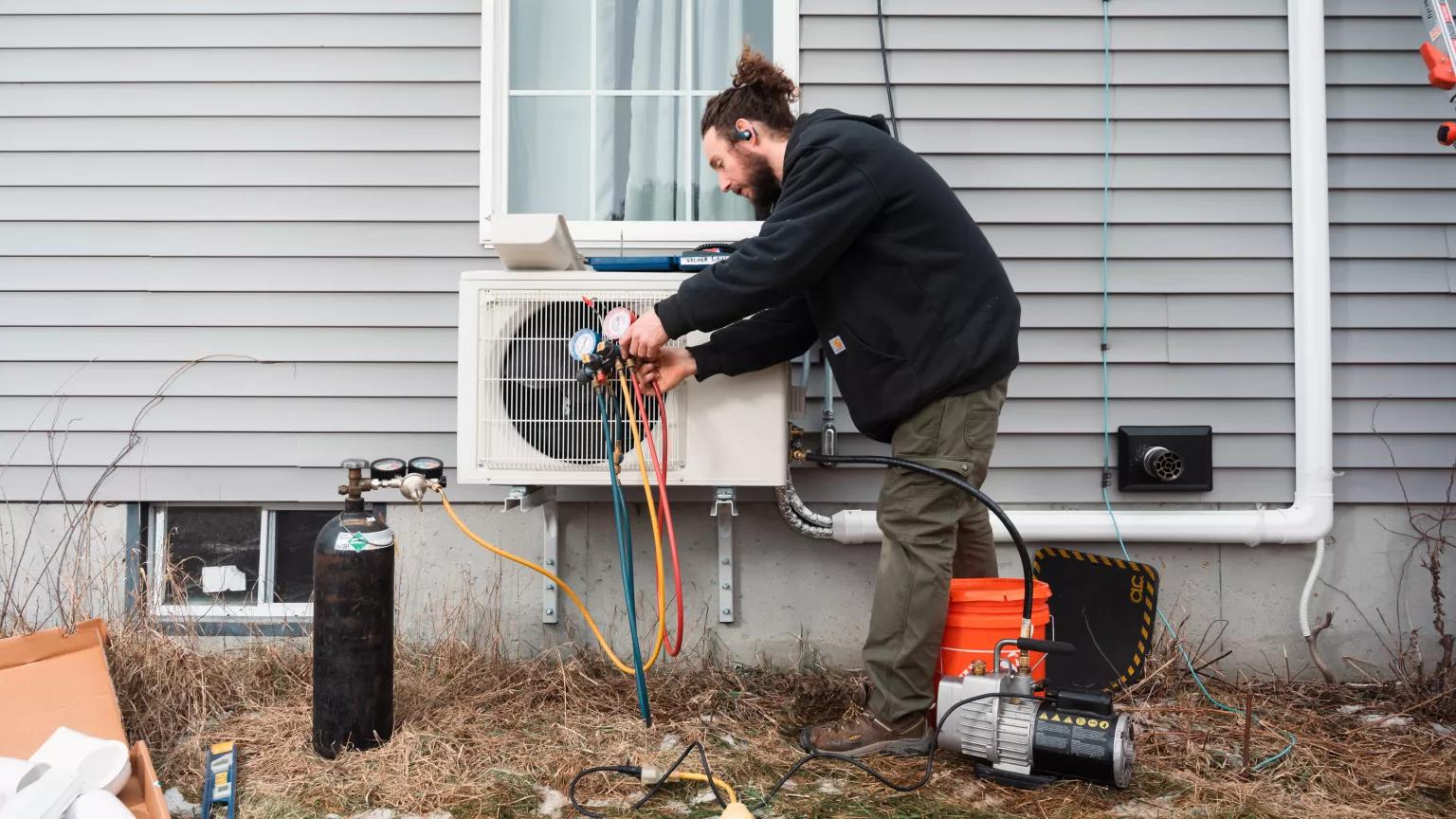
An HVAC technician working on removing all moisture from the line set of an newly installed electric heat pump on a home in Windham, Maine

In many states across the nation, gas heating has long been king. Take Colorado, where about 7 out of 10 homes rely on gas-burning furnaces and boilers. This stubborn reliance on fossil fuels stands squarely in the way of our climate goals.
But over the past couple of decades, we’ve seen gradual progress. According to the latest data from the U.S. Energy Information Administration, 42 percent of U.S. households now use electricity for heating, up from 35 percent in 2010. And various new public policy and consumer incentives could soon boost the share further.
“State and local governments, along with utilities, are stepping in to make it easier and more affordable for consumers to make the healthy, efficient, climate-friendly choice,” says Alejandra Mejia Cunningham, director of NRDC’s clean buildings advocacy.
Learn More

This summer, for example, the Power Ahead Colorado initiative plans to give away $40 million in rebates for climate-friendly heat pumps and other energy-efficient appliances to thousands of Denver-area residents. The electrification initiative, which aims to reduce home and building emissions across the region, says it will also install heat pumps at no cost for around 2,000 low-income households.
“Heat pumps are a kind of superpower when it comes to accomplishing our goals,” says Christine Selk, a spokesperson for Power Ahead Colorado. Electric heat pumps are energy efficient, reduce climate emissions, and improve indoor air quality. “It makes a world of difference in people's health and quality of life."
Of course, just before a new global energy crisis set in, Congress canceled the $2,000 federal heat pump tax credit, which expired at the end of last year. In the face of that setback, here’s a look at what local leaders are doing to speed the adoption of heat pumps over the long term with tips on how to make the most of the incentives still available near you.
What makes heat pumps so energy efficient?
If you’re new to electric heat pumps, you might not know that these impressive multitaskers can both heat and cool your home. That alone should make this single appliance that’s capable of replacing both your AC and heating system worth considering. By simply moving heat around—pulling warmth inside during the winter or pumping it outdoors during summer—a heat pump is up to five times more efficient than a system that burns fuel. And the modern versions work in most climates, handling even brutal winters and subzero temperatures. So nearly everyone can now reap the rewards of heat pumps.
That’s important, given that heating and cooling remain the largest source of building-related greenhouse gas emissions, which make up about a third of the U.S. climate emissions pie. And because heat pumps run on electricity, their carbon footprint is expected to shrink over time as the grid continues to run on more and more clean energy. So climate-conscious consumers need not wait until 100 percent of the power system is renewable to switch to appliances like these.

A mini-split heat pump installed on a home, which provides both heating and cooling without requiring traditional ductwork
How to find state and local heat pump incentives near you
The good news is that most people hoping to join Team Heat Pump can still offset some of the up-front costs via local incentive programs. But you have to know where to look first. Here are some smart steps to take to score all possible savings.
- Peruse database tools that compile the available rebates and other incentives in your area. Some of the most popular are those managed by the electrification advocacy and market research groups Rewiring America, the Building Decarbonization Coalition, and Atlas Public Policy.
- Check on whether your state offers rebates through HOMES and HEAR (sometimes called HEEHR/HEEHRA). Established under the Inflation Reduction Act (IRA) and still intact in some states, these programs often offer the largest savings for residents—up to $8,000. Caveat: Availability varies. Some states, like California, have already reached capacity and are not accepting additional applicants in certain regions, while others have yet to launch their programs.
- Browse the energy or environmental agency department websites for your city and state for other rebate programs. If you find more options, you may be able to stack them with the HOMES and HEAR rebates for additional savings.
- Consult with an HVAC professional who specializes in heat pump installation and who can potentially guide you through the resources available in your area.
- Check with your local utility. In some states, utility programs are beginning to offer electrification rebates to help avoid costly gas pipeline replacements, such as ConEdison’s Energy Exchange Program in New York.
How much money could heat pump incentives save?
“If you think you can't afford it, you might be surprised,” says Kelly Delaney, an energy programs manager at Rewiring America. Many people can shave thousands of dollars off the up-front cost of a heat pump, even without the now-expired federal tax credit, though the exact savings will vary.
In Maine, for example, residents can claim up to a $3,000 rebate on the total cost of a heat pump. In Austin, Texas, customers of the Austin Energy electric utility can also receive an average of $800 back on their purchase. In Seattle, homeowners moving from an oil-burning heater to a heat pump can earn a $2,000 rebate, with some able to earn an additional $4,000. Dozens more rebates like these exist. In most cases, state and utility rebates can also be combined, including with the IRA rebates.
Keep in mind that how and when people can access these savings varies. Some rebate programs go straight to the consumer and require filling out an application and waiting for a reimbursement. Some are available as a tax credit, tax deduction, or credit toward your utility bill. Others, often called “point-of-sale” rebates, are reimbursed instead by the seller or installer, who then deducts the rebate from your bill. The latter setup helps reduce delays and hassles for customers.
Of course, when upgrading to a heat pump, the savings go beyond the initial rebate. Homeowners can save up to $400 or more annually when they replace traditional heating and cooling equipment with modern heat pumps, according to calculations by Rewiring America. That estimate rises to $1,000 per year for anyone moving away from an inefficient heating system that relies on oil, propane, or baseboard electricity.
How do I know if I qualify for a heat pump rebate?
Take a close look at a rebate’s requirements before you get started. The HEAR rebate programs come with income restrictions, while the HOMES rebates require verification that the upgrade lowered your home’s total energy consumption by at least 20 percent.
Other common requirements include property ownership, residency status, the energy-efficiency rating of the heat pump, and the fuel type of the heating/cooling system that you’re replacing. For example, some rebates are specifically set aside for homeowners transitioning away from oil-burning furnaces.

A technician installing an indoor ceiling cassette unit, part of a heat pump climate control system, inside an apartment
Jackie Molloy/The New York Times/Redux
Where to find an approved contractor
Searchable databases, like this one from the Building Decarbonization Coalition, can help you find a credentialed technician who is qualified to work with heat pumps. Many incentive programs also specifically point customers to lists of vetted technicians in the area. Power Up Colorado, for example, set up a contractor hub to connect people with technicians who are experts in cold-climate heat pump models.
If searching on your own, you can also look for an HVAC professional with an “Energy Skilled” certification. As defined by the U.S. Department of Energy, this means the worker is up-to-date on the latest heat pump technology and best practices.
Can heat pumps become the norm?
Despite the wide range of incentives available, the cost of installing a heat pump still remains out of reach for many, such as some renters. And though heat pumps have outsold their gas-furnace counterparts for the past four years, the pace of heat pump sales in the United States must still triple by 2032 in order to get rid of fossil fuel heating and meet net zero emissions goals by 2050.
That’s why local leaders are also looking beyond consumer rebates and toward broader policies that make heat pumps more affordable from the start.
According to a recent NRDC report that assesses the California heat pump market, investing in training for HVAC technicians and distributors can help make installation more affordable. Basically, the more professionals selling and installing heat pumps in a given area, the higher the marketplace competition, which can lower costs. In that vein, the Power Ahead Colorado program is investing in heat pump training and other green energy jobs for nearly 5,000 professionals.
Other policies can also help move the affordability needle. These include requirements that heating systems for all new buildings run on electricity—lowering rates to better reflect the shared social benefits of electrification—and standards that gradually phase out appliances that run only on fossil fuels.
Of course, “what moves the dial in one region may not work as well in another,” says the report’s author, Mohit Chhabra, a senior policy analyst for NRDC’s Climate & Energy program. Housing type, climate, average income, the political landscape, and existing fuel infrastructure can influence which approaches work best in a given region. This is why local policymakers can be crucial players in expanding the heat pump marketplace and helping residents decarbonize.
For example, Colorado passed its Clean Heat Plan that requires gas utilities to reduce climate emissions in 2021. Since then, the state’s largest gas utility has been meeting the challenge by investing millions toward widespread building electrification.
Together with consumer rebates, policies like these can help get us where we need to be: warm in the winter, cool in the summer, and fossil fuel–free all year-round.
This NRDC.org story is available for online republication by news media outlets or nonprofits under these conditions: The writer(s) must be credited with a byline; you must note prominently that the story was originally published by NRDC.org and link to the original; the story cannot be edited (beyond simple things such as grammar); you can’t resell the story in any form or grant republishing rights to other outlets; you can’t republish our material wholesale or automatically—you need to select stories individually; you can’t republish the photos or graphics on our site without specific permission; you should drop us a note to let us know when you’ve used one of our stories.
Decarbonization: Why We Must Electrify Everything Even Before the Grid Is Fully Green
What Are Heat Pump Air Conditioners?
How to Ditch the Biggest Fossil Fuel Offenders in Your Life