
A Fund for Cleaning Up Coal Mining’s Toxic Legacy Dries Up
As rural communities seek to move on from polluted pasts, funds to address thousands of abandoned mines and wells are coming up short.

Once deemed a "dead" river due to pollution from unregulated coal mining, the West Branch of the Susquehanna River in Pennsylvania has undergone a major revival through intensive reclamation and treatment projects.
Kevin Zedack grew up in the heart of Pennsylvania’s coal country: northern Cambria County. His grandfather was a coal miner who suffered from black lung, and his dad went into the mines after high school. As a boy, Zedack, now in his thirties, accepted the scars from the mining industry as part of life. Kids hung out on gob, or "boney" piles, climbing or riding up and down the large mounds of dark, rocky waste material pulled from coal mines.
Abandoned mines abound in his 2,000-person town. Nearby, thousands of gallons of water from the Lancashire No. 15 mine would gush into the west branch of the Susquehanna River. Meanwhile, acid drainage from the mine would turn the water the color of orange juice and kill all types of aquatic life. At times, floating fish littered the local streams.
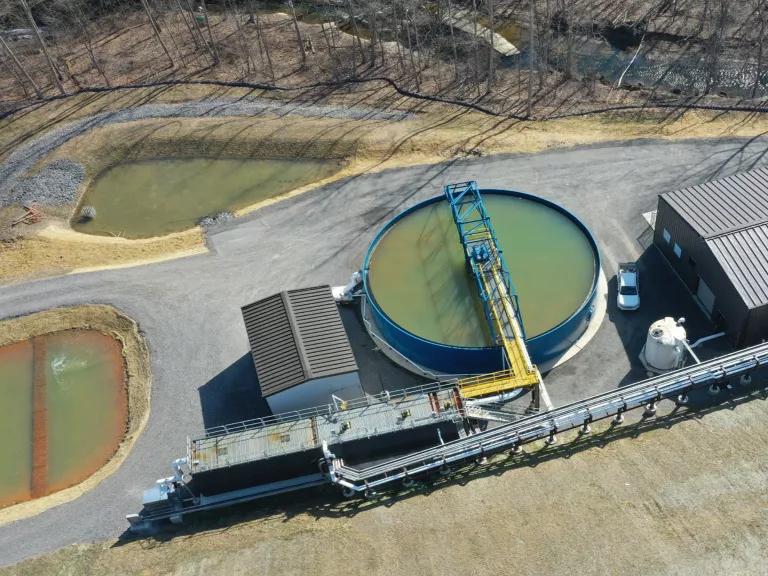
The Gladden acid mine drainage treatment plant in South Fayette, Pennsylvania, treats one to two million gallons of mine discharge per day and removes about 690 pounds of orange-hued iron from waterways each year.
Pennsylvania Department of Environmental Protection
Zedack now works as a government affairs specialist for Appalachian Voices, an advocacy organization that seeks to build an equitable clean energy economy for local communities. He points out that a $13 million water treatment facility in the area has been helping to restore a site polluted by mining waste. Constructed in 2011, the facility plans to remain in operation until the layer of pyrite within the mine, which can oxidize into sulfuric acid, eventually erodes.
“The project is kind of like a hallmark project for the state of Pennsylvania,” says Zedack. And the Susquehanna is already showing signs of recovery. The river is no longer orange, and people spot trout and shad swimming in the waterway. “The local community fully acknowledges that this is a different river than it was 20 years ago,” he says.
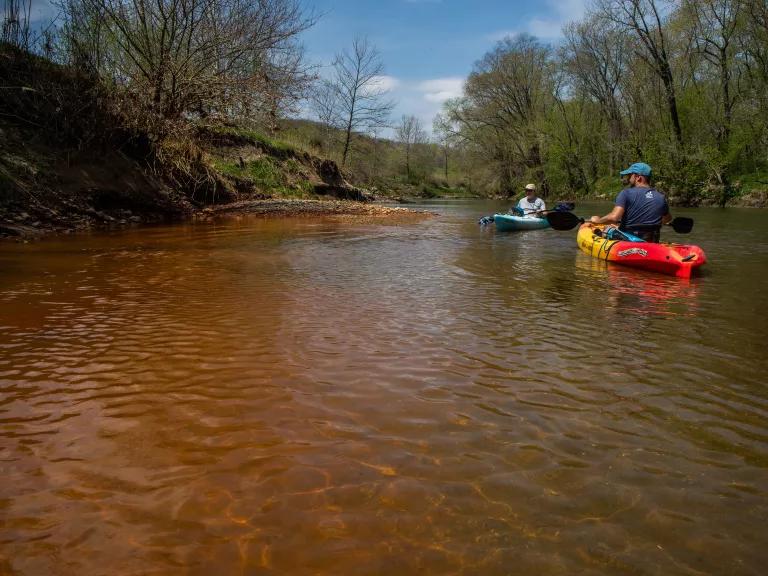
Andrew Rehn, director of climate policy at Prairie Rivers Network (right), paddles past coal ash waste seepage on the shore of the Vermilion River near Collison, Illinois
Cleaning up coal mining’s toxic legacy
Ten of thousands of abandoned mine lands (AMLs) are scattered across the country—and there are many more that state and federal datasets don’t currently account for. The restoration along the Susquehanna is just one among many efforts to clean them up. Such projects, from Washington to Missouri to Pennsylvania, received a big boost from the 2021 Bipartisan Infrastructure Law (BIL), one of the most significant federal investments toward revitalizing U.S. cities, states, and Tribal lands. Through BIL, Congress set aside $11.3 billion over 15 years to address abandoned coal mines.
The advantages of remediating these lands go far beyond reducing contamination. A 2021 report published by Eric Dixon of the Ohio River Valley Institute found that if the country could reclaim and reforest just a quarter of abandoned mine lands, the additional trees would sequester 232,000 metric tons of carbon, the emissions equivalent of about 40,000 households. Cleaning up half of those lands, the report calculates, could create nearly 7,000 jobs over the next decade.
“Now is the time to get it cleaned up and move on to something cleaner and better for the environment and communities,” says Amanda Pankau, director of energy and community resiliency for the Prairie Rivers Network, an Illinois environmental group. “Anything we can do to clean up sites and create jobs in the process is really important.”
Despite these benefits, advocates now worry AML funds may be in jeopardy.
Progress, interrupted
When the BIL was passed, rural areas welcomed the opportunity to address the scars of the mining industry in their midst—including piles of toxic waste and deteriorating infrastructure, along with employment holes that coal companies also left behind. Funding under BIL was a huge step toward helping communities add more jobs and transition to more sustainable economies.
Yet a mere five years later, Congress has just approved a budget that depletes the mining cleanup fund by $500 million. The money will instead go to the Bureau of Land Management’s wildland fire management account. The new allocations result in a decrease of $169 million for Pennsylvania, $97 million in West Virginia, and $52 million in Illinois, the three states that need it most.

Funding is also being yanked away from efforts to overcome another vestige of the fossil fuel industry: orphaned oil and gas wells. Many of the millions of unplugged wells leak methane, which contributes greatly to climate change. Congress pulled $285 million from a $4.7 billion program to seal these wells, also diverting the funds to fire management.
“Orphaned wells are not providing an economic benefit to anyone,” says Josh Axelrod, a senior program advocate for NRDC. “They’re literally just sitting out there on the landscape emitting greenhouse gases and often polluting groundwater. They can be found, and they can be plugged.”
Though this was the first time Congress diverted AML and well funds, environmentalists worry that the move could lead to more such diversions in coming years.
Abandoned mines, abandoned communities
While coal mining in the United States began in earnest in the early 1800s, it wasn’t until 1977 that Congress passed a law requiring coal-mining companies to clean up their messes. A tax on the amount of coal stripped from seams helped pay for some reclamation, but because companies mine less coal than they used to, states no longer collect enough revenue to adequately address the problem.
BIL funding gave states a much-needed cash infusion to assess and reclaim a larger number of polluted sites.
“Finally, the federal government was providing resources/funding to communities to do what they have decided is important to do,” says Sharon Buccino, a former NRDC attorney who headed the Office of Surface Mining Reclamation and Enforcement during the Biden administration. “And now the government’s just going to pull the rug out from under these communities.”
But even the full amount of BIL’s funds may fall short, and the longer that mines are left to fester, the more expensive the problem grows. Restoring former mines becomes pricier as construction costs rise, as old shafts and pits cave in, and as climate change complicates acid mine waste remediation.
And as time goes on, funding from BIL is also helping states identify more mining sites that need attention (and money). The law allotted funds for state agencies to update their records, which would in turn help the federal government maintain a national inventory that leaders could turn to for more accurate estimates of future remediation costs.

Earthmoving equipment working on a reclamation project at an abandoned 1970s coal mine in Norton, Virginia
The Ohio River Valley Institute estimates the actual cost of assessing, evaluating, and remediating abandoned coal mines to be upward of $26 billion, more than twice the $11 billion set aside by the BIL.
But such an investment, advocates say, is well worth it. Prior to BIL, the amount of money Pennsylvania received for AMLs was $25 million a year, a pittance when considering that it cost more than half of that to build the water treatment facility at only one site near Zedack’s childhood home.
Nonetheless, even just $2.5 million can go a long way in the right place. That’s how much was spent in Gillespie, Illinois, to turn a former mine site into a place where local children can play—but on soccer fields instead of gob piles. Solar panels may go in soon too.
“If these sites aren’t cleaned up, they’re unproductive lands that this community cannot use, whether it’s for community development, economic development, or whatever the next best use might be,” says Pankau. “It limits potential.”
This NRDC.org story is available for online republication by news media outlets or nonprofits under these conditions: The writer(s) must be credited with a byline; you must note prominently that the story was originally published by NRDC.org and link to the original; the story cannot be edited (beyond simple things such as grammar); you can’t resell the story in any form or grant republishing rights to other outlets; you can’t republish our material wholesale or automatically—you need to select stories individually; you can’t republish the photos or graphics on our site without specific permission; you should drop us a note to let us know when you’ve used one of our stories.
The Ohio River Defines the Borders of Five States—But Its Pollution Doesn’t Stop at State Lines
Single-Use Plastics 101
What the Latest SCOTUS Decisions Mean for Our Climate