From One Rail Yard Fight to the Next: Frontline Communities Push Back Against BNSF's BIG Project
Southern California communities are demanding a cleaner freight future—not another generation of diesel pollution.
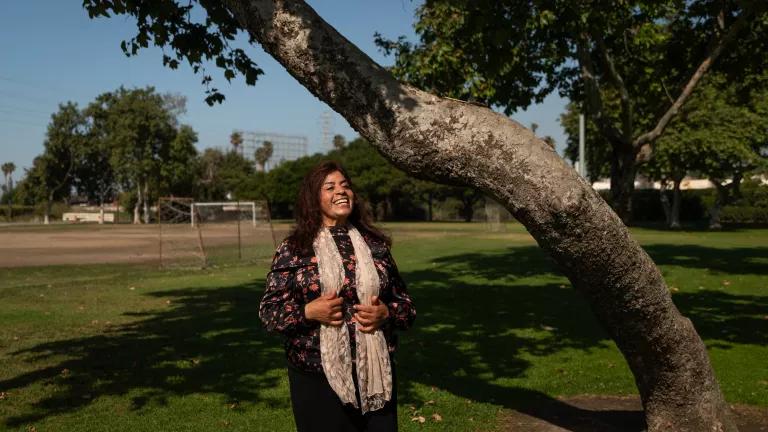
Maria Reyes, Long Beach resident and organizer with East Yard Communities for Environmental Justice, in Hudson Park, the site of the proposed Southern California International Gateway Railyard

In August 2023, after years of sustained community advocacy, BNSF Railway announced it would abandon plans to build the Southern California International Gateway (SCIG) rail yard. Residents and advocates had long opposed the project over concerns about air pollution, truck traffic, noise, and the disproportionate burden it would place on communities already facing some of the region's worst environmental health outcomes.
For many, the decision marked a hard-fought victory. But just three years later, many of the same communities are once again confronting a similar threat.
On June 17, 2026, the Barstow City Council approved BNSF's Barstow International Gateway (BIG) Project, a proposed 5,000-acre rail facility connecting the ports of Los Angeles and Long Beach to Barstow through the Alameda Corridor. For frontline communities already living with elevated rates of asthma, cancer, and cardiovascular disease associated with freight transportation and diesel pollution, the project represents another expansion of the freight system that has long impacted their health.
"We aren't against economic growth, but we also have the right to live a safe and healthy life in our community," says Maria Reyes, a lifelong Long Beach resident and organizer with East Yard Communities for Environmental Justice (EYCEJ).
Reyes helped lead EYCEJ's campaign against the SCIG project and spent years organizing residents who were concerned about its impacts.
"[The BIG] project removes our history, our fight, all of our hard work," Reyes says. "BNSF is telling us our fight was never worth it."
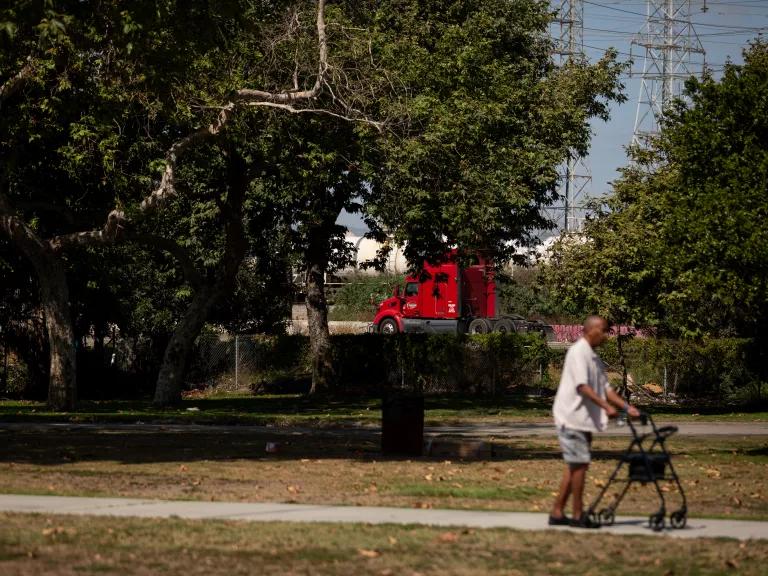
A semi-trailer truck on a road beside Hudson Park, the site of the proposed SCIG rail yard
The same fight, the same communities
Communities living along Southern California's freight corridors have borne the health costs of the goods movement for generations. Diesel-fueled locomotive operations and industrial activity around the San Pedro Bay Port Complex contribute significantly to regional air pollution, with the greatest impacts falling on low-income communities and communities of color.
The constant movement of ships, trains, trucks, and cargo handling equipment through California's ports and the transportation of goods from shipping terminals to inland warehouses has exposed frontline neighborhoods to harmful diesel emissions for decades. Airborne particulate matter from diesel exhaust has been linked to increased asthma symptoms, cardiovascular disease, and elevated lung cancer risk. Port-adjacent communities like West Long Beach face significantly shorter life expectancies than the broader Los Angeles County population.
The proposed BIG project would deepen this pollution burden by increasing locomotive activity along the Alameda Corridor and through port-adjacent communities while extending diesel-powered freight operations inland to Barstow. Without a transition to zero-emission operations, the project will lock in decades of additional diesel emissions across Southern California.
For communities like West Long Beach and Barstow—neighborhoods that are overwhelmingly Black, Latino, and low-income—the consequences are deeply personal.
“We can’t just move out,” Reyes says. “We have built not just our lives but our legacies in these communities.”
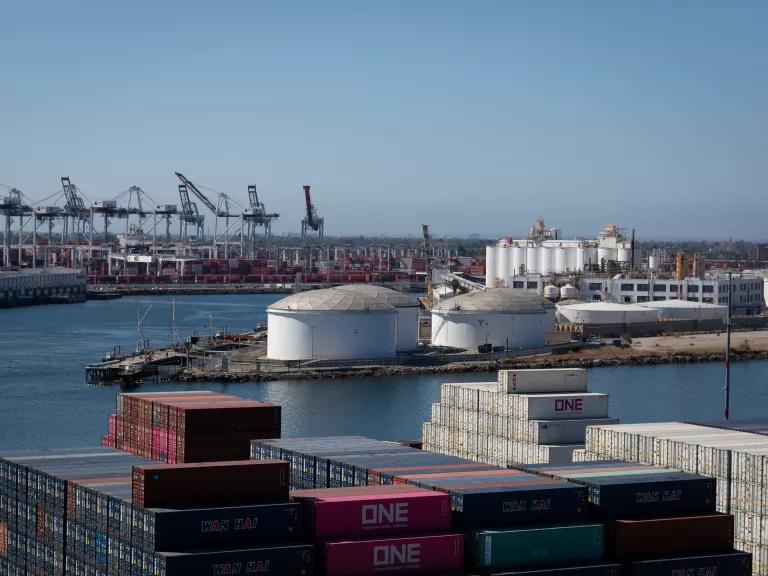
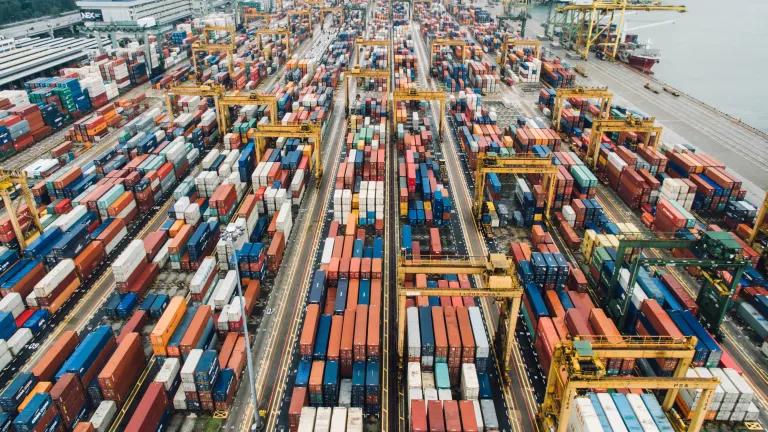
Shipping containers stacked at the Port of Los Angeles
False promises of a cleaner future
Despite claims that the project will reduce pollution, the BIG Environmental Impact Report (EIR) acknowledges that the project would actually increase diesel use by two to three million gallons annually.
BNSF has also stated that it intends to use Tier 4 locomotives, technology that is still fully powered by diesel, but it refuses to make that commitment legally enforceable.
"It's empty promises," Reyes says.
Advocates know that cleaner alternatives already exist. In fact, electric locomotives have been operating for more than 100 years and are the gold standard for freight rail technology around the world. Electric locomotives, trucks, and other freight equipment are commercially available and increasingly cost-competitive with diesel technology. Despite this, the EIR does not meaningfully evaluate using zero-emission alternatives at BIG.
As one of the richest companies in the world, BNSF can afford to adopt zero-emission technology. BNSF’s third-quarter earnings just increased 19.3 percent to 1.73 billion dollars. Studies continue to find that electrifying freight rail can be comparable in cost to diesel infrastructure while significantly reducing air pollution and protecting the health of both rail workers and nearby residents who may be exposed to substantially higher concentrations of diesel particulate matter than surrounding communities.
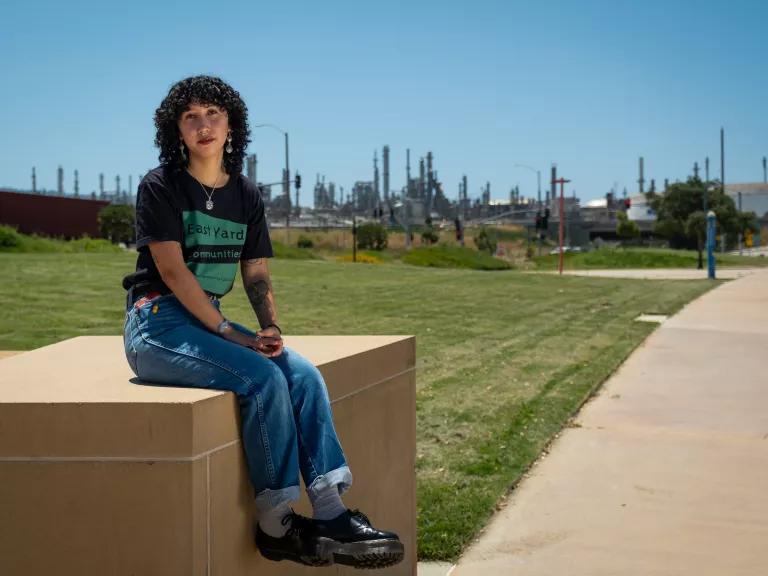
EYCEJ community organizer Paola Vargas in Wilmington Waterfront Park in Los Angeles
The future
Los Angeles and Barstow residents are urging the city of Barstow to revise the project's EIR, arguing that it fails to fully evaluate the project's impacts on public health, air quality, greenhouse gas emissions, biological resources, noise, and energy use.
We are also calling for a meaningful analysis of zero-emission alternatives, including electric locomotives, switchers, trucks, and other freight equipment. Excluding these technologies from serious consideration overlooks opportunities to reduce harmful pollution and fails to satisfy California's environmental review requirements.
Growing concerns surrounding the BIG project closely resemble those that ultimately led to the defeat of SCIG. "It seems like every time one monster is defeated, a bigger one emerges," Reyes says.
For Reyes and many other community members, the campaign against BIG is about more than a single project. It is about ensuring that communities already burdened by pollution are not continually asked to bear the costs of freight expansion while cleaner technologies remain available.
"We know we can never let our guard down," Reyes says. "If they give up in one area, they'll just do it in another one. But the environmental health of our communities is something we will never stop fighting for."
"Aquí seguimos."
We're still here.
Special thanks to Astrid Najarro, NRDC summer legal intern 2026, for her collaboration and contributions to this blog.
This NRDC.org blog is available for online republication by news media outlets or nonprofits under these conditions: The writer(s) must be credited with a byline; you must note prominently that the blog was originally published by NRDC.org and link to the original; the blog cannot be edited (beyond simple things such as grammar); you can’t resell the blog in any form or grant republishing rights to other outlets; you can’t republish our material wholesale or automatically—you need to select blogs individually; you can’t republish the photos or graphics on our site without specific permission; you should drop us a note to let us know when you’ve used one of our blogs.
Related Blogs

Proposed Port Expansion Puts South Oxnard Community at Risk
California Makes History with Clean Trucks Rule
