39 State DOTs Secure $1.2 Billion for Low-carbon Materials
The Federal Highway Administration awards $1.2 billion to state DOTs, growing the $10 billion pot of federal funding support for industrial decarbonization.


The Federal Highway Administration (FHWA) announced awards for the first tranche of money to support the use of low-carbon materials in construction projects. In this first round, the FHWA awarded $1.2 billion to state departments of transportation (DOTs) for low-carbon material pilots. This program leverages the public sector’s large purchasing power to accelerate the deployment of low carbon materials, including concrete, asphalt, steel, and glass. These low-carbon materials use innovative, cleaner production methods that reduce the release emissions and are the early products of decarbonizing heavy industry.
Painting the big picture
The federal government has been especially active in the past year in awarding Inflation Reduction Act (IRA) funds to states to reduce industrial emissions. From investing in research and development to maximizing government procurement, the federal government is tackling industrial decarbonization across the spectrums of technical and market timelines. In this blog, we discuss the importance of four federal programs that have awarded substantial grants to state entities and specific industrial decarbonization projects within states. We will demonstrate the role they play in the broader industry context and uplift exciting initiatives that are receiving funding support.

The states shown in the map have been awarded federal funding support from the four highlighted programs: FHWA Low Carbon Transportation Materials Grants, EPA Climate Pollution Reduction Grants, EPA Grants for Reducing Embodied Greenhouse Gas Emissions for Construction Materials and Products, and DOE Industrial Demonstrations Program.
Susan Lee/NRDC
The map above calls attention to the vast spread of states receiving funding from the highlighted industrial decarbonization programs. Cumulatively, thirty-nine states will receive funding from at least one of the programs. Illinois and Pennsylvania will be receiving money from all four of the programs highlighted.
FHWA Low Carbon Transportation Materials grants (LCTM)
Today, the FHWA announced 39 awards to eligible state transportation entities, to advance use of low-carbon materials on construction projects. DOTs are large, trusted customers that act as market movers for the materials they purchase, especially in the cement industry. This program can advance the market acceptance for low-carbon materials, building confidence in the application of low-carbon products. More details on award highlights and amounts can be found here.
Award highlights include:
-
California DOT (Caltrans) will develop new specifications for concrete and asphalt, including performance-based specifications that enable the use of lower carbon concretes through increased flexibility.
-
Arizona DOT will develop an inventory of low-carbon transportation materials and a process for selecting eligible materials.
-
Ohio DOT will develop a program to use construction materials and products, including asphalt mixtures, concrete, cement and steel, that have substantially lower levels of embodied emissions.
EPA Climate Pollution Reduction Grants (CPRG)
This Summer, the Environmental Protection Agency (EPA) announced $4.3 billion in grant awards to state, local, and tribal entities to “implement community driven solutions that tackle the climate crisis, reduce air pollution, advance environmental justice, and accelerate the clean energy transition”. These grants are in addition to the $250 million in CPRG planning grants awarded in 2023.
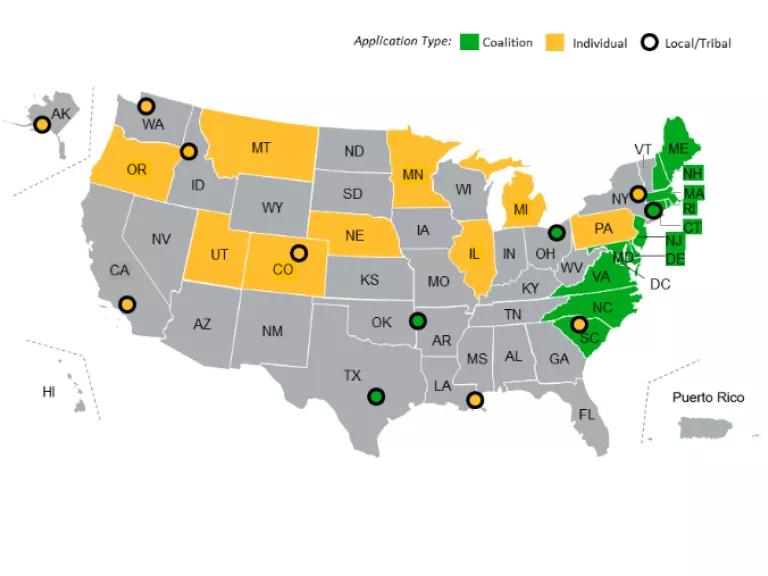
Map of the 25 selected applications for the 2024 CPRG grants.
https://www.epa.gov/inflation-reduction-act/cprg-implementation-grants-general-competition-selections
Among the 25 selected applications, seven of them feature solutions specifically for industrial decarbonization. Awardees and their respective projects that cover the industrial sector:
- Pennsylvania
- The award will support the creation of RISE PA (Reducing Industrial Sector Emissions in Pennsylvania), a statewide industrial decarbonization incentive program that will reduce greenhouse gas (GHG) and other emissions from Pennsylvania’s industrial sector.
- Colorado
- The award will support statewide industrial measures such as an emissions analysis and conducting strategy development for decarbonizing the state’s industrial sector.
- Illinois
- The award will support initiatives such as creating a clean industry concierge to support low carbon retrofitting of 10 industrial facilities
- Virginia
- The award will support measures such as increasing industrial energy efficiency and identifying/implementing opportunities for emissions reductions at industrial facilities.
- Minnesota
- The award will support measures to spur innovation in the industrial sector.
- Utah
- The award will support measures toward industrial efficiency upgrades.
- Nebraska
- The award will support measures such as promoting energy efficiency in industrial facilities.
EPA grants for reducing embodied greenhouse gas emissions for construction materials and products (EPD assistance)
This past July, the EPA announced nearly $160 million in grants to provide technical assistance for the development of environmental product declarations (EPDs) for low carbon materials and products. EPDs are verified documents that report the environmental impacts of a product The grants range from $250,000 to $10 million and include investments in data and tools. The awards include 14 material categories, including concrete, steel, insulation, and reused materials.
This program is crucial to maximizing the emissions reductions possible in the industrial sector. Currently, industry lacks standardized reporting for carbon emissions embedded in construction materials. EPDs are becoming the industry standard approach to reporting and verifying such data. Therefore, robust and reliable EPDs are critical for reducing the carbon intensity of public procurement and the construction industry at large.
Grantees listed by region, can be found in the official summary document (starting on page 23).
DOE Industrial Demonstrations Program (IDP)
In March of this year, the Department of Energy (DOE) announced thirty-three projects across eight industrial sectors will receive up to $6 billion in federal funds from the Office of Clean Energy Demonstrations (OCED), catalyzing an additional $14 billion of private-sector capital. These demonstration projects are intended to catalyze first-of-a-kind, large-scale decarbonization projects in the industrial sector to validate promising yet nascent technologies and lock-in an early-mover advantage for U.S. manufacturers. To learn more about the program and project highlights, please view our blog here.
Looking forward
In the four programs highlighted here, $8 billion in funding will go to dozens of states to accelerate efforts to clean-up and revitalize heavy industries. While this funding is a good start, it is not enough to get the job done. For steel and cement manufacturing, additional funding and regulation are needed to modernize U.S. plants, significantly reduce their carbon and pollution footprint, and secure good domestic jobs. States have undoubtedly just received a much welcome jolt from the federal government to support such efforts. The hard work of ensuring programmatic success and continued support has just begun.
Related Blogs
Uncovering the Secret Documents Behind the Trump Administration's Clean Manufacturing Cancellations

Building Codes, Buy Clean, and Beyond: An Embodied Carbon State Policy Playbook