Hyperscalers Should Put Community Investment First: Here’s How
New research shows that cities, utilities, hyperscalers, community-based organizations, and other stakeholders can work together to prioritize community-focused energy investments to manage rapid load growth while delivering direct local benefits.
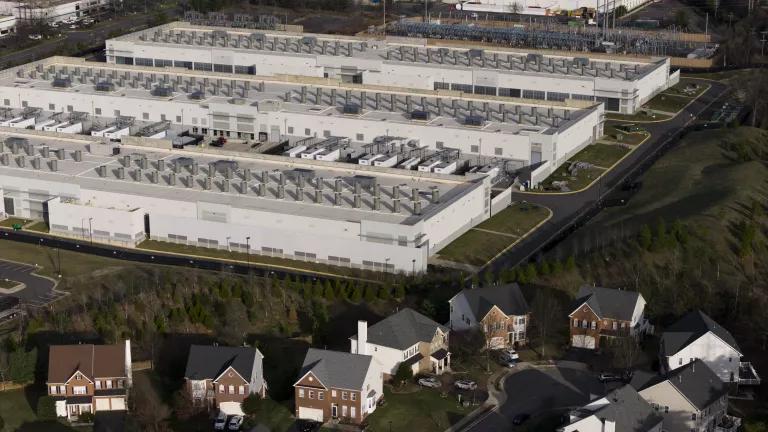
Northern Virginia has the largest concentration of data centers in the world—like this Amazon data center in Sterling—managing roughly 70 percent of global internet traffic.

This blog was coauthored by Ilmi Granoff, senior advisor, NRDC.
The rapid rise of AI is driving a sharp increase in electricity demand from “hyperscalers”—large-scale AI data center developers. Without careful planning and key guardrails, meeting that demand could mean environmental and health impacts, higher household electricity bills, expensive grid overbuild, and new fossil fuel infrastructure, whose costs and impacts will fall on host communities. Communities find themselves in different positions with respect to AI data center development. Some are already living with them. Others are trying to attract them, and increasingly, others are opposed.
For those who are living with AI data centers or are considering them, hyperscalers, utilities, and local governments should take a “high road” approach to energy demand growth that implements guardrails and strengthens the grid while prioritizing direct investment in households and communities. Investments in weatherization, home repairs, heat pumps, distributed solar and storage, and demand-management technologies can reduce household energy costs; at the same time, they could lower peak demand, improve grid flexibility, reduce the need for expensive new infrastructure, and provide other benefits.
New research prepared by the Brattle Group for NRDC suggests these opportunities could be significant. Examining four metropolitan areas—Atlanta; Memphis; Columbus, Ohio; and Kansas City, Missouri—Brattle’s study found that targeted household and building-level energy improvements could unlock roughly 1.4 gigawatts (GW) of summer peak capacity and 1.2 GW of winter peak capacity within five years while reducing household energy costs by as much as $1,175 annually.
Community investments are not quid pro quo for community approval or a reason to evade or weaken guardrails, and communities have the right to oppose data center development. Where data center development is occurring, however, approaches that align system needs with community benefits can help avoid worsening affordability and infrastructure burdens.
Rapid load growth is already straining communities
Electricity load growth is not inherently bad. In fact, fighting climate change will entail a significant increase in electricity demand as we free buildings, transportation, and industry from fossil fuel dependency. Under the right conditions, load growth can support investment in cleaner infrastructure, strengthen utility economics, and accelerate broader electrification. But the scale, speed, and geographic concentration of data center build-out create a distinct challenge.
In grid regions such as PJM’s, which includes Virginia’s “Data Center Alley,” rapid data center expansion is already contributing to rising system costs. Capacity market auction prices at PJM surged by a factor of 10 to hit record highs in 2024, only to rise again in 2025, contributing to higher retail electricity prices across the region. Between the summer of 2024 and summer 2025, 8 out of 10 PJM states experienced retail electricity price increases above the national average. Washington, D.C., saw electricity prices rise by 36 percent over that period and Virginia experienced a 13 percent increase.
These trends are consequential, particularly for households that are already under significant financial strain. Recent polling shows that electricity bills are a major source of stress for more than a third of U.S. adults, and one in six households is behind on their utility bills. As electricity becomes a larger share of total household expenditures, particularly in regions undergoing rapid load growth, the distributional impacts of utility investment decisions demand attention. In some of these regions, hyperscalers, utilities, and local governments are pursuing short-term solutions that may ultimately increase costs, emissions, and system vulnerability over time.
The “low road” approach to load growth: Risky, shortsighted, and costly
The “low road” to data center growth prioritizes rapid supply expansion without adequately considering long-term system efficiency, affordability, resilience, or community impacts.
In practice, that can mean heavy reliance on new fossil fuel generation, including partially or entirely off-grid “islanded” gas infrastructure that is built specifically to serve data centers. It can also mean utilities making large investments in generation, transmission, and distribution infrastructure based on uncertain long-term demand forecasts, with costs ultimately borne by households and businesses through higher rates.
These approaches may appear to offer near-term fixes, but they can create significant risks for both communities and the broader electricity system. New, expanded, or renovated fossil infrastructure can lock in emissions, worsen local air pollution, and expose consumers to fuel price volatility. Large-scale grid investments can also ultimately leave ratepayers responsible for stranded or underutilized infrastructure costs if projected demand growth does not materialize.
Just as importantly, a narrow focus on supply-side expansion can crowd out investments in demand-side resources, distributed energy technologies, energy efficiency, battery storage, and grid flexibility measures that could help meet load growth more efficiently, affordably, and resiliently while delivering more direct benefits to communities.
The result is a path that risks producing a grid that is more expensive and carbon-intensive, is less resilient, and misses the opportunity to use hyperscaler-driven investment to lower energy burdens, strengthen local infrastructure, improve resilience, and create broader community benefits.
The “high road”: Big potential for power system resilience and community investment
The “high road,” by contrast, recognizes that investments in households and buildings can play an important role in both managing rapid load growth and delivering direct benefits to communities. Rather than treating community investment as separate from energy planning, this approach integrates household energy improvements into broader grid and resource strategies.
Targeted investments in weatherization, home repairs, heat pumps, distributed solar and storage, and demand-management technologies can reduce household energy costs while also improving overall grid performance. These investments lower electricity demand during peak periods, reduce strain on constrained infrastructure, and create flexibility that can help utilities integrate large new loads more efficiently. Different technologies and program models offer different strengths and tradeoffs.
They can also often be deployed faster than traditional generation and transmission projects. That matters in regions where data centers face years-long delays for interconnection due to transmission bottlenecks or insufficient generation capacity.
For households, these investments can lower energy bills, improve comfort and resilience, reduce exposure to electricity price volatility, and enhance housing quality. For utilities and the broader electricity system, they can reduce peak demand, lower emissions, and support a cleaner, more flexible, and more resilient grid. Community investments may even function as “virtual capacity,” in some cases helping to defer or avoid expensive infrastructure upgrades and reducing pressure for large rate increases tied to speculative demand growth.
Importantly, community investment does not substitute for responsible utility planning, transmission expansion, or clean energy procurement. Nor does it address every community concern associated with data center development. It should not be a substitute for complying with guardrails or a quid pro quo for absorbing data center impacts. But it does represent an approach to meeting rapid load growth that seeks to align system needs with community benefits rather than treating them as competing priorities.
New research shows community investments can scale at speed
The Brattle Group research found that targeted investments in household and building-level energy improvements could unlock more than 1.4 GW of summer peak capacity and 1.2 GW of winter peak capacity within roughly five years. These outcomes were achieved assuming upgrades in only a small share of eligible households—roughly 3 to 8 percent, depending on the market and technology—pointing to the potential for even greater capacity additions if more eligible households can be reached. The modeled portfolios also reveal important trade-offs across technologies: Demand response programs offered a highly scalable and comparatively low-cost, near-term capacity opportunity while community solar and storage provided the largest potential household savings and firm capacity benefits, albeit at a higher up-front cost.
The modeled investments also produced significant household savings. Depending on the measures deployed and local conditions, participating households could save between roughly $50 and $1,175 annually on energy bills. Across the modeled portfolios, data centers were assumed to fund a substantial share of up-front customer costs in order to accelerate adoption and minimize out-of-pocket costs for participating households.
Approximately 35 to 40 percent of eligible households across the study areas were low-income households, indicating that these investments could meaningfully reduce energy burdens where they are often most acute. It is important to note, however, that the report does not cover program design: To ensure low-income customers actually participate and benefit without increasing debt burden, funding should be targeted to benefit them.
The study also found that these investments could avoid approximately 1.15 million metric tons of carbon dioxide emissions annually while reducing pressure on constrained electricity systems.
Although implementation strategies will differ by region, the research points to several promising pathways for deployment, including utility-administered programs, aggregator partnerships, green banks and community development finance institutions, and targeted financing mechanisms that build on existing energy efficiency and distributed energy initiatives. With sufficient coordination and support, these approaches could help translate system-level benefits—such as avoided capacity costs and increased flexibility—into investments that directly improve community outcomes.
NRDC plans to continue building on this work through additional analysis and engagement with metropolitan regions, utilities, hyperscalers, community-based organizations, and other stakeholders to help them prioritize community-focused energy investments in order to manage rapid load growth while delivering direct local benefits.
Related Blogs

Why Repealing the Greenhouse Gas Reporting Program Would Harm American Manufacturers
10 Years After Kigali: What Comes Next for the Global HFC Phasedown?