Every Road Cuts Deeper: How Forest Fragmentation Threatens Water and Wildlife
As more and more of our forests face threats from industry and the Trump administration, it’s critical to protect the Roadless Area Conservation Rule.


Forests and water
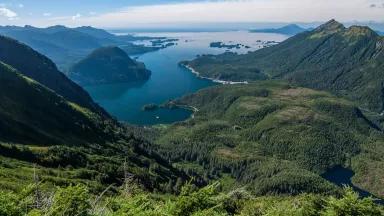
Our forests are complex living ecosystems. Forests catch the fog and mist in the air, letting tiny droplets roll down the surfaces of trees into the soil. They breathe groundwater back into the atmosphere during photosynthesis. Tree roots allow water to seep deeper into the ground, often lessening flooding impacts. And understory vegetation filters dirt and pollution from stormwater runoff, cleaning it before it enters the rivers and streams from which millions of Americans get their drinking water.
A healthy, intact forest quietly does all these things to support our natural clean water resources.
But what happens when you cut a road through that forest? Once roads are built—for logging projects or to mine resources—they have lasting impacts, crisscrossing the landscape well into the future. Rainwater runs into and along the roadway, diverting from its natural path across the landscape and leading to higher flood risk in some places and less water infiltration in others. This water rushes over the soil and past the vegetation that would filter out pollutants, picking up sediments that degrade water quality along the way. Pollution from road traffic accumulates on the road’s surface, further degrading the water that it funnels from the forest.
Learn More


With so much water rushing over the landscape, even small flood events can lead to deadly landslides, as the tree roots that previously held the slope together are lost to logging and roadbuilding. And these dangers typically persist for more than a decade after logging ends since roads remain and trees are slow to regrow.
When you cut 370,000 miles of roads across the National Forest System, the impacts add up quickly: You get overtaxed forest ecosystems, even more polluted waterways, and costly infrastructure damage as nearby slopes give way to landslides and the roads themselves get washed away. So much infrastructure—more miles of roads than our National Highway System—is already hard to maintain, and indeed, the Forest Service currently faces a more than $10 billion road maintenance backlog. More roads will only spread the agency thinner.
Inventoried Roadless Areas play a unique role, doing the heavy lifting to support our clean water resources. But they can only continue to play that role if they remain free of unnecessary roads.

An aerial view of clearcut forest on the coast of Oregon
Fragmentation and the grizzly
Forest roads, logging projects, and other human infrastructure all degrade water quality. And when fragmentation—the cutting up of the landscape into tiny, disconnected pieces—occurs in forests, it’s not only our water resources that suffer but also the animals and plants.
When a forest is intact or well-connected, wildlife has the room and safety to migrate, hunt and forage for food, and find a mate. But when habitat is fragmented, their range shrinks, limiting their movement and where they can live. Compare, for example, a series of islands to that of a mainland. On the mainland, where everything is connected, traveling from one place to another is easy. But it’s much more challenging and often dangerous to move from one “island” of suitable habitat to another. That danger is even greater when instead of water separating those islands, it is roads, vehicles, and heavy logging machinery.
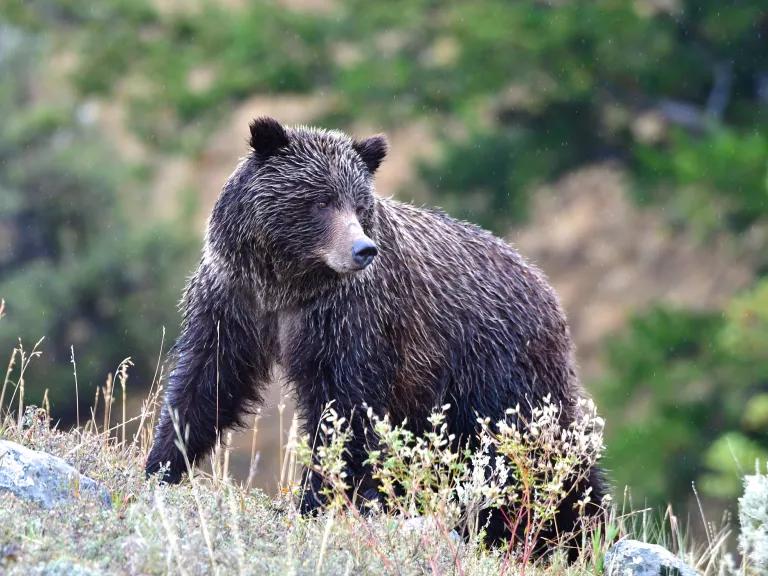
Take grizzly bears, for example. Logging, mining, roads, and other kinds of human development can separate once connected and interbreeding populations from each other, leading to less genetic diversity in their mating pool. Grizzlies are particularly vulnerable because their populations grow slowly and can be hard to monitor. This isolation from other populations is especially detrimental to the continued survival of threatened and endangered species because it makes them more vulnerable to population decline.
Beyond the existential risk of dying out due to a small mating pool, roads also pose a more direct danger to bears: Increased forest resource extraction (i.e., logging, mining, oil and gas exploration, etc.) leads to more grizzly bear deaths. This is for a number of reasons, from temporary and permanent roads granting greater access for hunters and poachers to vehicle strikes and increased conflicts with humans. One study found that “[e]ven in ‘pristine’ landscapes, such as national parks where grizzly bears are protected from hunting, as much as 100 percent of known adult grizzly bear mortalities occurred within 500 m of roads or 200 m of high-use trails.”
The Roadless Rule as the solution
In 2001, the Roadless Area Conservation Rule set out to protect some of the last remaining areas of intact forest on federal lands; that is, large patches of national forests that have not yet been broken up and fragmented into tiny, disconnected pieces. For the last 25 years, this rule has protected nearly 60 million acres (roughly one-third) of the otherwise heavily roaded National Forest System from development—all without stifling necessary restoration work, fire prevention, public access, or recreation.
This policy was adopted and has been defended with massive public support—and for good reason. The rule works. Roadless areas protect essential wildlife habitat. A study assessing the value of roadless areas for wildlife found that every Inventoried Roadless Area supports at least two protected wildlife species, and the median supports 10. While only making up about 2 percent of the continental United States, roadless areas provide extremely high-quality habitat with outsize benefits for wildlife.
The grizzlies depend on roadless areas to connect patches of habitat and populations throughout the Northern Rockies in states like Idaho, Montana, and Wyoming. Roadless areas are the best and last wild forests we have, and they are critical for the recovery of species like grizzly bears. The rule ensures the ecological heart of America’s National Forest System—its roadless areas—remains intact.
Now, the Trump administration is trying to remove these protections across 45 million acres of roadless forest (with no replacement) and make it open season for logging, drilling, mining, and building of thousands of miles of unnecessary roads. This is a move that would reverse decades of species recovery, degrade our drinking water, and harm an untold amount of wildlife.
Our national forest system is already full of roads, and more roads are cut into these public lands every year. The Roadless Area Conservation Rule keeps the most remote and valuable intact forests from suffering a death by a thousand cuts.
Related Blogs

Trump Administration Readies the Axe for Nearly 45 Million Acres of Public Forests
The Public Lands Rule Falls Victim to the Dirty Energy Agenda