In Uncertain Times, Tribes Provide Steady Protection for Clean Water
Tribal Nations protect and manage millions of acres of wetlands, which help improve water quality, curb the risk of floods, recharge groundwater, and store large amounts of carbon.


Two years ago, the U.S. Supreme Court slashed federal Clean Water Act protection of wetlands, streams, and all of our clean water with its decision in the Sackett v. EPA case. NRDC scientists mapped the potential impact of the Sackett decision and found it devastating—threatening harmful repercussions for droughts, wildfires, flooding, wildlife, and the drinking water supply.
In the absence of federal protection, the imperative to defend our shared waters falls increasingly on individuals, states, and Native American Tribal Nations. NRDC is actively working to prevent any further weakening of the Clean Water Act (which the federal U.S. Environmental Protection Agency intends to pursue) and to ensure the law remains a robust tool for all wetland and stream advocates, including Indigenous Peoples. Tribal Nations protect and manage millions of acres of wetlands in the United States, and with commitments made by the U.S. government to Tribal co-management and co-stewardship of federal lands, the amount of clean water safeguarded by Tribal Nations is growing.
NRDC’s Science Office mapped the wetlands found within and intersecting the boundaries of Tribal reservation lands in the contiguous United States. Across the 294 federally recognized Tribal reservations mapped in this analysis, our scientists found that Tribes steward more than 3 million acres of wetlands. Even typically arid regions like the American Southwest have significant wetlands on Indigenous reservations.
NOTE: This map is best viewed on a desktop/laptop/tablet; on mobile, the map is best viewed in Chrome.
We acknowledge that Tribal land ownership in the United States today is complicated by a long history of colonization and relentless acts of legal and physical violence, whereby Indigenous Peoples have been forcibly uprooted and Indigenous homelands mostly dismantled, partitioned, or stolen. Additionally, the act of mapping reservation boundaries is admittedly fraught with limitations. For one thing, within a reservation boundary, lands can be held in trust, held in common, restricted fee lands, fee lands, or allotted lands, among other ownership statuses. (You can learn more about the different Tribal land ownership statuses here.)
For another, in addition to the 56.2 million acres that are part of the Tribal reservation system, many Tribes have reserved or treaty rights on lands outside reservation boundaries, and most Tribes and their members maintain ongoing physical, cultural, spiritual, and economic relationships with their ancestral homelands. These reciprocal land and water relationships extend far beyond the political boundary of any designated reservation.
This analysis is limited to federally recognized Tribes in the Lower 48 due to the complex Tribal governance systems in Alaska and Hawai’i. For example, the Alaska Native Claims Settlement Act of 1971 altered the previous Tribal ownership system to one led by Alaska Native Corporations. This system differs from federally recognized Tribes, which have a government-to-government relationship with the United States that includes eligibility for funding and services from the Bureau of Indian Affairs.That is to say, NRDC’s analysis looked at just a fraction of the total wetlands stewarded by and connected to the lives and well-being of Native peoples today.
To learn more about Tribal wetland conservation, we spoke with leaders in the wetland management programs of the Navajo Nation and Red Lake Band of Ojibwe. This blog describes some of the ongoing efforts of those two Tribes—in very different parts of the country—to protect wetlands and other waters on their lands.
Learn More

The Navajo Nation
The Navajo Nation spans large parts of Arizona, New Mexico, and southern Utah, and according to NRDC’s analysis, it has more than 175,000 acres of wetlands within its boundaries, most of which are riverine, occurring in the floodplains of rivers, creeks, or seasonal streams. For the Diné people, as the Navajo call themselves, living in an often hot and dry climate means a lot of traditional ecological knowledge and culture is centered on water.
The Colorado River (Nts'ósíkooh) and Rio Grande (Tooh Ba'áadii) are the two largest rivers in the Southwest and are part of the Diné reservation landscape. These two rivers, along with the Little Colorado (Tółchíʼíkooh) and San Juan (Tooh Biką’í) rivers frame Diné lands in the four cardinal directions. Brent Powers, biologist and wildlife manager of the Navajo Natural Heritage Program, shared that the Navajo Nation hosts an annual trip down the Colorado River, during which participants spend a lot of time talking about water and places where you can find water.
In the Navajo language, there are many ways to describe water. Tó is the root word for water, and then you can add other descriptors, explained Powers, depending on whether it’s a drip of water, swift-moving water, or a small pool of water that has collected.
Navajo Nation agency staff are engaged in numerous projects to help restore and protect this essential resource. The Diné Native Plants Program recently submitted a grant application to remove invasive plant species along the Little Colorado’s riverbank. This will make space for native vegetation to grow and help with groundwater recharge for nearby Navajo farmers and families. The Diné Native Plants’ seed program also provides seed mixes for restoration projects that are solely sourced from Navajo plants.
Jesse Mike, the Diné Native Plants program coordinator, stepped out of the greenhouse to speak with us. He shared about the history of livestock grazing, trampling, and erosion that have impacted not only the health of the headwater streams on Navajo lands but also the underlying water table. His team is currently working to increase groundwater infiltration and improve the overall ecosystem health of three degraded streams in the Chuska Mountains.

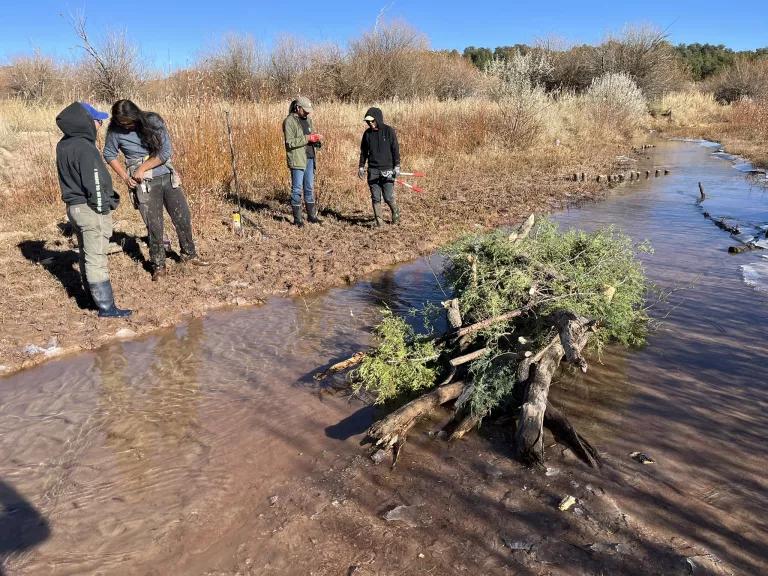
Totsoh Creek in the Navajo language translates into “big water,” and the stream is one of several that, in the past, flowed into a lake. Today, the lake is gone, and the stream no longer flows year-round. The other two restoration sites, Crystal Creek and Tsaile Creek, are also seasonal streams. Mike is hopeful that by building structures that mimic beaver dams and Zuni bowls—an Indigenous technology used to slow the flow of water, catch sediment, and halt erosion using stone and wood—his team can help induce more meandering, improve floodplain connectivity, and, perhaps, even restore these streams so they flow year-round again.
Clean and reliable water is in short supply for many Diné people. About 30 percent of Diné households don’t have any access to running water. Much of the available water has been contaminated by a long history of the U.S. government’s extraction and exploitation of the Navajo people’s lands and resources. Hundreds of abandoned uranium mines near Diné communities have yet to be cleaned up and remediated by industry owners. This issue becomes increasingly relevant given the resurgence of interest in uranium to power the country’s growing energy demand. The Trump administration’s deregulatory agenda may also clear the way for domestic uranium extraction by undermining community input.
Wetlands act as a natural filtration system, and they have been found to trap uranium and other metals, helping to protect water quality. Restoring wetlands and intermittent streams is a critical piece of the urgent effort to help secure fresh, clean drinking water for Navajo Nation families. When we asked Mike whether he was concerned about the current uncertainty of federal funding for Tribal agency conservation efforts, he said, “We really believe in this work. Whatever happens, we’re going to keep going.”
The Red Lake Band of Ojibwe
The Red Lake Band of Ojibwe’s reservation is in northern Minnesota and has the greatest area of wetlands of any reservation in the contiguous United States. Across the Tribe’s more than 835,000 acres of land—all held in common by the Tribe—the Red Lake Band manages an astonishing 541,000 acres of wetlands. “So many wetlands,” says Tyler Orgon, a biologist and the lead wetland specialist for the Red Lake Band Department of Natural Resources, “and we’re very fortunate for that.”
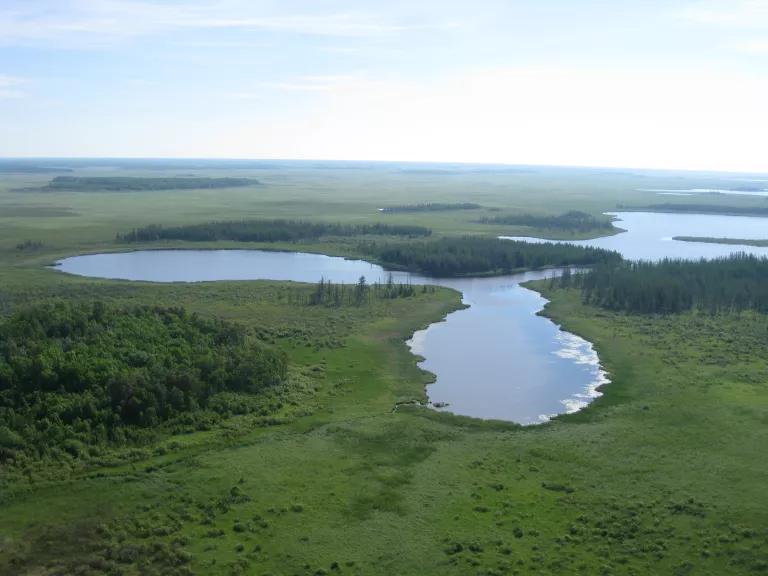
A sizable portion of the Tribe’s wetland acreage north of Upper Red Lake is part of the largest expanse of peatlands in the continental United States. Peatlands cover about 3 percent of the earth and store more carbon than all of the planet’s other types of vegetation, including the world’s forests, combined.
One of the most important wetland-dependent plant species for the Red Lake Band—as well as other Anishinaabe and Dakota peoples across the Great Lakes region—is manoomin (Zizania palustris and Z. aquatica), the only wild rice native to Turtle Island. According to an Ojibwe prophecy, their ancestors were instructed to move west to the place where “the food floats on water.”
The University of Minnesota research team We Must First Consider Manoomin (Kawe Gidaa-naanaagadawendaamin Manoomin) works to help protect this essential wetland-dependent plant by combining Western science with Indigenous science and learning from Ojibwe stewardship. The scientists have found that an increase in extreme weather conditions (like flooding events and record-breaking snowfall) negatively impact manoomin growth by uprooting the plant or drowning it out in its sensitive early stages. These weather events compound the already present settler-colonial impacts on wetlands in the region, including deforestation and conversion of wetlands into agricultural land use.
Orgon hopes to restore some of the Red Lake Band’s wetlands that have been impacted by past agriculture. These wetlands hold large amounts of mercury, likely accumulated and deposited over the years from releases into the atmosphere by distant coal-fired power plants. When wetlands are drained with dikes and ditches, the stored mercury can be released. Today, for example, mercury still runs into Upper and Lower Red Lakes and can bioaccumulate in the fish that Tribal members eat. This is a big problem, since the fishery on Lower Red Lake is one of the largest sources of income for Tribal members. Additionally, the Red Lake Nation Fishery is the oldest-operating commercial walleye fishery in the United States. Mercury levels can be four to eight times higher in the abandoned agricultural ditches running through the Tribe’s wetlands than other reference sites. The restoration for these ditches must be considered case by case and will likely involve ditch plugs to slow the flow and restore the peatlands, explains Orgon. Currently, a collaborative effort between federal, Tribal, state, and nonprofit agencies is taking place to restore the hydrology of a couple of abandoned ditches north of Upper Red Lake.
In addition to manoomin, the Ojibwe people have cultural connections to other wetland-dependent plants like sweet flag, which is used for pain relief; dogwood, which is mixed with tobacco for recreational and ceremonial use; and birch bark, which is used to make canoes.
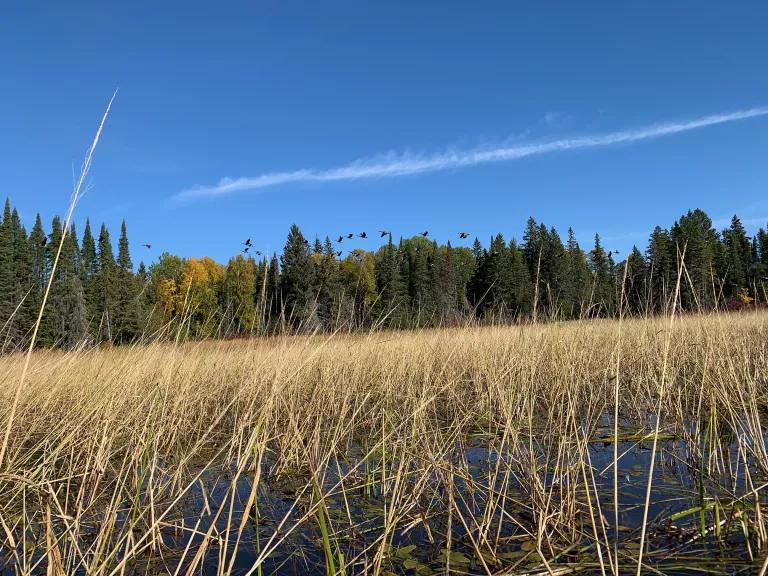
The wetlands in and adjacent to the Red Lake Band’s reservation also provide essential habitat for birds during migration. The Important Bird Areas initiative designates high-value areas for avian species and biodiversity health. Two such areas are on or directly next to Red Lake Band’s reservation lands: the Big Bog and Lake of the Woods. The Big Bog, also known as the Red Lake Peatlands, is home to at least 289 bird species, including 12 species of breeding warblers.
In the spring and fall, the Tribe’s wildland firefighting crews conduct prescribed burns in some of the Tribe’s forests, meadows, and wetlands. This ancient cultural practice helps to limit the spread of invasive species, maintain the native seed bank, and improve wildlife habitat for birds and other species. With careful stewardship, the hope is that these wetlands can continue to provide for Ojibwe people for many generations to come.
Conclusion
Around the world, the key role that Indigenous Peoples hold in safeguarding biodiversity and clean water is well established. That care is age-old. At a recent convening of the National Association of Wetland Managers, which included Tribal and state agency wetland managers, Rue Hewett-Hoover, the wetlands program coordinator for the Nez Perce Tribe, reminded the attendees that for Tribes, they don’t just see a wetland with its countless ecosystem services: “They see fiber and food.”
Meanwhile, federal agency staff charged with protecting public lands are experiencing mass layoffs, federal funds that support conservation are highly uncertain, and legal protection for freshwater is under threat. Now is the time for all of us to advocate for greater investment in and support for Tribal stewardship and management of aquatic resources. Tribal Nations have entered into more than 400 cooperative agreements with federal agencies to co-manage public lands, and many Tribes are well poised to build off past sovereign-to-sovereign agreements. In an effort supported by NRDC and others and led by the Native American Rights Fund and the Native American Law Center at the University of Washington, there is now a repository of these cooperative agreements to learn from, available here.
We must also be collectively vigilant against any effort by the federal government to evade its legal trust obligation, codified in statute and court rulings, and to consult Tribes on matters that impact their lands, resources, and lifeways. This includes watchdogging the U.S. Department of the Interior’s announcement last month that it will invoke alleged “energy emergency” authorities to fast-track fossil fuel and mining on public lands and in federal waters, as well as a similar effort being pursued by the U.S. Army Corps of Engineers.
This country’s wetlands and waters are shared, and as we reflect on the two-year anniversary of Sackett, it might bring us all a bit of much-needed hope to recognize that we collectively benefit from the leadership and expertise of Tribal Nations, who have a long, steady, and successful history of clean water stewardship.
Related Blogs
Trump's Eleventh Hour Attacks on America's Natural Treasures
Stewarding Biodiversity at the Bureau of Land Management