
Clean Trucks, Cloudy Prices: Why Transparency Matters
Price transparency is a simple yet powerful way to help clean trucks reach more people.
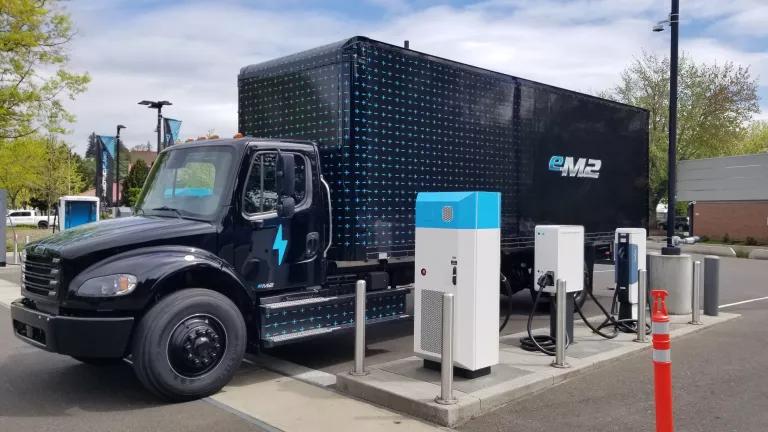
An electric semi-trailer truck


States across the country are investing in the shift to zero-emission trucks—building charging networks, supporting fleets, and driving toward a cleaner, healthier future. These investments promise big wins for air quality, public health, and climate goals while helping fleets save on fuel and maintenance. The stakes couldn’t be higher: Transportation is the leading source of greenhouse gas emissions in the United States, responsible for more than a quarter of the nation’s total. And while heavy-duty vehicles make up just 10 percent of vehicles on the road, they account for 28 percent of the transportation-related greenhouse gas emissions, 45 percent of its nitrogen oxide (NOx) emissions, and 57 percent of particulate matter pollution.
With demand rising from fleets, states are in a prime position to grow this market, but there’s a secret problem (literally!) that could slow everything down: Opaque truck pricing makes it extremely difficult to compare costs, stifling the competitive pressure that would drive prices down. Without transparency, public investments risk padding manufacturer margins instead of delivering affordability for fleets.
The problem with hidden prices
In most consumer-facing industries, like passenger cars, you can easily compare prices online or on a dealership lot. Manufacturer’s Suggested Retail Prices (MSRPs) are publicly posted, and buyers have access to a wealth of pricing data. But in the medium- and heavy-duty (M/HDV) truck world, pricing is far more complex and far less transparent. Here’s why:
- No public price listing: Unlike light-duty vehicles, most manufacturers don’t publish MSRPs for heavier trucks and buses.
- Highly customized sales: Trucks are often tailored to specific fleet needs, with varying configurations, add-ons, and dealer markups.
- Negotiated deals: Prices vary widely depending on the buyer’s size, purchasing power, and relationship with the dealer or manufacturer. In some cases, these deals are even protected by nondisclosure agreements, further limiting transparency and public oversight.
- No centralized public database: There’s no publicly accessible repository of historical truck prices, making it difficult to track trends or compare costs across buyers or regions.
This lack of visibility gives manufacturers significant control over price and limits accountability, especially when public dollars are involved. The result is a market landscape where pricing trends tell a surprising story.
What we’re seeing in the market
Despite these challenges, recent research from the International Council on Clean Transportation (ICCT) sheds light on a troubling trend: The median price of class 8 battery-electric tractor trucks in the United States has increased 27 percent since 2020, even as battery costs have dropped. In contrast, in the European Union, similar tractor trucks fell in price by 32 percent over the same period.
To reach these conclusions, ICCT drew from a mix of commercial databases, government incentive records, anonymized fleet data, and industry consultants. While granular data was hard to obtain due to the commercially sensitive nature of truck pricing, aggregated and adjusted figures revealed a clear pattern: Electric trucks are getting more expensive in the United States, not less.
That’s a big red flag. It suggests that public investments meant to support clean trucks may be padding manufacturers’ margins instead of driving down costs for fleets. And that’s a problem for many reasons.
When prices for both electric and diesel trucks lack transparency, it becomes harder for policymakers and fleet owners to evaluate the total cost of ownership and confidently justify electrification. That slows down adoption and makes it tough for policymakers to design smart incentive programs. It also creates an uneven playing field—smaller fleets and public agencies pay more, while big buyers with more negotiating power get better deals. Without transparency, we risk wasting public money and leaving behind the communities that need these trucks the most.
How states can lead: Make prices public
With the federal government actively rolling back support for clean energy and electric vehicles, states are stepping up to fill the gap. For instance, California conservatively projects an annual funding need of $950 million per year over the next five years for its M/HDV incentives. But if states don’t address the pricing issue, they risk spending big without getting the impact they’re aiming for. That’s why price transparency measures must be built into clean truck programs to ensure that every dollar drives affordability and market growth.
Here’s what states should do when designing or updating their clean truck programs:
- Make price disclosure a requirement for receiving state incentives.
- Use pricing data to set cost targets and shrink the gap between diesel and electric trucks.
- Make sure public dollars expand access to clean trucks, especially in freight-impacted communities.
Price transparency isn’t just nice to have—it’s what makes good policy work. When states know what trucks actually cost, they can design smarter programs that stretch public dollars and help fleets make informed choices. For example, researchers at University of California Davis’s Institute of Transportation Studies recommended tying purchase incentives and financing to annual price targets to close the cost gap between electric and diesel trucks and give fleets a clear path to savings. A coalition of environmental, equity, and public health groups recently urged California regulators to go further: require full price disclosure for any truck receiving state incentives, publish aggregated pricing data twice a year, report back within 60 days with more ideas, and use real-world pricing data to update programs. These steps would help level the playing field and ensure that investments support fleets that need help.
Why now?
Budgets are tight. Pollution is rising. Communities are struggling. We can’t afford to waste money or miss the mark. Price transparency is a simple, powerful reform that can help clean trucks reach more people, faster—and recent research shows why it’s overdue. Smart policy starts with clear numbers. Show us the price tag.
Related Blogs
Congress Is Cutting Off Transportation Investments that Help Families Save Money

Getting Off the Gas Price Rollercoaster