
The Trump Administration Wants Your Car to Pollute More
Yet again, the EPA is willfully ignoring health benefits and putting polluters over people.
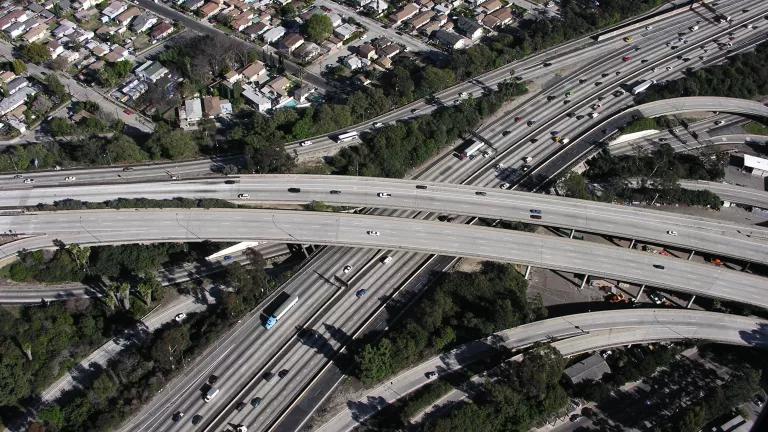
A freeway interchange near a residential neighborhood in Los Angeles

The Trump administration gutted electric vehicle (EV) tax credits, fuel economy regulations, and greenhouse gas standards for vehicles. Now it’s arguing that it can’t cut tailpipe pollution because those policies are gone and fewer EVs are going to be on the road. The head-spinning nihilism at work here is hard to fathom.
Specifically, the U.S. Environmental Protection Agency (EPA) has proposed a two-year delay of stronger tailpipe standards that were set to go into effect by 2027—measures that would protect our health with proven, widely available, cost-effective technology.
What’s more, this is just “Part 1” of the EPA’s plan: The agency announced that it plans to weaken the standards even further after this.
Who loses in this cruel cycle? Every child with asthma and grandparent with heart disease. But, no worries, the EPA has refused to calculate the significant health impacts of delaying these rules. Adding insult to literal injury, the EPA’s proposal tallies up the savings for the auto industry: $1.77 billion, to be precise. Ignoring the problem is apparently the EPA’s plan to try and make these health impacts disappear, even as it touts purported cost savings down to the decimal.
This lopsided analysis makes the EPA’s priorities clear, revealing the proposed delay is nothing more than a giveaway to automakers and oil and gas corporations, which the administration is cynically justifying by pointing to its own disastrous deregulatory agenda. But as the Trump administration doubles down on this path—sacrificing our health—NRDC and our members are fighting back.
What’s at stake
Vehicles cause a tremendous amount of pollution: over half of the nation’s nitrogen oxide (NOx) emissions and large percentages of particulate matter pollution, according to the EPA. Vehicles are estimated to be the largest source of air pollution related to premature deaths—tens of thousands per year.
For this reason, the EPA has adopted increasingly stringent tailpipe standards over many decades, starting with the “Tier 1” standards in 1990. Most recently, the EPA adopted the Tier 4 standards for passenger vehicles and smaller commercial trucks to further reduce NOx, non-methane organic gas, and particulate matter —the pollutants that burden our skies with soot and smog and harm our health.
Indeed, the EPA’s own modeling shows that over the lifetime of these regulations, the standards will prevent millions of tons of pollution. These emissions reductions will prevent millions of asthma attacks, thousands of hospitalizations, and hundreds of premature deaths—adding up to $13 billion in annual health benefits, according to the EPA’s own 2024 analysis. These benefits would be especially pronounced for communities living near major transportation corridors, which are disproportionately low-income and communities of color.
The EPA buries its head in the sand
Despite these significant benefits, the Trump administration’s EPA now proposes delaying these standards by two years and has announced that it later intends to weaken them. The EPA justifies this groundless delay by burying its head in the sand. The agency tasked with protecting the environment and public health refused to conduct air quality modeling of the pollution caused by this delay or quantify the impacts on human health and welfare.
You read that right: Despite tallying the cost savings to automakers from this delay, the EPA left the other side of the ledger—our public health—blank. But even if the EPA refuses to look, we know that its proposed delay will cost lives and endanger the health of our most vulnerable.
The EPA’s twisted logic
Why does the EPA say all of this is necessary? Because the Trump administration’s other actions have caused EV sales to be slower than expected (albeit still rising): rolling back or eliminating other federal clean vehicle and fuel economy regulations, attempting to render state-level clean vehicle regulations unenforceable through unprecedented uses of the Congressional Review Act, and eliminating tax credits for clean vehicles. In other words, the Trump administration has sought to lock drivers into one option—gas vehicles—seemingly for the sole benefit of oil and gas companies and other corporate interests.
The EPA’s logic goes something like this: EVs help automakers comply with the pollution standards because they emit zero tailpipe emissions. As a result, the more EVs an automaker sells, the fewer emissions controls they must put on their gas-powered vehicles. But because of the Trump administration’s own policies, there are fewer EVs, so automakers have to install more pollution controls on their gas-powered vehicles. The EPA now claims reduced EV sales make it so hard for automakers to comply with the Tier 4 standards over the next two years that it has no choice but to delay them.
This approach is incredibly cynical, using the administration’s past actions that increase pollution to justify further degradation of our air and health. The EPA is like an arsonist arguing for fewer fire codes because the building is already burning.
We can and must reject this warped reasoning.
Luckily, the EPA is also wrong: Automakers have all the tools they need to meet the tailpipe pollution standards, and there is no justification for delay.
Another path is possible
Even with lower-than-expected EV sales, the Tier 4 standards are achievable. Indeed, the Biden EPA designed the standards to be feasible solely with widely available and highly cost-effective technologies for gas-powered vehicles. To take just one example, gasoline particulate filters (GPF), which can achieve the Tier 4 particulate matter standards, have already been installed in an estimated 100 million vehicles worldwide. Numerous other technologies exist to meet the Tier 4 standards. Even the Trump EPA admits it has no “concerns with the ability of technologies to achieve the…Tier 4 standards.”
Not only is the technology available, but it is also a good deal. The EPA estimates the cost of a GPF at $133–$361 per vehicle, below 1 percent of the average cost of a new vehicle, and NOx controls are even cheaper according to the EPA, at just $34–$63 per vehicle. Overall, the EPA projects its proposed delay will save automakers $1.77 billion, but those costs are easily dwarfed by the $13 billion annual health benefits that implementing the Tier 4 standards would bring. The EPA is willing to sacrifice health benefits that are 10 times higher than the savings for the auto industry just to increase profits.
In short, even putting aside that EVs remain a cost-effective compliance pathway—indeed, consumer satisfaction with EVs is at all-time highs, with significant growth in the used EV market—the EPA ignores the fact that automakers have long had all the tools they need to comply with gas-powered vehicle pollution standards.
What comes next
We’ve said it before, and we’ll say it again: The EPA’s one job is to protect the environment. This proposal to delay the Tier 4 standards is a cynical corporate giveaway that sacrifices our health.
Luckily, there is an opportunity to make your voice heard (below) by filing a public comment before July 6, 2026.
This NRDC.org blog is available for online republication by news media outlets or nonprofits under these conditions: The writer(s) must be credited with a byline; you must note prominently that the blog was originally published by NRDC.org and link to the original; the blog cannot be edited (beyond simple things such as grammar); you can’t resell the blog in any form or grant republishing rights to other outlets; you can’t republish our material wholesale or automatically—you need to select blogs individually; you can’t republish the photos or graphics on our site without specific permission; you should drop us a note to let us know when you’ve used one of our blogs.
Tell the EPA: Don't delay clean car Standards
Trump’s EPA just proposed delaying life-saving clean car standards—which will cut the soot, smog, and toxic chemicals from cars and trucks that cause asthma attacks, heart attacks, and premature deaths—until 2029. We must stand against this handout to the auto industry. Submit a public comment before July 6 opposing this plan.
Related Blogs
The EPA Cooks the Books in Trying to Cook the Planet
The EPA Continues Pushing a Gas Guzzler Mandate
