
The EPA Cooks the Books in Trying to Cook the Planet
The agency’s power plant rollback—right after the hottest summer on record—will raise your power bills and worsen the climate crisis.
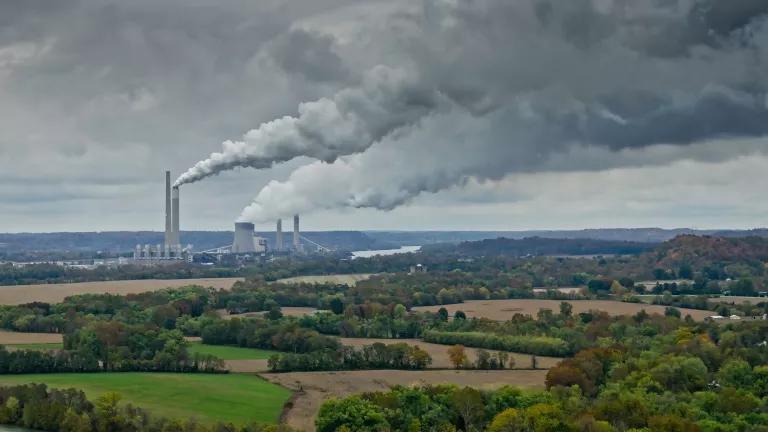
Emissions pouring from two coal-fired power stations located on the Ohio River in Cheshire, Ohio


The U.S. Environmental Protection Agency (EPA) announced its repeal of the 2024 carbon pollution standards for power plants, on the heels of the hottest summer that Americans have ever endured. Those standards were reasonable, affordable, legal, and absolutely necessary when they were first unveiled. The climate-fueled extreme weather and data center blitz of the last year make them even more so now.
Without these standards, dirty coal and gas power plants will continue spewing as much carbon pollution into the atmosphere as they please, worsening the air we all breathe and amplifying the climate extremes we’re already seeing today. NRDC has sued the EPA to stop this unlawful and dangerous rollback in court.
But the Trump EPA didn’t stop at repealing the 2024 power plant standards: The agency also issued a new proposal purporting to find that the EPA lacks any authority at all to regulate power plants’ climate pollution under the Clean Air Act. The new proposal doubles down on the EPA’s repeal of the landmark 2009 endangerment finding and climate pollution standards for motor vehicles earlier this year and is yet another step on this administration’s campaign against climate action.
In the case of this repeal, the EPA is trying to hide a $2.2 trillion rabbit inside a $160 billion hat.
Both the EPA’s repeal of the 2024 standards and its broader proposal to evade its statutory responsibility entirely are preposterous, running afoul of both the plain text of the Clean Air Act and U.S. Supreme Court precedent. The Trump EPA is trying to cook the books to hide the full impacts of its dangerous actions, but the consequences are clear: These rollbacks threaten our pocketbooks and endanger our lives.
Cooking the books
In announcing that it would repeal carbon pollution standards for power plants, the Trump EPA made repeated references to “affordability” and claimed that these rollbacks would save consumers money.
But the Biden EPA determined in 2024 that the power plant standards would have delivered $390 billion in total benefits—more than 20 times the compliance costs—by reducing health-harming pollution and thereby avoiding thousands of hospitalizations, asthma attacks, lung disease, missed work and school days, and other public health impacts.
So which EPA is right? The answer will not surprise you.
In February, the Trump EPA changed how it calculates the costs and benefits of its regulations. Building on its earlier decision to ignore the harms caused by climate pollution, the agency decided that it would likewise no longer monetize the public health harms caused by air pollution. Instead, the EPA would only look at one side of the ledger: how much it would cost the regulated industry to reduce that pollution. Why? The EPA knew that math wasn’t on its side, and the agency wanted to hide the truth of its destructive actions (NRDC sued the EPA over that policy change in March).
In the case of this repeal, the EPA is trying to hide a $2.2 trillion rabbit inside a $160 billion hat.
Because of data center–fueled power demand and other efforts by the Trump administration to prop up the polluting fossil fuel industry, keeping carbon pollution standards in place would actually be even more beneficial than what the Biden EPA projected back in 2024—and thus, rolling them back will be even more harmful. According to the Trump EPA’s own modeling, the 2024 standards would save up to 10 times as much carbon, more than 50 times more nitrogen oxide, and almost 100 times more sulfur dioxide annually by 2040 than what the EPA originally projected back in 2024. By using the Trump EPA’s own modeling and applying the benefit-per-ton values that the agency historically used, we can calculate the monetized cost from the increased air pollution this rollback will cause:
Even taking into account the Trump EPA’s estimate of $160 billion saved by the power sector if it doesn’t have to reduce its emissions, this repeal will harm Americans to the tune of $2 trillion in net costs over the coming decades.
As NRDC found in a report last month, this rollback is just one way the Trump administration’s energy policies are driving an affordability crisis. By propping up the most expensive forms of energy and blocking affordable renewable energy, the total impact of the White House’s actions is expected to cost Americans up to an extra $125 billion on electricity over the next decade and increase health-care spending by up to $1.7 billion a year by 2035.
Repealing commonsense standards
The 2024 standards were based on the pollution cuts that coal and gas power plants could achieve by installing carbon capture equipment on their smokestacks, as well as what coal plants could achieve by co-firing with gas, exactly as the Supreme Court had said was allowed in its West Virginia v. EPA decision—and exactly as the EPA has regulated under Section 111 of the Clean Air Act for decades.
Based on an extensive legal, scientific, and technical record, these rules would have required the largest plants that run the most to reduce emissions by 90 percent over a reasonable time period; smaller plants that don’t run as often were only subject to minimal efficiency standards. And while the standards went into effect right away, the rules didn’t mandate major changes to what states and plant owners did until 2032, giving them plenty of time to plan for what they would need to do to comply.
The Trump EPA now claims that carbon capture is economically and technologically infeasible. But its own analysis shows precisely the opposite. In fact, the Regulatory Impact Analysis accompanying the repeal projects that industry will continue to invest in carbon capture equipment over the next decade even with no standards in place due to the economics alone.
With higher electricity demand growth from data centers, the One Big Beautiful Bill Act, and higher expected fuel prices, the calculus of carbon capture has actually changed for the better. In fact, the EPA’s new modeling projects even more fossil capacity installing carbon capture by 2035 without standards than the EPA projected would be installed under the standard back when the rule was finalized in 2024.
Denying Clean Air Act authority
Alongside repealing the 2024 emission standards, the EPA issued a new proposal intended to block any future carbon pollution standards for power plants. The proposal doubles down on the same three bogus legal claims that the EPA made earlier this year when repealing the Endangerment Finding and vehicle emission standards.
First, the EPA makes the remarkable claim that carbon dioxide pollution is not “air pollution.” The Supreme Court settled that question two decades ago in Massachusetts v. EPA, where it ruled that CO2 and five other greenhouse gases are “air pollutants” under the act, rejecting the Bush administration’s arguments that the statute cannot be used to regulate substances that contribute to climate change. Trying to get around Massachusetts, the EPA now asserts that these “air pollutants” do not cause “air pollution.” The EPA makes up limitations that are not in the statute, claiming air pollutants are covered by the Clean Air Act only if they cause “local or regional” air pollution. Climate pollutants don’t count, the EPA claims, because climate pollution is “global.” This is just a wordplay twist on arguments the Court rejected nearly 20 years ago. The Court found then that the Clean Air Act was “unambiguous” and rejected arguments that the global character of climate pollution exempted U.S. emissions from the EPA’s authority.
Second, the EPA claims that subsequent Supreme Court “major questions” decisions undermine the Massachusetts decision. Regulating climate pollution, the EPA asserts, is such a big deal that it requires clearer authority than the Clean Air Act provides. What the EPA ignores (among other things) is that Massachusetts itself was a “major questions” decision. The Court considered and expressly rejected this argument, holding that the act’s coverage of climate pollutants is “unambiguous” and that regulating them requires no extraordinary measures, only technologically feasible, cost-effective standards.
Third, the EPA asserts that it lacks authority to set carbon standards for power plants because they would be “futile,” since reducing power plant emissions alone would not fix climate change. This is the same specious argument the EPA made when eliminating vehicle greenhouse gas standards earlier in the year, and it makes no more sense now than it did then. The EPA knows that the transportation and power sectors are the largest climate polluters in the United States, so the agency went searching for the largest denominator it could find to make those significant numbers appear insignificant. But that’s not how the Clean Air Act works. Congress directed the EPA to regulate sources that significantly contribute to dangerous air pollution, full stop. There is no carve out for problems that the agency arbitrarily decides are Too Big to Solve.
Every ton counts
Paradoxically, while President Trump calls climate change a “hoax,” his EPA contends the problem is so big that cutting emissions from either of the two biggest U.S. sources—vehicles and power plants—would make “no material difference.” It’s true that climate pollution comes from many industries in many countries. But that doesn’t make the largest contributors “insignificant,” as the EPA claims. It will take many actions to slow and reduce the dangerous buildup of climate-changing pollution in the atmosphere. But each one makes a difference. Every ton matters. Every million tons of climate pollution avoided brings huge health, environmental, and economic benefits, as we have summarized above.
In Massachusetts, the Supreme Court recognized that we can’t always solve big problems in “one fell swoop.” But that doesn’t mean the fight is futile. Instead, as the Court said then, we must “whittle away” at them, step by step.
This NRDC.org blog is available for online republication by news media outlets or nonprofits under these conditions: The writer(s) must be credited with a byline; you must note prominently that the blog was originally published by NRDC.org and link to the original; the blog cannot be edited (beyond simple things such as grammar); you can’t resell the blog in any form or grant republishing rights to other outlets; you can’t republish our material wholesale or automatically—you need to select blogs individually; you can’t republish the photos or graphics on our site without specific permission; you should drop us a note to let us know when you’ve used one of our blogs.
The EPA wants to stop protecting us from power plant pollution—we must stop them.
Power plants are responsible for a quarter of U.S. carbon emissions. Not regulating them would result in severe consequences.
Tell the EPA to protect us from power plant pollution
Power plants are responsible for a quarter of U.S. carbon emissions. And yet, the Trump administration proposed to abandon its legal authority to regulate climate pollution from power plants, which would bring more unnatural disasters, dirtier air, and higher costs for families. Help us stop this illegal attempt to hand polluters a free pass while the rest of us pay the price.
Related Blogs

Trump’s EPA Declares It’s “Futile” to Fight Climate Change

EPA's Climate Denial Puts Americans in Danger
