The EPA Doubles Down on Science Denial to Undo Climate Protections
In its radical denial of settled climate change science, the Trump administration’s EPA is also ignoring mounting costs to human health and safety.

The Norco oil refinery is seen beyond residences in Norco, La., Thursday, April 2, 2026.

This blog was co-authored by NRDC Climate Legal Fellow Glenda Valdez.
The Trump administration’s U.S. Environmental Protection Agency (EPA) took reckless and unprecedented steps this year to dismantle federal climate law and policy. At the core of that agenda is its move to rescind the EPA’s own 2009 endangerment finding, which recognized that climate pollutants like carbon dioxide and methane endanger human health and welfare. Appearing before a group of climate change deniers in early April, EPA Administrator Lee Zeldin proclaimed that carbon dioxide is no threat but rather how “good and necessary” it is for our planet. Celebrating his agency’s February repeal of the 2009 endangerment finding and its clean vehicle standards, he told the audience that these formerly “fringe” views had finally received “vindication.”
The EPA’s determination 16 years ago was based on a robust scientific and legal foundation, and the basis has only strengthened over the past 16 years. In its latest move to undermine limits on climate pollution, the current EPA is mistaken on the science and dismissive of legal requirements. Zeldin’s recent appearance at this climate denial conference only underscores the extent to which the agency is bent on clinging to outlier views on the science to permeate the public conversation—and the agency’s rulemakings—with uncertainty on established science. Collectively, these actions reflect a dangerous and costly effort to roll back core protections for public health and the climate.
The EPA’s radical denial and dismissal of established science
The EPA’s original determination about the dangers of climate change in 2009 was supported by a 198-page scientific synthesis report. That document was authored by more than 30 of the EPA’s own expert scientists, trained across a wide range of disciplines to analyze how climate pollution affects our health, infrastructure, and overall economy. That report was subject to transparent peer review among additional experts stationed in at least 12 other agencies, and the EPA’s Science Advisory Board was given the opportunity to review. At the time, the agency stated that the scientific report “synthesizes major findings from the best available scientific assessments that have gone through rigorous and transparent peer review.” Notably, the Science Advisory Board that once provided independent oversight was dismissed by the Trump administration’s EPA and had no members when the proposed repeal of the endangerment finding was released.
In contrast to the robust process that the EPA executed in 2009, the Trump EPA has attempted to hijack scientific oversight and ignore expert input at every turn. Faced with an overwhelming and growing scientific consensus on the harms of climate change, the current EPA relied on a secret U.S. Department of Energy–convened “Climate Working Group” to produce an error-ridden report designed to manufacture uncertainty. This group, composed of only five members—all known climate skeptics—compiled its document in secret and never circulated it for public comment prior to publishing it. Nevertheless, this “report” was the primary source that the EPA relied on in its original proposal to rescind the endangerment finding, citing it more than 25 times with little mention of the thousands of scientific studies clearly demonstrating current and future harm from climate pollution.
After the EPA published its proposal last summer, public commenters called out the cherry-picked data and flawed arguments it relied on while numerous scientists cited in the Climate Working Group report pointed out that their own work had been misrepresented. The National Academy of Sciences found last year that scientific support for the endangerment finding has been “reinforced by even stronger evidence.” And the overwhelming majority of commenters in the docket were opposed to the report, demonstrating the broad consensus of the public.
As one commenter stated, “Since 2009, the confidence in human attribution of climate change has moved from ‘very likely’ to ‘unequivocal,’ and the evidence for climate impacts on extreme weather, sea level rise, and human health has become more detailed, robust, and concerning.”
Compounding these concerns, in January, a federal judge found this climate “report” had been produced by an unlawfully convened federal advisory committee.
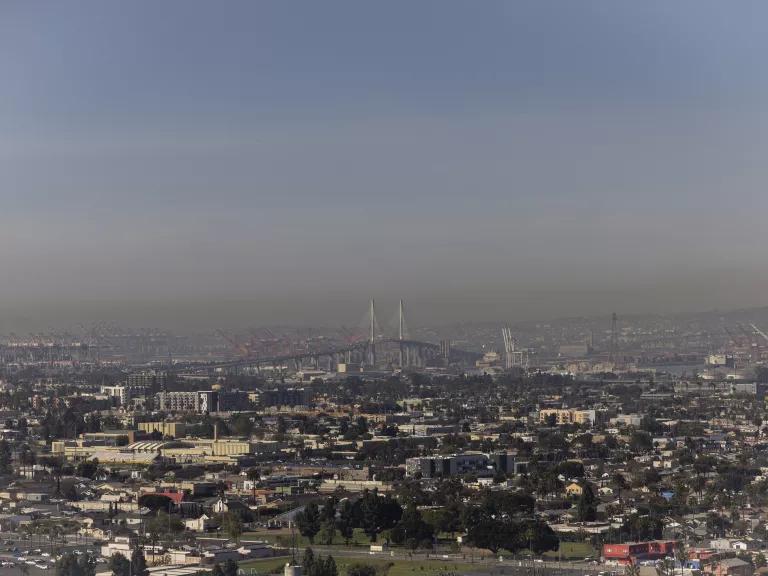
Smog lingers over the city overlooking the Ports of Long Beach and Los Angeles as seen from Signal Hill, California, on March 10, 2025.
The EPA’s final rule repackages climate science denial
In its final rule, the Trump EPA attempts to retreat from relying on its previously debunked climate claims. Instead, the agency introduces new modeling to argue in the final rule that the impacts of vehicles on climate change are so small as to not matter at all. That assertion directly conflicts with our understanding that every fraction of a degree of warming is dangerous to our health. In another attempt to minimize the tangible suffering linked to climate pollution, the EPA chose to ignore the billions of dollars in health-related costs tied to fossil fuel–related pollutants like ground-level soot particles and ozone smog. In doing so, the agency departed from its long-standing approach to cost-benefit estimation and failed to consider the growing and well-documented human costs of climate change.
This reckless move to reverse the endangerment finding is especially galling in light of the public health evidence demonstrating real, lasting harm to the American public from climate-linked extreme events. Since the 2009 action, authoritative scientific reports—such as the National Climate Assessment 5 (NCA5), the Sixth Assessment reports from the United Nations Intergovernmental Panel on Climate Change, and the National Academies of Sciences report on the effects of human-caused greenhouse gas emissions—demonstrate how the science has only continued to grow in strength. For example, the NCA5 found there is “unequivocal” evidence of the role of human activities in increasing atmospheric levels of climate pollution; further, there is very high confidence that climate change is harming human health. Notably, the Trump EPA raised vague concerns with the extensively reviewed NCA5 while also abruptly halting effort on the next update of that assessment—further underscoring its hostility toward established climate science.
Over the past 16 years since the EPA made its original finding, health experts have increasingly sounded the alarm about climate change as a “threat multiplier” that poses the greatest global public health risk of our time. Researchers estimate that climate-driven extreme heat spikes are responsible for more than a third of warm-season deaths globally since the early 1990s and that elevated temperatures are sending Americans to emergency rooms for heat stroke and heat exhaustion at higher rates over time.
But climate-linked human health harms extend well beyond extreme heat episodes. Since 2009, a wealth of scientific evidence points to intensifying health and welfare risks from wildfire smoke, coastal storms, inland flooding, prolonged drought, and the transmission of infectious diseases such as Lyme disease and West Nile virus. These climate-fueled challenges are not just causing disease and early deaths across our country—they’re also linked to billions of dollars in health-related costs for medical treatment in emergency rooms and hospitals, lost worker productivity, and ongoing health-care and prescription medication needs. By rescinding the endangerment finding, the EPA would invite even greater harm and economic burden on the public.
The EPA’s abrupt reversal defies its own scientific record
Beyond the scientific flaws, a slew of process problems and legally suspect maneuvers plague the current effort to repeal the finding. The Trump EPA’s recent actions to undermine climate policy are especially erratic in light of the agency’s own dismissal of similar claims made over the past 15 years.
If the EPA had a credible reason to revisit the endangerment finding in the past, it had more than a dozen specific opportunities to do so. Since the original finding was made, multiple petitions have asked the EPA to reconsider the endangerment finding. Time and again, across political administrations, these petitions were denied by the agency as well as the courts, reaffirming the scientific consensus that climate pollution endangers human health and welfare. For example, back in 2010, when the EPA denied multiple petitions, the agency said “the petitioners have provided inadequate and generally unscientific arguments and evidence that the underlying science supporting the Findings is flawed, misinterpreted or inappropriately applied by the EPA.”
The EPA’s reckless and legally flawed rush to reverse climate protections
Overall, the Trump EPA’s efforts to reverse our nation’s progress in addressing climate change pollution are built on a dangerous foundation of biased evidence and process failures. From the unlawfully constituted Climate Working Group to the last-minute analysis and memos posted to the final rule docket, there is good reason to question whether the EPA in its current form can be taken at its word, especially when it comes to science and the underlying analysis therein, which permeates its legal basis. The February rule purports to be based solely on law—but the agency has left the science behind. And, if there is any doubt as to whether or not the agency is still pushing forward climate science uncertainty and denial, Administrator Zeldin gave no illusions during his recent speech, renewing his embrace of an off-the-rails approach to science.
Because the Trump EPA has abandoned its mission to protect human health and our environment, NRDC and our coalition partners are standing up at this critical moment. Within days of the rule’s publication, we filed a legal challenge, and we are prepared to defend the rule of law and the overwhelming scientific consensus that climate change is a threat to us all.

Add your name: I stand with climate science and the law
NRDC is fighting back in court to stop the EPA’s illegal giveaway to polluters. Help us get to 25,000 signatures for climate protections. Join us in demanding that the EPA respect climate science and the law, uphold the endangerment finding, and protect people from dangerous vehicle pollution.
Related Blogs

From Shadows to Light: Spotlighting Major Companies in the U.S. Liquefied Natural Gas Industry
Power Plant Carbon Rules: What’s Changed Since the 2023 Proposal?