From Shadows to Light: Spotlighting Major Companies in the U.S. Liquefied Natural Gas Industry
NRDC releases informational cards that seek to hold the LNG industry in the U.S. accountable.

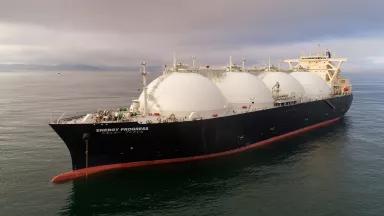
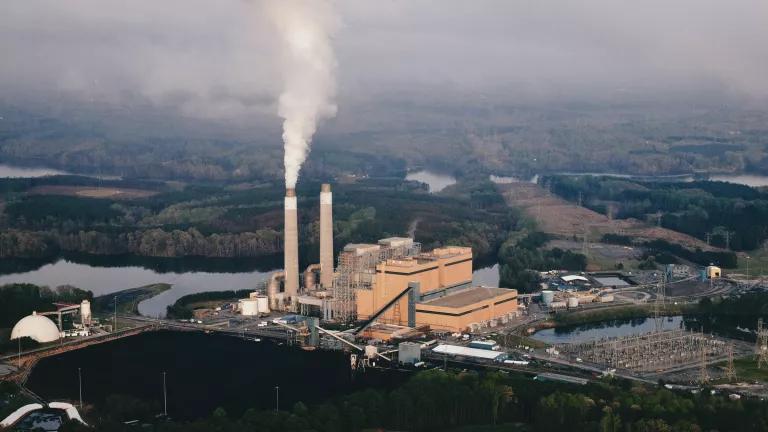
Venture Global’s Calcasieu Pass LNG export facility in Cameron Parish, Louisiana


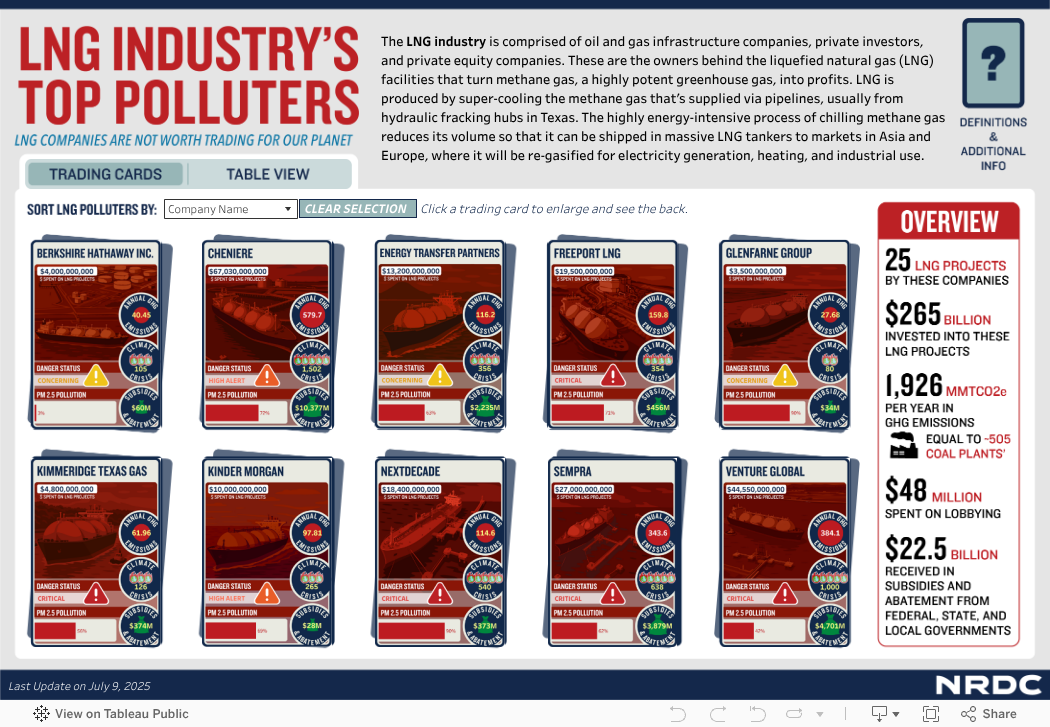
NRDC is launching its new accountability card series to hold 10 influential U.S. oil and gas companies accountable for the harmful impacts that the liquefied natural gas (LNG) industry poses on the environment and people. As the world’s top LNG exporter, the United States plays a critical role in the supply, development, and financing of LNG expansion worldwide. Additional U.S. export permit approvals only help the LNG industry to maximize profits while compromising the public interest by raising consumer energy prices and causing adverse health impacts to communities impacted by the environmental pollution resulting from LNG exports.
Ten influential U.S. oil and gas companies, private equity firms, and private investors are the primary owners and developers behind this sector’s growth. These LNG companies account for 1,926 million metric tons of carbon dioxide equivalent (CO2e) emissions per year, which is equivalent to the greenhouse gas (GHG) emissions of 505 coal plants. Moreover, $22.5 billion in tax breaks are granted by federal, state, and local governments to subsidize the development of 25 LNG export projects that cost $265 billion to build.
Learn More

The U.S. LNG industry’s unfettered growth
The U.S. capacity for LNG exports is set to double by the end of 2027 from 2023 levels, contributing to the 130 billion cubic meters of surplus LNG liquefaction capacity in 2030 that was forecasted by the International Energy Agency’s 2024 World Energy Outlook. The looming LNG market supply glut comes with no economic or energy security upsides, yet the U.S. Department of Energy (DOE) and the Federal Energy Regulatory Commission (FERC) under the Trump administration continue to approve permits to build new LNG export terminals.
Most recently, FERC approved Calcasieu Pass (CP2) LNG and Commonwealth LNG, two projects that NRDC and partners challenged to defend the health of frontline communities and the public interest. Such exports of fracked methane gas come at substantial costs to the environment, communities, and the climate throughout their supply chain. Because the Natural Gas Act requires agencies to consider the public interest, additional LNG export permits are not defensible when there is a “triple-cost increase to U.S. consumers from increasing LNG exports” that leads to degraded air quality, adverse health outcomes, and safety risks near LNG facilities along the Gulf Coast in Texas and Louisiana.
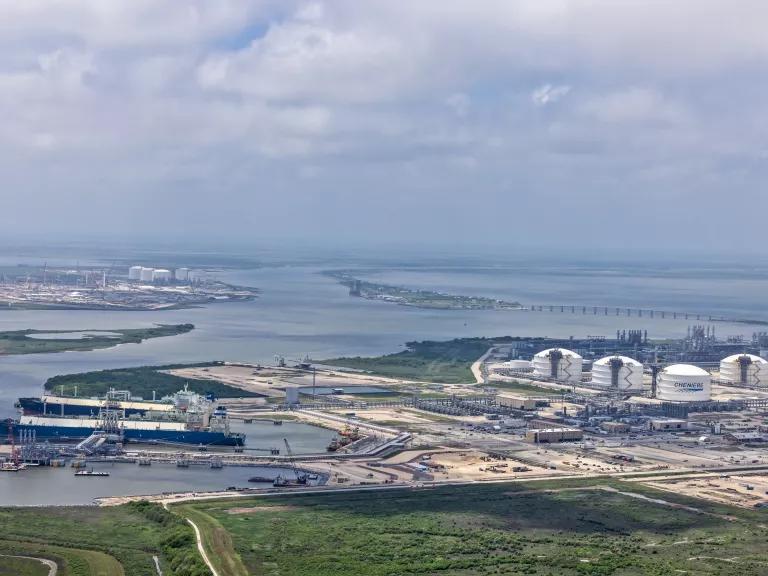
Cheniere Energy’s Sabine Pass LNG facility in Cameron Parish, Louisiana
Dangerous climate costs of U.S. LNG companies
According to the DOE 2024 study, projected increases in LNG exports could drive direct life cycle GHG emissions of all U.S. LNG to 1.5 gigatons of CO2e emissions in 2050, which is equivalent to 25 percent of U.S.annual GHG emissions. The industry accountability card project focuses on 10 U.S.-headquartered parent companies that own LNG projects across the country. Using annual GHG emissions data from the Sierra Club LNG Export Tracker, we found that the top three companies ranked by annual GHG emissions are Cheniere, Venture Global, and Sempra, respectively.
State and local governments have dedicated tax abatements—also referred to as tax exemptions, corporate subsidies, and tax breaks—that the LNG industry uses to defray project costs, ranging from $3 billion to $18 billion. Incidentally, Cheniere, Venture Global, and Sempra are also the top three companies in terms of total tax abatements received, based on data from the Good Jobs First Subsidy Tracker. In aggregate, our research found that these 10 LNG companies benefited from $22.5 billion in tax breaks from federal, state, and local governments, eclipsing the $2.33 billion in health costs per year if all planned LNG terminals and expansions were built.
Growing community impacts and resistance toward U.S. LNG expansion
Many of the pending U.S. LNG export projects join the patchwork of industrial development along the U.S. Gulf Coast and “Cancer Alley,” the petrochemical corridor stretching from New Orleans to Baton Rouge in Louisiana. As petrochemical industry facilities replace the vibrant coastal ecosystems that sustain local communities’ traditional livelihoods (e.g., in agriculture, fishing, tourism), these areas have become natural resource “sacrifice zones,” with severe environmental pollution burdens that disproportionately affect communities of color.
LNG terminals release harmful air pollutants—such as volatile organic compounds, nitrogen oxides, and particulate matter—that can contribute to increased incidences of respiratory disease, heart disease, and cancer. The particulate matter (PM2.5) indicator in the cards illustrates how companies are choosing to build LNG facilities in communities that are already exposed to serious and cumulative health risks. Sierra Club’s LNG tracker provides data for the U.S. LNG projects’ environmental justice national percentile indicators—such as low income, cancer risk, and particulate matter—based off of the U.S. Environmental Protection Agency’s former EJScreen tool. Based on the averaged national percentiles for PM2.5 pollution, the industry accountability cards show that NextDecade, Glenfarne Group, and Cheniere are the three companies with the highest PM2.5 pollution indicators.
Despite the uphill challenges of living near existing and planned LNG facilities with environmental pollution and negative climate costs, there is a vibrant network of community organizations actively resisting further build-out from these 10 U.S. LNG companies. When clicking through the right side of each company card, you can find more details on active environmental litigation brought on by NRDC and other partners, as well as details on active anti-LNG campaigns and organizers against the LNG projects affecting their way of life.
The U.S. LNG industry does not serve the public interest
NRDC’s U.S. LNG industry accountability cards are a digestible way to understand the U.S. LNG industry’s impacts on climate, environment, and public health. They further demonstrate that U.S. LNG export permit approvals are not in the public interest and more should be done to support community organizations resisting greater fossil fuel build-out in the U.S. Gulf Coast and abroad.
More details on the data sources, research, and methodology behind the U.S. LNG industry accountability card project are available here.
Related Blogs

The EPA Doubles Down on Science Denial to Undo Climate Protections
Power Plant Carbon Rules: What’s Changed Since the 2023 Proposal?