
The EPA Continues Pushing a Gas Guzzler Mandate
Congress should address the real affordability crisis—not waste time turning decade-old clean car standards into a political boogeyman.
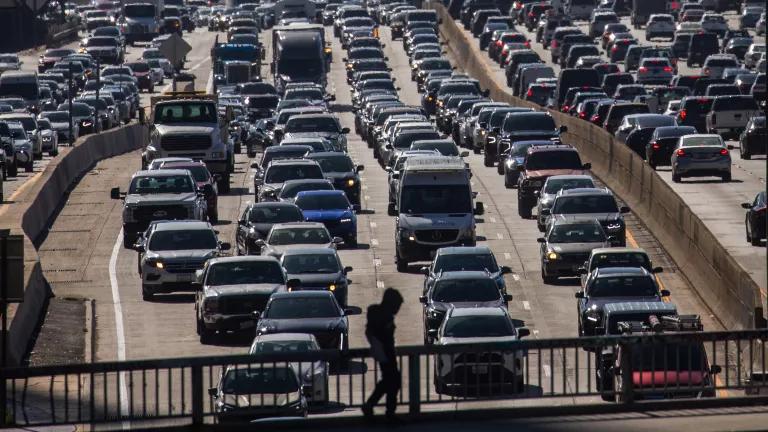
The 4th Street overpass bridge on the 110 Freeway in Los Angeles

During a summer marked by record-breaking prices at the pump and surging utility bills, this Congress and the U.S. Environmental Protection Agency (EPA) offered no real plan to address the affordability crisis facing Americans. Instead, it is moving to attack California's clean car standards—standards that have been in place for more than a decade. Repealing them would do absolutely nothing to help consumers.
The EPA’s latest move makes little sense. The agency sent long-standing California Clean Air Act waivers to Congress for review, including those that have been in place for more than a decade, in a legally fraught attempt to use the Congressional Review Act (CRA) to invalidate these waivers.
These waivers enabled state enforcement of standards that have helped bring cleaner and zero-emission vehicles to market, giving consumers more options while cutting harmful pollution. Vehicles on the road today are already meeting these requirements—yet the EPA and Congress are trying to drag the country backward. Disapproving the waivers would hurt the long-term competitiveness of U.S. auto manufacturers and harm domestic job creation.
Given the EPA’s recent attacks on federal standards, using the CRA on these waivers means there would be no greenhouse gas pollution standards for vehicles on our roads, even though they are the largest source of climate pollution in the United States.
We've seen this playbook before from the Trump administration: After the president asked for $1 billion in campaign funds from oil and gas executives in exchange for a polluters-first agenda, the president is now actively undermining the adoption of more affordable clean technologies.
Learn More

When it comes to cars, Americans lack the same clean and affordable options available in other countries—thanks to how the administration sides with corporations and oil and gas interests and continues to limit consumer options to purchase cleaner, more affordable vehicles. If Congress disapproves these waivers, it would be wasting its time on show votes while ignoring the real affordability issues facing Americans.
The waivers at risk
Trump’s EPA has already rolled back, eliminated, or delayed almost all federal standards that would have improved air quality and our health. But now it is testing the limits of how far it can go until there are no rules left at all to protect Americans and our environment.
Last year, the EPA claimed that previously approved waivers for clean vehicle standards were considered “rules,” despite long-standing precedent that pointed to the contrary. Then, using the CRA, Congress disapproved California’s waivers under the Clean Air Act for three standards that would significantly reduce greenhouse gas emissions and other toxic pollution.
Unlike the older waivers that the EPA is now sending to Congress, these three waivers covered vehicle model years 2024–2035 and had only recently been approved by the EPA. Two of them—the Advanced Clean Cars II and Advanced Clean Trucks waivers—were aimed at accelerating the transition to cleaner, zero-emission cars and trucks.
Now, the EPA has transmitted four more waivers to Congress—including one from 2009 and two others related to on-road vehicles—in the hopes that Congress will again sidestep the rules in an attempt to invalidate the waivers.
- 2009 Greenhouse Gas Rules: These regulations were the first in the country to reduce greenhouse gas emissions from vehicles on the road, reducing emissions by 30 percent in 2016. The EPA argues that it is transmitting this waiver because “automakers are forced to make a vehicle fit California’s standards instead of the federal standards…” However, the EPA earlier this year finalized rules that would completely eliminate all greenhouse gas emission standards for vehicles. We are fighting this in court. What’s more, vehicles on the road are already achieving these standards today.
- Advanced Clean Cars: In 2013, California adopted the Advanced Clean Cars I program to reduce greenhouse gas emissions and toxic air pollution while helping to launch the early EV market. The rule put automakers on a path to offering cleaner, zero-emission vehicles with better range and performance. Because of the credit system established by the program, automakers could comply with roughly 7–9 percent EV sales while still giving consumers more clean vehicle options across the country. This program positioned the domestic auto industry to be globally competitive.
- Advanced Clean Cars II: The first Trump administration attempted to illegally revoke the Advanced Clean Cars waiver. The Biden administration reinstated this waiver. Now, the Trump EPA and Congress are trying yet again to revoke this waiver through the CRA.
- Small Off-Road Engine regulations: These regulations apply to small off-road equipment, such as lawn and gardening equipment. Notably, no other state can adopt these regulations.
Disapproving these waivers would be a waste of Congress’s precious floor time. The vehicles affected by these standards are already on the road, and reopening settled waivers would do nothing to lower emissions or transportation costs for families today.
What it would do is send the wrong signal to the auto industry and the American people: Washington is more interested in protecting large corporations than in reducing pollution in our communities. The result of the CRA would mean fewer clean vehicle options, more pollution, higher fuel costs for consumers, and a domestic auto industry that will continue to fall behind in the long term.
Most important, these votes will do nothing to address the affordability crisis that Americans are feeling. Congress would be better served using its time to actually tackle rising costs and not turning decade-old waivers into a boogeyman to create the appearance of action.
This NRDC.org blog is available for online republication by news media outlets or nonprofits under these conditions: The writer(s) must be credited with a byline; you must note prominently that the blog was originally published by NRDC.org and link to the original; the blog cannot be edited (beyond simple things such as grammar); you can’t resell the blog in any form or grant republishing rights to other outlets; you can’t republish our material wholesale or automatically—you need to select blogs individually; you can’t republish the photos or graphics on our site without specific permission; you should drop us a note to let us know when you’ve used one of our blogs.
Related Blogs
The EPA Cooks the Books in Trying to Cook the Planet
The Trump Administration Wants Your Car to Pollute More
