
A Green Bank Is Coming to a Country Near You
Momentum is growing for financial institutions dedicated to funding climate projects.

Installation of a photovoltaic solar panel at a solar park on the outskirts of the coastal town of Lamberts Bay in South Africa, which is one of the countries the Green Climate Fund has been supporting in the creation of green banks

As we look toward the U.N. Climate Change Conference in Brazil, we are witnessing a sea change in climate finance. Economic uncertainty, the reallocation of traditional sources of climate finance, and the reduction of overseas development assistance, as well as the desire for countries to chart their own destiny, mean that countries are exploring innovative solutions to scale investment in climate projects. Green banks—domestic financial institutions that specialize in mobilizing capital into green projects—are one potential solution that is seeing increased interest.
Initially established in advanced economies like Australia, Japan, the United Kingdom, and U.S. states like Connecticut and New York, emerging and developing economies (EMDEs) are increasingly developing these institutions. The Green Climate Fund (GCF)—the world’s largest climate fund—has been supporting the creation of green banks in countries such as Barbados, Cambodia, Mongolia, Rwanda, and South Africa. Crucially, GCF’s 2024–2027 strategic plan focuses on deploying resources directly to these kinds of entities, rather than through intermediaries like the World Bank. These resources include technical assistance grants to build capacity and project pipelines and long-term investment capital and loans.
Learn More

Green banks are ready and willing to meet the needs of local contexts, especially as international aid is upended due to the shifting priorities of donor governments. On the one hand, green banks create investment partnerships to channel funds from developed countries to their home markets for low-carbon and climate resilient projects. At the same time, they lead the way in developing domestic capital markets, working side by side with local banks and engaging with local investors looking to diversify into climate. Their ability to de-risk and demonstrate returns on nascent climate technologies encourages local financial institution participation, and their support of green bond issuances and other climate-aligned financial instruments can help deepen domestic debt markets while standardizing green finance practices.
Developing green banks that can unlock green finance and generate market transformation can be challenging and requires resources. A new report from NRDC and our partners offers guidance for those navigating the green bank design process and provides an overview of the current global green bank ecosystem.
The State of Green Banks 2025
In 2020, NRDC and partners published an inaugural global report, State of Green Banks 2020, analyzing the activity of green banks. This year, Climate Policy Initiative, NRDC, the Green Finance Institute, and Bezos Earth Fund followed up the report with The State of Green Banks 2025: Learnings from Green Financing Structures around the World. This report situates green banks within our changing global context while connecting stakeholders in EMDEs with guidance for designing and operationalizing green financing institutions. It also provides the first green bank landscape analysis since the 2020 State of Green Banks report was published five years ago.
Key to the updated analysis are new data from green banks, national and subnational development banks, private finance, think tanks, and other stakeholders, which were collected through surveys, interviews, and feedback sessions. This includes data provided by members of the international guild of green banks, the Green Bank Network, including Clean Energy Finance Corporation, Connecticut Green Bank, DC Green Bank, Development Bank of Minas Gerais, New Zealand Green Investment Finance, and Tata Capital Limited.
Thirty-two green finance institutions were surveyed for the report. Of these, nine are institutions that already have a green bank, nine are international institutions, 13 are institutions with green windows, and one is in the process of setting up a green bank. This pool includes entities working in EMDEs, making this data reflective of green banks across the globe. The authors used the data to highlight recent trends in green bank capitalization, financial instruments, focus sectors, and barriers to green bank success.
Key findings
The report builds upon 2020’s findings to establish the first taxonomy for the green bank model, identifying four institutional structures:
- Stand-alone de novo green banks: Establishing a new independent institution dedicated to green financing
- Enhanced existing public development banks: Greening the mandates and operations of existing financial institutions
- Green facilities within public development banks: Creating dedicated green finance facilities, windows, or funds within larger financial institutions
- Green country platforms: Embedding green bank functionality within multi-stakeholder partnerships designed to coordinate large-scale climate finance
We examined the four green bank types in the Green Banks Design Guide. This guide pairs the taxonomy with practical guidance and decision matrices to assist governments, public development banks, and other stakeholders in developing green banks that fit their local context.
The need for a green bank accelerator
Establishing a sustainable green bank can be difficult, especially within EMDEs that have varying levels of political and financial support. To address these needs, the report proposes a dedicated platform or accelerator to help emerging green bank structures. The accelerator would provide localized guidance while targeting key enablers for success in designing green bank structures and their offerings across financial, environmental, and political sustainability.
There is flexibility in how this platform is established, with the option to set it up as a new accelerator, house it within an existing platform, or build a coalition of existing initiatives, such as a global summit, to promote knowledge sharing and coordinated action. Fundamental across all the options is the common goal of connecting emerging green banks with the assistance and/or knowledge they need to be successful.
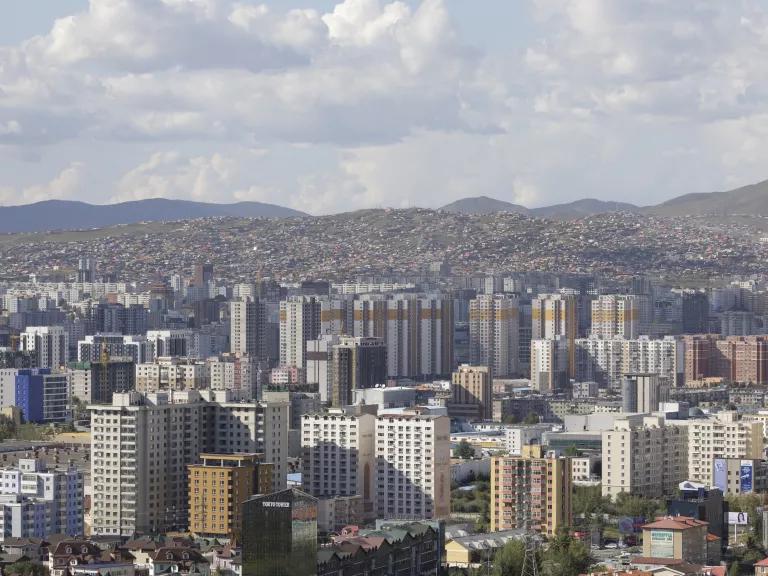
The Green Climate Fund recently supported green banks in Mongolia, among other countries. Here, Ulaanbaatar, the capital and largest city of Mongolia.
Case studies
To ground the report findings, NRDC analyzed the formation of green banks recently funded and established in EMDEs with anchor funding (e.g., grants, equity, loans) from Green Climate Fund’s Private Sector Facility and coinvestors. These entities include Barbados Blue Green Bank, Cambodia Climate Finance Facility, Development Bank of Southern Africa’s Climate Finance Facility, and Mongolia Green Finance Corporation. We found that each of these banks was formed to mobilize private capital and promote market-level shifts to mainstream climate projects.
A bank’s specific activities in pursuit of this goal reflect the gaps and needs of their specific jurisdiction. For example, Barbados established the Blue Green Bank (BGB) partially in response to a lack of domestic financial institutions (public or private) that are willing and able to provide finance for clean energy, clean water, or climate resilience. In this case, Barbados mandated BGB to provide wholesale lending to local financial institutions in order to stimulate growth in securities and loan markets.
Local context also informed the ultimate organizational structure of green banks. Mongolia and Barbados set up new de novo institutions due to a lack of existing public development banks, while Cambodia and South Africa leveraged their existing institutions to house climate facilities.
Finally, each of these banks benefitted from support from a cadre of experts, including consultants, green bank advocates, and GCF-accredited entities. Without this support, it is unlikely that these banks would have become operational. This highlights the importance of some type of green bank accelerator that can connect fledgling green banks, especially in EMDEs, with technical assistance that supports the development of long-lasting, impactful institutions.
Moving forward, we anticipate continued interest and growth in green financing structures due to increased support from entities like GCF and from jurisdictions looking for new ways to stimulate climate finance. The 2025 State of Green Banks report is an indispensable resource for those looking to navigate the changing green bank ecosystem.
Related Blogs

A Costly Dissonance: Putting America Last in Climate Resilience

COP29: Key Outcomes Signal Need to Deliver Greater Climate Action
