
How to Deliver the New Climate Finance Goal
At COP29 in Baku, governments agreed to a new collective quantified goal (NCQG) for climate finance. Now the focus turns to delivery.

The plenary hall at COP29 as the new climate finance goal is adopted
Joe Thwaites

Nine years after governments agreed to do so at COP21 in Paris, the world’s governments meeting at COP29 in Baku have at last set a new collective quantified climate finance goal (NCQG) for the post-2025 period. In one of the most bitter negotiations in the UN climate convention’s 32 year history, countries agreed that all actors in the global community would work to scale up climate finance to developing countries from all public and private sources to at least $1.3 trillion per year by 2035 (paragraph 7 of the decision). This aligns with expert assessments, including by the Independent High-Level Expert Group on Climate Finance, commissioned by the COP26 and COP27 Presidencies, of the amount of international public and private financing developing countries would need by 2035 towards their overall climate investment needs of $3.1–3.5 trillion.
In addition to the overarching $1.3 trillion goal, developed countries agreed to take the lead in mobilizing at least $300 billion per year by 2035 (paragraph 8). This goal has a similar scope as the previous $100 billion per year goal for 2020 to 2025: public funds, private finance mobilized by the public sector, and alternative sources (paragraph 8(a)). But the new goal also allows developing countries to voluntarily count finance they provide towards the goal (paragraph 9), and there was a voluntary agreement that all multilateral development bank (MDB) climate finance to developing countries can be counted, rather than just the portion attributable to developed countries (paragraph 8(c)).
While there was no overarching goal for public finance provision, governments agreed to pursue efforts to at least triple the annual outflows from UNFCCC climate funds from 2022 levels by 2030 (paragraph 16). These funds are: the Global Environment Facility, the Green Climate Fund, the Fund for Responding to Loss and Damage, the Adaptation Fund, the Least Developed Countries Fund, and the Special Climate Change Fund. Outflows from these funds amounted to $1.74 billion in 2022, so they must grow to at least $5.2 billion per year by 2030.
The relationship between the three quantified goals within the NCQG can be visualized as such:
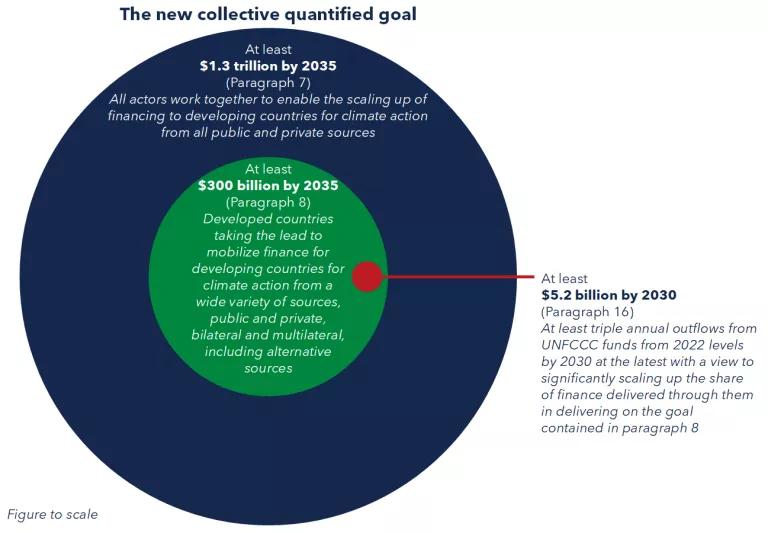
Figure 1
Getting to at least $300 billion per year
In nominal terms, the $300 billion represents a tripling of the previous $100 billion per year goal for the period 2020-2025. However, when taking into account projected inflation, this would be less in real terms.
Another way to conceptualize the effort is to compare historic growth rates of international climate finance—9.2 percent annually between 2013 and 2022—with the 7.6 percent growth rate needed to get from the 2022 amount of $115.9 billion to $300 billion by 2035.
But this is not a like-for-like comparison, since, as noted, the NCQG decision now allows developing countries to voluntarily contribute towards the goal. The decision also allows all MDB climate finance to developing countries to be counted, rather than only the share attributable to developed country contributions under the $100 billion goal (this varies by year, but was roughly 70 percent in 2022). If one was to count all MDB climate finance in 2022, it raises total international climate finance from $115.9 billion to $135.1 billion, and the annual growth rate needed to reach $300 billion by 2035 lowers further to 6.3%.
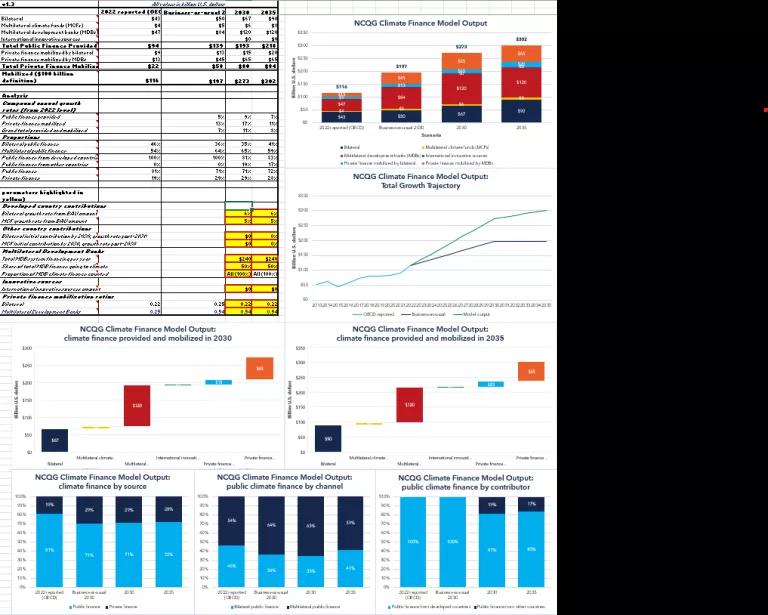
In the lead up to COP29, we developed a model to let users explore how climate finance can be scaled up. Our model focuses on the four key components of international climate finance: bilateral flows, multilateral climate fund contributions, multilateral development bank finance, and mobilized private finance.
Now that the NCQG has been adopted, we can update some of the model assumptions with pledged future finance flows:
- Tripling UNFCCC climate fund outflows from 2022 levels by 2030 (paragraph 16): at least $5.2 billion, 1.7% of $300 billion. To reach the tripling of UNFCCC climate funds from 2022 levels ($1.74 billion) by 2030, outflows from these funds will have to grow at 15% per year between 2022 and 2030.
- Count all multilateral development bank finance to developing countries (paragraph 8(c)): at least $185 billion, 62% of $300 billion. MDBs have stated they expect to provide low- and middle-income countries $120 billion each year by 2030, along with $65 billion in private finance they expect to mobilize with their public funding. Under the NCQG decision, all climate-related outflows from and climate-related finance mobilized by multilateral development banks that goes to developing countries can be counted, not just developed countries’ share.
There are then multiple options for how to meet the remaining $110 billion:
- Grow bilateral finance: Bilateral public climate finance was $43.4 billion in 2022, according to OECD figures, and based on existing pledges is projected to grow to $50 billion by 2025. It would then need to grow by 6 percent annually between 2025 and 2035, to reach $90 billion. Assuming the current ratio of 22 cents of private finance mobilized for every dollar of bilateral finance provided, private finance mobilized by bilateral finance would be $20 billion, for $110 billion total. The growth rate of public bilateral finance is lower than its historic growth rate from 2013-2022 of 6.9%, so this would require governments to expend less budgetary effort than in the past.
- Further increase multilateral development bank finance: experts and many governments agree that there are further reforms and capitalization that could allow the MDBs to grow their financing further in the coming years; the idea that they will reach $120 billion provided in 2030 and flatline from there is unlikely. There have been estimates that their financing could grow to between $130 billion and $195 billion based on different packages of reforms and capitalization. As a result, continued reforms to make the MDBs bigger and better will be important in the coming years.
- Increase private finance mobilization ratios: In recent years the ratio of private finance mobilized by each dollar of public finance provided has begun to grow, and if this trend continues it would mean private finance could comprise a larger share of the goal. However, this could present challenges for ensuring that finance meets developing countries’ needs, since private funding may not be suitable for all climate investments.
- New developing country contributors voluntarily agreeing to count their international climate finance towards the goal (paragraph 9): bilateral climate finance contributions from developing countries were estimated by the UNFCCC’s Standing Committee on Finance to be $2.7 billion in 2022, though this is likely an underestimate due to reporting being only voluntary. Indeed, China announced at COP29 that they have provided and mobilized RMB 177 billion (approximately $24.5 billion) in climate finance for developing countries since 2016, an average of $3.1 billion per year. Since the NCQG leaves it to developing countries to voluntarily decide whether they want their “South-South” financing to count towards the goal, it is unclear how much of this will count towards the $300 billion target.
| Channel | Amount | Citation |
|---|---|---|
| UNFCCC multilateral climate funds | $5.2 billion by 2030 | NCQG decision paragraph 16, SCF Biennial Assessment |
| Multilateral development banks | $120 billion provided by 2030 $65 billion private mobilized by 2030 (1:0.54 ratio) | NCQG decision paragraph 8(c), MDB Joint Statement at COP29 |
| Bilateral from developed countries | $43.4 billion provided in 2022 $9.2 billion private mobilized in 2022 (1:0.22 ratio) | NCQG decision paragraph 8(a), OECD |
| Bilateral from new contributor countries | $2.7 billion in 2022 (if voluntarily counted) | NCQG decision paragraph 9, SCF 6th Biennial Assessment |
| Total | $245.5 billion by 2030 (assuming current levels as a floor) |
We have updated our model to allow users to experiment with different possible approaches. What is clear is that $300 billion by 2035 is eminently achievable, with little to no additional budgetary effort required from developed countries, let alone other contributors, to meet the goal.
NCQG Climate Finance Model
NRDC/Joe Thwaites
A “straight-line coalition” for finance
A key area the NCQG was silent on was the trajectory of finance between now and 2035. When the previous $100 billion goal was agreed in 2009, developed countries also agreed to provide $30 billion in “fast-start finance” over the three-year period 2010 to 2012.
Under the NCQG decision, international climate finance must be at least a floor of $100 billion per year between 2026 and 2034, but besides the aim of tripling UNFCCC funds by 2030 (to $5.2 billion), it did not set any intermediate goals. There is concern that this could mean that finance may grow in a “hockey stick” nature, stagnating in early years before spiking as the deadline for the goal gets closer. This was the case for the $100 billion goal, in part due to the first Trump administration, and there are fears similar dynamics could play out with the second.
Trump may cut some or all of the $11bn per year the United States currently provides in bilateral and multilateral climate fund contributions. If he removed the U.S. from the Paris Agreement these contributions would no longer be officially reported and would be hard to count. But it is important to keep this in context: U.S. contributions in 2022 ($5.8 billion) accounted for just 12% of developed countries’ climate finance through bilateral channels and multilateral climate funds ($47.1 billion). Moreover, some other developed countries are also falling short of their fair share of the climate finance effort under the $100 billion.
The U.S. share of MDB finance is arguably more of a concern. The U.S. is a major shareholder in MDBs—often the largest and up to 30 percent in some—and these institutions are the largest channel for international climate finance. The agreement in the NCQG decision to count all MDB climate finance for developing countries towards the $300 billion goal can be seen as a Trump-proofing measure; allowing the U.S. attributed share of MDB climate funding to still be counted towards the goal, even if the U.S. leaves the Paris Agreement. Concerns remain about the future Trump administration’s potential impact on MDB climate finance. Trump's appointment of David Malpass as head of the World Bank from 2019 to 2023 undermined MDBs' joint efforts on climate finance. But the MDB joint statement at COP29, after Trump's election, that they estimate their collective climate finance provided to developing countries will rise to $120 billion per year by 2030, and that they aim to mobilize $65 billion annually in private finance, goes some way to providing reassurance that MDBs are confident they can still continue to scale up their funding for climate action.
What else could be done to provide reassurance that climate finance will scale up even before 2035? Colleagues working on emissions reductions might have provided a good model. At COP29, 11 countries and the European Union committed to set 2035 climate targets that are at least on a straight-line to their net zero targets as part of their next Nationally Determined Contributions under the Paris Agreements NDCs, due next year.
Rich countries could similarly commit to scale up climate finance in at least a straight-line trajectory towards $300 billion by 2035, to provide reassurance to developing countries that finance will not stagnate in what has been termed "the critical decade for climate action". Below we show the indicative figures for a straight-line trajectory from 2022 levels to $300bn in 2035.

NRDC/Joe Thwaites
Going beyond $300 billion, to reach the $1.3 trillion needed
The needs of developing countries to address the climate crisis are in the trillions of dollars per year. While some countries may be able to make some of these investments through their domestic resources, both public and private, many will need significant international support. The $300 billion per year mobilization goal was extremely disappointing to many developing countries, since it represents less than a quarter of the overall international climate finance they have said they needed, at least $1.3 trillion annually. This larger amount was recognized as an aspirational goal to be met from all actors and all public and private sources, but there are understandable concerns about whether such sums will materialize.
While $300 billion per year by 2035 is what rich countries committed to mobilize in a tough geopolitical and domestic political and budgetary environment, it cannot and must not be the end of the story. Our analysis finds that there are various pathways to increase international climate finance in the coming years. There are two opportunities in the NCQG decision to deliver greater finance ambition:
- First, the NCQG decision mandated the Presidencies of COP29 and COP30, Azerbaijan and Brazil, to produce a “Baku to Belem Roadmap to $1.3T” to look at how to scale up climate finance to developing countries (paragraph 27), including through grants, concessional and non-debt-creating instruments, and measures to create fiscal space. This roadmap process can bring together the multiple actors to look at fair ways to scale up international climate finance beyond the $300 billion, including further reforms to the international financial architecture to unlock more finance and deliver debt relief, raising innovative sources of finance such as through levies on highly polluting sectors, and better use of fiscal policy carrots and regulatory sticks to direct private finance away from where it’s doing harm and towards places where it can help meet climate investment needs.
- Second, the implementation of the NCQG will now be part of the global stocktake of the Paris Agreement that takes place every five years, and the decision will be reviewed in 2030 (paragraph 36). This provides an opportunity to revise the mobilization goal upwards, especially if the political outlook towards international cooperation in rich countries has improved, and if there has been progress in further reforming international financial institutions and tapping innovative sources of finance.
Going well beyond the $300 billion is within reach if countries step-up in the coming years. This is a floor, not a ceiling, and it is incumbent upon countries to roll up their sleeves and do more.
"When the elephants fight, the grass gets trampled"
Amidst the fights among major powers in Baku, the most vulnerable countries lost out. Countries failed to agree to the Least Developed Countries (LDCs) and Small Island Developing States (SIDS) ask for strong provisions to ensure they could more easily access a fair share of climate finance. This was important for them since so far only 2.8 percent of current international climate finance reaches SIDS and 18 percent goes to LDCs, despite them being particularly vulnerable to climate impacts they have done little to cause. The decision does push climate finance providers to increase funding for LDCs and SIDS, especially as concessional and grant financing, and to improve access (paragraphs 21, 22, 23 and 24). And there will be a special assessment of access to climate finance in 2030 (paragraph 34). It will be important to build on these provisions in future years.
Vulnerable countries have particularly focused on the need for more funding to address the loss and damage caused by climate change, securing the creation of a new Fund for Responding to Loss and Damage in the last two years. The NCQG decision recognized the need for urgent and enhanced action and support for loss and damage arising from climate impacts, and that this would need public and grant-based resources and highly concessional finance (paragraphs 14 and 19). But the goal did not include any targets or policy measures specifically for loss and damage. With climate impacts rising, the issue of loss and damage will not go away, and countries will need to find a place to discuss these.
The NCQG also lacked a specific goal on finance for adaptation, the measures taken to prepare for and adjust to climate impacts, which can help avoid much more expensive loss and damage. At COP26 in Glasgow in 2021, developed countries agreed to at least double their collective provision of adaptation finance from 2019 levels ($18.8 billion) by 2025, i.e. at least $37.6 billion. This is the only time developed countries have agreed to a specific public finance goal, and there were signs at COP29 that developed countries were open to a new adaptation finance goal. This did not ultimately happen, but with the current doubling goal only running to 2025 there will certainly be questions at COP30 about whether a new adaptation finance goal is needed. MDBs have already announced that their collective provision of adaptation finance for low- and middle-income countries will rise from $24.7 billion in 2023 to $42 billion by 2030, showing that a higher goal is possible. A new adaptation finance goal could include an emphasis on scaling up provision for countries that are particularly vulnerable, such as SIDS and LDCs, linking to Article 9.4 of the Paris Agreement that recognizes their special needs.
Getting more and better international climate finance
With the COP29 outcome as the floor, it is important that countries implement pathways to scale-up international climate finance in the coming years – going well beyond $300 billion by 2035 and ensuring we are on an upward trajectory in intermediate years. And, it is essential that developed countries better respond to the requests of the LDCs and SIDS to ensure that they have easier access to more of this critical funding.
It won’t be easy, but it is essential that rich countries don’t declare job done and move on. Success in curbing greenhouse gas emissions and dealing with climate impacts, in line with the Paris Agreement’s goals, will depend in large part on how well the global community mobilizes the trillions in climate finance needed. The moral, economic, and security rationale for delivering more international climate funding is clear: it is an investment to safeguard future prosperity and prevent the far greater costs of unchecked climate change. It is time to get to work.
Related Blogs

A Green Bank Is Coming to a Country Near You

A Costly Dissonance: Putting America Last in Climate Resilience
