
Death by a Thousand Cuts: FEMA Under the Second Trump Administration
The agency’s mission is simple: to help people before, during, and after a disaster. This administration is making that almost impossible.

A FEMA staff member walks door to door to register residents for Disaster Survivor Assistance in the Breckenridge neighborhood of Little Rock, Arkansas, after a devastating tornado hit the state in April 2023.


In a year, the Trump administration has crippled the Federal Emergency Management Agency (FEMA) through indecision, layers of bureaucracy, and massive staff loss. The American public is now faced with a FEMA that is too buried in paperwork to respond, too afraid to act, and increasingly too depleted to lead. Communities reeling from catastrophes are left asking: “Will FEMA be there to help?” And increasingly, the answer is “no.”
What reform could have looked like
FEMA was originally intended to support—not replace—state and local response, stepping in only when events overwhelm lower jurisdictions. However, the scope and scale of FEMA’s mission have evolved. Driven in part by climate change, “unprecedented” events now occur with alarming regularity. Combined with an increasing overreliance on FEMA to support smaller disasters, this reality has left the agency overstretched, chronically understaffed, and less able to prepare for truly catastrophic events.
Broad bipartisan agreement exists that the nation’s current disaster management model—which is dominated by large-scale, post-disaster federal assistance—needs reform. To break this cycle of escalating loss and suffering, all layers of government must proactively invest in disaster resilience: encourage smarter land use and building decisions, invest in strategies to protect housing and infrastructure from current and future risks, and fund local emergency preparedness capabilities. Effective, strategic reform at FEMA could encourage more state and local responsibility without throwing the nation’s emergency management capability into chaos.
This is not reform—it is sabotage
However, instead of meaningful reform, the Trump administration is manufacturing the very dysfunction it claims to be solving.
Weaponized bureaucracy
The U.S. Department of Homeland Security (DHS) has paralyzed FEMA through bureaucratic obstruction. Routine actions such as modest contract approvals, payments for disaster assistance and hazard mitigation grants, and staffing assignments now require a memo with Secretary Kristi Noem’s signature. Direct efforts from DHS to withhold funding have faced bipartisan pushback and been successfully challenged in court. This bureaucratic approach allows DHS to delay funding indefinitely in the name of preventing waste and selectively release funds to political allies.
Agency officials at FEMA have diligently drafted thousands of these memos in their attempts to keep the mission afloat. The memos, after navigating opaque internal review processes dictated by political leadership, then go to DHS, where they either sit without response or are routed back for revisions to comply with ever-evolving formatting requirements. This creates an ongoing cycle of bureaucratic churn that requires significant effort but delivers few outcomes. Noem, through her deliberate mismanagement, has turned FEMA staff into the ineffective, paper-pushing bureaucrats that she has always claimed they were.
The primary weapon in this strategy is the $100,000 secretarial review mandate. By lowering the threshold for secretary approval of contract and disaster payments from $25 million to $100,000, DHS created a bottleneck that effectively paralyzed FEMA in the name of limiting waste. This has resulted in a multibillion-dollar backlog that has left call centers unstaffed and search-and-rescue teams grounded. When about 70 percent of survivor calls went unanswered during the 2025 Central Texas floods, it was not due to a lack of resources but a deliberate accountability process that prevented those resources from being deployed.
Reduction of staff through inaction
In January, DHS deployed another weapon of bureaucratic inaction to pursue its goal of dramatically reducing the FEMA workforce. While more than 2,400 (almost 1 in 10) of FEMA’s staff left in 2025, there has yet to be a mass layoff at FEMA. As it turns out, there is an easier way to cut the workforce—one that requires precisely zero action to implement.
For months, DHS has required Noem’s approval to approve renewals for the two- or four-year contracts of more than 10,000 Cadre of On-Call Response/Recovery Employees (COREs). FEMA’s CORE staff make up the backbone of FEMA’s disaster support, working hand in hand with communities to manage the more than 160 disasters declared on average each year, staying long after the news crews have left and the nation’s attention has turned elsewhere.
These are not temporary staff. Many of FEMA’s most experienced emergency managers are currently in CORE positions, expanding their experience and local relationships as they support disaster after disaster. Considered full employees within the agency, they have been granted increasing protections and status over the years, including under the first Trump administration, to reflect their critical value in delivering FEMA’s mission.
Abruptly, on New Year’s Day, DHS simply stopped approving these routine but critical renewals. With no notice, affected staff were pulled back from disaster deployments. Supervisors spent the holiday scrambling—frantically communicating up to leadership what had happened, convinced it was a mistake. Appeals by managers and FEMA’s nonpolitical leadership, documented through even more memos, detailed how terminated staff were critical to supporting FEMA’s mission. But the message was clear: no exceptions.
DHS even prevented supervisors from hiring their most experienced, critical staff into other positions to renew their contracts and keep them on board. Roughly 300 responders have been pulled from their work in the past few weeks—based not on their performance, experience, or the necessity of their skills but rather on an arbitrary date.
Then, just as abruptly, DHS paused its nonrenewal strategy as the country stared down a potentially crippling and devastating winter storm. It is unclear when or if the cuts will resume. But one thing is clear: The Trump administration and Noem have decided to place their desire to quickly cut FEMA’s workforce to some arbitrary number above the needs of the American people.
Culture of fear and retaliation
Compounding the operational paralysis is a growing culture of fear and uncertainty. Staff hesitate to make even basic decisions, worried that they will be punished for simply doing their jobs or speaking the truth. Staff and senior executives face retaliation, including reassignments to other parts of DHS or being put on administrative leave. In August, signatories of the “Katrina Declaration,” a whistle-blower statement sent to Congress on the state of FEMA, were put on administrative leave.
Unsurprisingly, much of FEMA’s experienced leadership has departed. Those who remain face a daily dilemma: Stay and try to preserve the mission from within, knowing they are partially complicit in the agency’s unraveling—or leave the agency and the mission that they love altogether, withdrawing whatever support they can provide to their colleagues and the communities they serve.
Retaliation is not limited to within the agency. DHS also punishes state and local officials in the form of delayed or denied disaster declarations and withheld grants if they are viewed as politically uncooperative, transforming FEMA’s bipartisan mission and legislatively mandated assistance into political favors to be curried.
In 2025, the president denied 16 major disaster requests—nearly double the annual average of the president’s first term. Even when declarations are granted, key forms of assistance are increasingly withheld for temporary housing and home repairs, medical and funeral expenses, debris removal, and repairs to roads, schools, and other public infrastructure.
Rolling back resilience investments
At the same time, progress in driving long-term investments in resilience has been undermined. Programs and policies designed to reduce future losses and build state and local capabilities have been stalled, weakened, or tied up in litigation. For example, the Trump administration’s abrupt cancellation of the Building Resilient Infrastructure and Communities (BRIC) program put thousands of communities at risk by stalling lifesaving projects. BRIC was created during President Trump’s first term to fund the efforts of states, Tribes, territories, and local governments to save lives, protect property, and reduce the long-term costs of disasters. Since 2020, BRIC has directed more than $1 billion annually to disaster-resilient projects to help break the expensive cycle of destruction and rebuilding. Twenty states sued the Trump administration in July 2025 after FEMA attempted to terminate the program, and a federal judge ruled in December 2025 that the termination was unlawful, issuing a permanent injunction that restored the program.
Unfortunately, the impacts of canceling BRIC weren’t being felt in a vacuum. Since March, multiple states have requested Hazard Mitigation Grant Program assistance as part of a major disaster declaration (a standard request, usually granted as a matter of course) and were denied or their requests went unanswered, despite receiving other types of aid. At the same time, the administration quietly pulled down grant notices for the Flood Mitigation Assistance and Safeguarding Tomorrow Revolving Loan Fund programs, leaving their futures uncertain.
Each delayed retrofit, each postponed buyout program, and each unfunded infrastructure upgrade represents not just a missed opportunity but a compounding vulnerability. Their impacts will continue to be felt in the disasters to come—in higher death tolls, in communities that take longer to recover, in disaster costs that continue to spiral upward, and in the widening gap between those who can afford to protect themselves and those who cannot.
The result will be more suffering
Twenty years ago, Hurricane Katrina showed the nation that there is no substitute for an experienced, coordinated federal emergency management capability during catastrophic events. After everything we have learned, it was once unthinkable that the United States would knowingly repeat those mistakes.
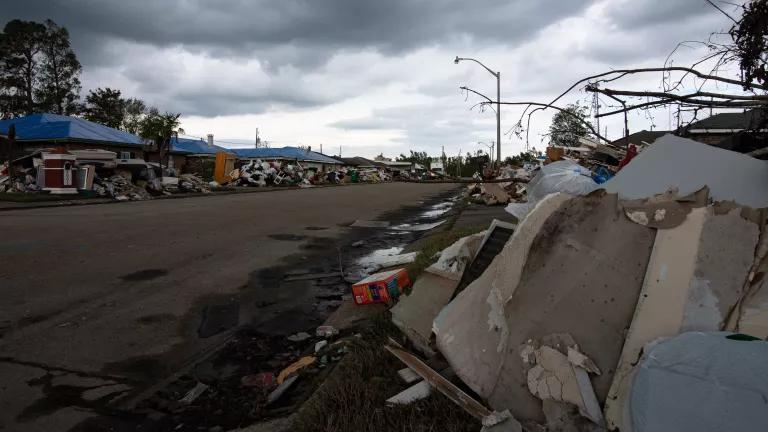
Americans expect that when a big disaster strikes, help will arrive. FEMA, while imperfect, is the cavalry. Support from FEMA experts and the promise of FEMA reimbursements enable state and local officials to act swiftly and decisively to save lives, stabilize critical infrastructure, and deliver essential supplies to communities in the critical hours and days after an event. Communities, especially those that are generally overlooked, have seen this year what happens when the cavalry does not come or when its eventual arrival is uncertain. Emergency food and water go undelivered, debris remains in place, local governments struggle to manage costs, and communities never recover. These consequences are concentrated in communities with fewer resources to begin with, compounding trends of wealth inequality.
The administration’s strategy of the past year is unmistakable: FEMA does not need to be formally abolished to be destroyed. Neglect, delay, and indecision are enough. And the cost of that approach is not measured in budgets or authorities; it is measured in lives upended when help arrives too late—or not at all.
Related Blogs
The Law Requires States to Plan for Climate Impacts

Political Control of Research Funding Threatens Sound Science
