
Market Boundaries Matter: Western Electricity Markets Can Better Share Affordable Power
How better coordination between western power markets could save consumers up to $840 million a year.
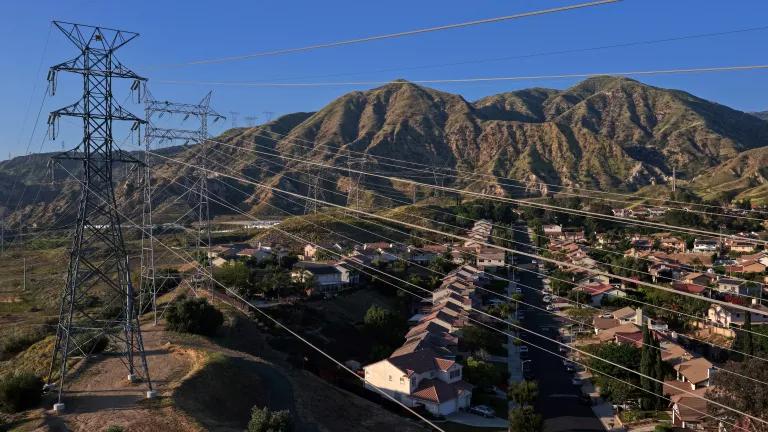
High voltage electrical transmission lines in Sylmar, California, March 2026

The western U.S. grid is entering a historic period of transformation. Today, moving low-cost power across the region is often complicated by a maze of separate trading agreements among grid managers, known as balancing authorities (BA). New day-ahead markets are designed to change that by making it easier to share power across BAs, helping reduce electricity costs, strengthen grid reliability, and accelerate clean energy deployment across the West. However, the success of these benefits depends on the rules that govern how day-ahead markets operate and coordinate with one another.
As two separately optimized day-ahead markets—the California Independent System Operator’s (CAISO) Extended Day-Ahead Market and the Southwest Power Pool’s (SPP) Markets+—are implemented, the western grid will partition into multiple market footprints. This shift introduces critical market "seams"—operational and economic boundaries that create dispatch inefficiencies, trade hurdles, and substantial administrative burdens if left uncoordinated.
What are seams?
A seam is a border between two separately run electricity markets. Power can cross it, but, because neither market can see the full picture on the other side, the trade of that power can be inefficient. This often leads to cheaper resources—often including wind and solar—being underutilized, which may impact electricity costs, access to reliable power, and the potential for clean energy build-out.
To quantify the financial and operational stakes of this market division, NRDC (the Natural Resources Defense Council) and Environmental Defense Fund commissioned Aurora Energy Research to conduct a comprehensive analysis that modeled the western power grid across four distinct market footprint and friction scenarios. The study results present a road map for western decision-makers: While a unified single market offers the highest economic benefits, implementing best-in-class seams management in a multi-market West can still unlock up to $840 million in annual cost savings that would be lost in uncoordinated, poorly managed seams agreements.
Crucially, these modeled cost figures represent a conservative floor, not a ceiling. Other factors related to utility operations and the real-world implementation of seams agreements can add extra costs that are difficult to model. In a time of rising energy prices, mitigating seams costs can go a long way to alleviating further strain on ratepayers and the function of the western energy system overall.
Estimating seams costs
Aurora’s modeling evaluated four scenarios for a 2032 study year, chosen as an example year when both day-ahead markets will be fully implemented, holding generation capacity and demand constant across scenarios based on published utility integrated resource plans (IRPs), which are long-term plans that explain how a utility expects to meet future electricity demand. These scenarios include:
- Single market: All balancing authorities participate in one centralized day-ahead market—representing the most efficient theoretical configuration for resource sharing.
- Multiple markets (low friction): Balancing authorities split between the Extended Day-ahead Market, Markets+, Southwest Power Pool (SPP) West, or remaining uncommitted, with low friction reflecting best seams management practices.
- Multiple markets (central friction): Standard seams management reflecting moderate coordination frictions.
- Multiple markets (high friction): Poor seams management reflecting siloed, worst-case operational frictions.
The multiple markets scenarios used expected market footprints for the Extended Day-ahead Market and Markets+ based on best-available information. Aurora based its seams scenarios on observed market frictions across seams in the eastern United States. Using several years of hourly trading data, Aurora analyzed how often power flowed the "wrong" way: out of an expensive market and into a cheaper one, when it should have been moving the other direction. Those backwards trades are a sign that operational inefficiencies between the two markets are getting in the way of the cheapest power reaching customers. Aurora measured the cost of that inefficiency at several eastern market borders and used the results as its best case (low friction), middle case (central friction) and worst-case (high friction) scenarios for the West.
Single market is best, but best seams practices can save $840 million annually
Operating as a single market produces the lowest total system cost at $17.44 billion annually because no market boundaries within the West means a single operator can maximize efficient dispatch at lowest-cost energy resources across the entire region. Compared to the best-managed two-market outcome (low friction at $18.62 billion), a single market delivers an additional $1.19 billion (6.8 percent) in annual savings.
In a two-market footprint, moving from worst-case (high friction at $19.46 billion) to best-case (low friction at $18.62 billion) seams management reduces western system costs by $839.1 million annually—a 4.5 percent overall reduction.
These cost outcomes are the result of two categories of factors. First, direct friction costs across market seams represent the inefficiencies resulting from buyers paying a higher cost for power when it flows across a market seam. In addition, Aurora estimates significant indirect costs resulting from these market frictions, which are the result primarily of reducing total trading across the region due to higher prices, meaning that lowest-cost power is deployed less to meet demand because it sits on the other side of a market seam. Even while estimating hundreds of millions in these direct market friction and production cost differences, these numbers only tell part of the story. These modeled figures reflect a conservative baseline rather than the full cost burden.
Production cost models calculate economic generator dispatch against fixed friction charges. They do not capture the massive expenditure of human capital, including many hours from regulatory staff, legal counsel, market analysts, and grid engineers required to negotiate, draft, and continuously update inter-RTO coordination agreements.
Historical experience in the Eastern Interconnection demonstrates that seams management is rarely simple or quick. PJM, MISO, and SPP have spent more than 22 years attempting to agree on updated methodologies for "firm flow entitlements" without resolution. Furthermore, administrative and operational errors along the MISO-SPP seam resulted in $119 million in excess congestion costs in 2022 alone.
Real-world power grid operations face unpredictable renewable ramping, real-time communication lags, and execution constraints. Furthermore, because Aurora’s model holds generation capacity fixed based on current IRPs, it underestimates the long-term compounding benefits of coordinated capacity procurement under a unified market footprint.
How effective seams management drives greater access to power and lower costs
Market friction translates into tangible operational hurdles, including non-standardized data formats, siloed congestion management, and communication delays. To calibrate realistic friction rates, Aurora analyzed historical hourly trade data across Eastern Interconnection market seams (including PJM, MISO, NYISO, and IESO).
When western market operators establish proactive, automated coordination (the low-friction scenario), the operational benefits ripple across the region:
-
Expanded trade volumes: Lowering seams barriers increases interregional trade volume by 43 terawatt-hours (21 TWh in imports and 23 TWh in exports) compared to high friction. This is roughly equivalent to 10 Hoover Dams’ worth of annual energy generation, enough to power about four million homes.
-
Clean energy integration: Seamless trading allows surplus renewable and hydro generation to move freely across market borders, displacing emitting thermal generation and creating a cleaner West-wide grid.
-
Lower production costs: Better resource dispatch lowers overall energy production costs—the cost of building, operating, and maintaining power plants—by $256.5 million annually (falling from $20.06 billion under high friction to $19.81 billion under low friction).
-
Maximized transmission value: Increased trade volume generates higher utilization of the existing transmission system, meaning additional revenues for transmission owners and market participants.
Who benefits most?
While West-wide costs drop with lower seams friction, the impacts vary significantly across specific subregions and individual balancing authorities.
-
Bonneville Power Administration (BPA): BPA is the single-largest beneficiary of effective seams management, capturing $296 million in cost savings moving from high- to low-friction scenarios. This accounts for 35.2 percent of total savings across the entire western United States. As a major net exporter with low-cost hydro capacity, reducing seams fees enables BPA to export power across a wider footprint, boosting export revenues by 3.6 to 16.1 percent and far outweighing minor increases in generation production costs.
This evaluation of the benefits of a unified western grid is strongly underscored by BPA’s recent decision to reevaluate its day-ahead market strategy. In a September 2026 letter to regional stakeholders, BPA Administrator Travis Kavulla outlined a pragmatic, forward-looking framework for considering the Extended Day-ahead Market. BPA’s evaluation validates what this report’s modeling demonstrates: a contiguous, single-market footprint is the most effective path for ensuring grid reliability and keeping energy affordable.
Current market commitments place Markets+ entities in the Pacific Northwest and Desert Southwest separated by the Extended Day-ahead Market entities in California and the Rocky Mountain regions. Lowering seams barriers restores crucial interregional trading pathways between these noncontiguous footprints.
- Arizona Public Service (APS): Reduced seams friction lowers net trade costs for APS by $81 million, resulting from increased nuclear and solar exports into California to offset thermal generation facing state carbon prices. Additionally, reduced seams friction allows PacifiCorp East to increase thermal exports into APS from 0.44 TWh (high friction) to 1.56 TWh (low friction), yielding a $28 million (4.1 percent) net benefit.
- Puget Sound Energy (PSE): In what may be an unexpected result, PSE experiences a $63 million cost increase under low seams friction. As BPA exports its hydro power to a broader footprint, PSE loses access to "captive" local hydro and must ramp up domestic thermal generation to meet local demand.
- Nevada Power Company (NEVP): Finally, total system costs for NEVP change by less than 1 percent across all scenarios because its primary trading partners (CAISO, Idaho Power, and PacifiCorp East) are already committed to the Extended Day-ahead Market, leaving virtually no seams on its primary interfaces.
Why urgent seams action is needed today
The study underscores that western market fragmentation presents real economic risks, but proactive coordination offers a powerful remedy. With the Extended Day-ahead Market already live and Markets+ advancing toward implementation, market operators cannot afford to wait or assume seams will resolve themselves easily.
The time, financial cost, and manpower needed to resolve market conflicts represent a major ongoing drain on utility and regulatory resources. Mitigating this requires market operators to act immediately to establish formal, comprehensive, and binding seams agreements before western utilities are fully integrated in their respective markets. Whether through the ultimate goal of a unified single western market or aggressive, best-in-class seams management, taking action today is the only way to protect families and businesses in the West from unnecessary costs that would otherwise escalate far beyond modeled expectations.
This NRDC.org blog is available for online republication by news media outlets or nonprofits under these conditions: The writer(s) must be credited with a byline; you must note prominently that the blog was originally published by NRDC.org and link to the original; the blog cannot be edited (beyond simple things such as grammar); you can’t resell the blog in any form or grant republishing rights to other outlets; you can’t republish our material wholesale or automatically—you need to select blogs individually; you can’t republish the photos or graphics on our site without specific permission; you should drop us a note to let us know when you’ve used one of our blogs.
Related Blogs

Tailoring the Grid: The Complex Reality of Western Seams Management

Connecting the West to a More Stable Clean Energy Future
