Remembering Robert Redford
For decades, the Hollywood superstar used his influence to speak truth to power and advance environmental progress.

Actor and NRDC Trustee Robert Redford (right) with NRDC founding director and president John Adams (second from left)at a meeting with the Institute of Resource Management concerning outer continental shelf drilling in Morro Bay, California, 1982

Film icon Robert Redford cast so great a shadow across the American cultural landscape that it can be easy to overlook his real-life role as an environmental giant. Over more than five decades, there wasn’t a more prominent voice, more determined advocate, or more insistent champion for the protection of clean air and water, public lands, oceans, wildlife, and habitat.
Through the influence he wielded, the weight of his views, and his clear and reasoned judgment, Redford, who died Tuesday, was an indispensable force for environmental progress.
He embodied the movement to defend the American West—its ranchers, outdoorsmen, and farmers, and the rights of Indigenous Peoples—speaking passionately about the need to protect the dwindling supply of clean water in a region essential to the nation and central to its identity.
He worked to beat back destructive oil and gas drilling to protect special places like the Arctic National Wildlife Refuge, the Gulf of Mexico, and more.
And he recognized the climate crisis early on and stood up to demand the action we need, at home and abroad, to avert a climate catastrophe.
Redford’s star appeal gave him access to a wide international audience, which he used to great impact during the 2015 Paris climate talks, where he hosted panel discussions and advocated directly to climate diplomats and political leaders.
Where he was most at home, though, was drawing on his unique stature and common touch to drive home the rising toll that climate change is inflicting on American communities and people: the farmer or rancher facing blistering heat and withering drought; the fisherman or coastal resident coping with rising seas and worsening floods; the family fleeing for their lives before a raging wildfire; the homeowner priced out of property insurance.
He also worked tirelessly behind the scenes, serving for nearly five decades as a Trustee of my organization, NRDC. He carved time from a hectic schedule to be there for board meetings, where he would engage his fellow Trustees in dialogue and debate and proffer rich counsel and insights.
He had a valuable gift for summing up the collective view of the whole in a few carefully chosen and memorable words, a rare ability that helped guide our efforts to galvanize support for a sustainable world.
Most of all, perhaps, Redford was a natural storyteller, and he used those gifts to advance his advocacy—not only for himself but to lift up the voices of other artists and activists—through his work with the Sundance Institute and Film Festival, the Redford Center, and other environmental and Indigenous Peoples organizations. He never did it for money or glory but out of dedication to the causes he believed in and to his colleagues in those fields.


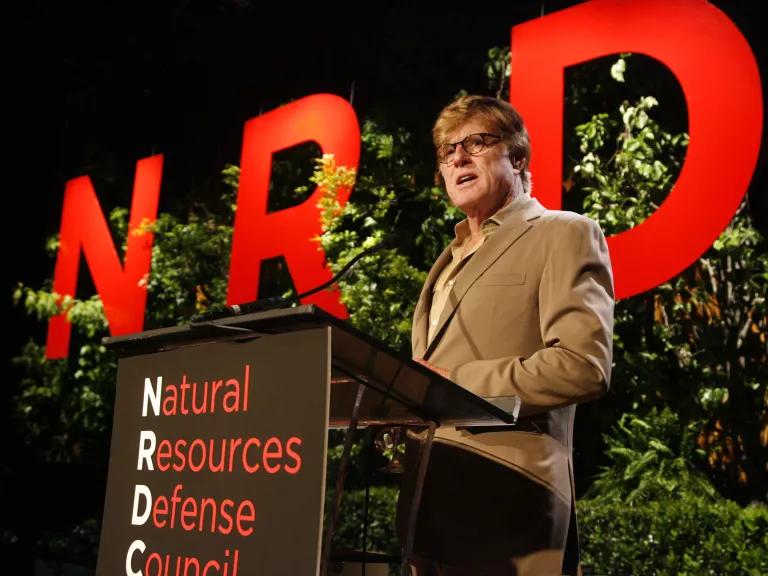
Clockwise from top left: Redford with then U.N. Secretary-General Ban Ki-moon during a visit to the U.N. headquarters in New York, June 2014; Redford, together with James Redford, cofounded the Redford Center, a non-profit organization merging the powers of environmental justice, collective action, education, and impact filmmaking; Redford speaking during NRDC’s 20th-anniversary celebration in Beverly Hills, April 25, 2009
He pioneered the use of Hollywood stardom to advance environmental progress. Much as some of the characters he created on-screen as an actor, Redford the activist never shied away from speaking truth to power. A year ago this month, in fact, he presciently warned against a Trump administration that would “hobble our government, toss science out the window, and slam the brakes on climate action,” in an op-ed published in USA Today.
And he was willing to take the heat—literally, in at least one instance, when he was burned in effigy by opponents of his advocacy that helped block construction of a coal-fired power plant in Utah.
We need his clarity and courage, now more than ever.
Much as Redford cautioned, the Trump administration has taken, or proposed, more than 330 separate actions that threaten healthy natural resources and our children’s future. Redford was horrified, as we all should be, at these attacks on the environment and public health. He called on us all to pay attention to what our government does, and fails to do, on our behalf, and to the ways that public policy impacts what’s happening in our own families and communities. More than that, he called on us to remember that, in a democracy, it’s the voice of the people that counts most.
After five decades on the frontlines of environmental progress and change, Redford’s own voice has been stilled. His legacy, though, endures—both in all he’s achieved and in the example he set by standing up for his belief in leaving our children a livable world.
A few highlights from NRDC's 50 years of partnership with Robert Redford
Related Blogs

Trump Administration Readies the Axe for Nearly 45 Million Acres of Public Forests
Renewable Energy on Federal Lands Brings New State and County Revenues