Research Suggests Auto Loans Should Account for Vehicle Efficiency
It turns out that gas guzzlers aren’t just bad investments for drivers—they’re bad for banks too.
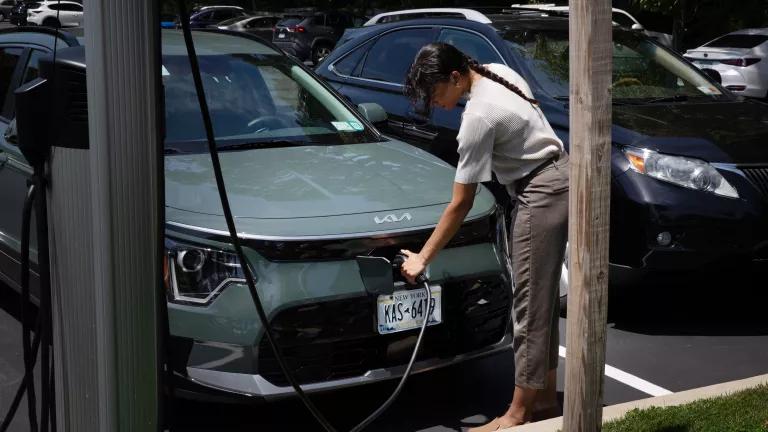
The cost of car ownership has climbed almost 50 percent in the last six years and shows no sign of slowing as gas prices continue to rise while the conflict with Iran drags on. Improving vehicle efficiency is the best way to insulate drivers from oil price shocks. Now, research shows improving vehicle efficiency also insulates lenders from loan defaults and missed payments, suggesting lenders should take vehicle efficiency into account.
A new report from Atlas Public Policy found that drivers purchasing more fuel-efficient vehicles are at lower risk of defaulting on their auto loans, with electric vehicle (EV) drivers—whose cars are the most efficient—leading the pack with a 50 percent lower default rate when compared to drivers of average fuel economy cars. Perplexingly, however, EV drivers consistently face higher loan rates than drivers of less efficient vehicles who default on their auto loans more frequently.
Personal factors like credit score, income, and savings are widely accepted as risk predictors when applying for a loan. But when it comes to auto loans, it appears that risk isn’t just influenced by a borrower’s financial history but also by the type of vehicle being purchased. When controlled for credit score, income, and other key underwriting criteria, Atlas found that the fuel efficiency of a vehicle was correlated to the borrower’s ability to pay back their loan.
It turns out that gas guzzlers aren’t just bad investments for drivers—they’re bad for banks too. Financing a less-than-average fuel economy vehicle equates to a 16 percent greater likelihood of defaulting on the loan. Borrowers financing high fuel economy vehicles (hybrids and plug-in hybrids) are 16 percent less likely to default. And those financing the most efficient vehicles, EVs, are 50 percent less likely to default when compared to vehicles of average fuel economy.
So why can’t drivers of more efficient vehicles get loans that reflect their lower risk? Borrowers purchasing EVs pay consistently higher rates when compared to borrowers purchasing vehicles across all other fuel economy ranges, with this gap growing as borrower income decreases. Those who stand to benefit the most from the lower fueling and ownership costs of EVs are being unfairly punished for their prudence, paying an additional $300–$350 over a typical 72-month loan. And this is just compared to the average; not accounting for the even lower rates that should be available to EV purchasers due to their demonstrated lower risk.
We’ve long known that purchasing efficient vehicles like EVs has numerous benefits to the environment, public health, and household costs, due to lower maintenance and fueling costs, but now we know that vehicle efficiency benefits lenders too. Despite this, lenders offer better rates for gas guzzlers than for EVs (the most efficient vehicles on the road), even as those loans are more likely to result in losses.
If lenders make money on efficient vehicles and lose money on inefficient vehicles, the loan terms they offer should reflect this relative risk. Adopting lending practices that reflect the demonstrated risk associated with fuel efficiency benefits both the purchaser and the lender: Purchasers receive better terms for their auto loans, making their vehicle more affordable and increasing their ability to repay their loan each month, while lenders assume less risk across the board, in addition to expanding their pool of potential borrowers. A vehicle purchaser on the cusp of being deemed too risky for a loan, due to an inaccurate risk assessment, can be pushed over into the acceptable risk range when purchasing an efficient vehicle.
Even greater benefits may be available to a subset of private lenders. Captive auto lenders like Ford Credit, GM Financial, and Toyota Financial Services are the financing subsidiaries of automakers and issue loans exclusively for their parent companies. In addition to savings, fuel-efficient lending can help automakers reach fleet-wide fuel economy goals by increasing the affordability of high-efficiency vehicles.
More fuel-efficient vehicles mean less dependence on foreign gasoline, lower fueling and repair costs for drivers, better air quality, and fewer climate change–causing greenhouse gas emissions. It’s in our best interest to ensure that these vehicles and financing mechanisms are priced appropriately according to risk.
This NRDC.org blog is available for online republication by news media outlets or nonprofits under these conditions: The writer(s) must be credited with a byline; you must note prominently that the blog was originally published by NRDC.org and link to the original; the blog cannot be edited (beyond simple things such as grammar); you can’t resell the blog in any form or grant republishing rights to other outlets; you can’t republish our material wholesale or automatically—you need to select blogs individually; you can’t republish the photos or graphics on our site without specific permission; you should drop us a note to let us know when you’ve used one of our blogs.
Related Blogs
Congress Is Cutting Off Transportation Investments that Help Families Save Money

Getting Off the Gas Price Rollercoaster