
Accounting for AI: Environmental Transparency for a Responsible Digital Future
AI’s environmental footprint is becoming harder to ignore. We still know too little about it.
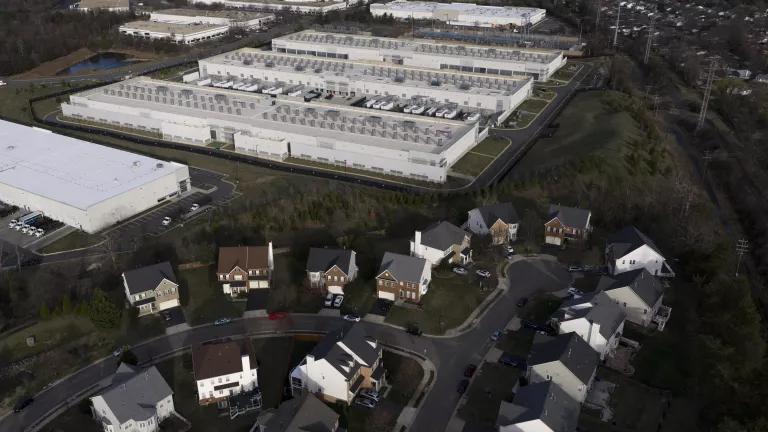
Northern Virginia has the largest concentration of data centers in the world—like this Amazon data center in Sterling—managing roughly 70 percent of global internet traffic.

Data centers are being planned and built at breathtaking speed. At the beginning of March 2026, 23.1 gigawatts of data center IT capacity was under construction across 831 sites worldwide. Yet governments, utilities, researchers, and communities often lack comparable information about the electricity, emissions, water, land, and supporting infrastructure involved. That is a governance problem, not simply a reporting gap.
In June, United Nations Secretary-General António Guterres proposed an AI Environmental Transparency Initiative and called on major AI companies to measure and publicly disclose the carbon, water, and land footprints of their systems. The initiative is welcome. The harder question is what companies should disclose, how detailed that information should be, and when it should be available. That will determine whether transparency changes decisions or merely records impacts after the fact.
Environmental transparency should become part of the basic governance architecture for AI: comparable across companies and countries, independently verified, detailed enough to guide energy and infrastructure planning, and available early enough for affected communities to have a meaningful voice.
AI has a physical footprint
AI, like much of our digital infrastructure, is often discussed as though it were weightless. Language matters: The “cloud” sounds ephemeral and harmless, but the systems behind it are anything but. AI depends on data centers, chips, cooling equipment, power networks, water, land, and mineral supply chains. The scale of those demands depends on choices about which models and services are built, where facilities are located, what chips they use, how they are powered and cooled, and how often they operate. These are infrastructure choices, with consequences that differ sharply by place.
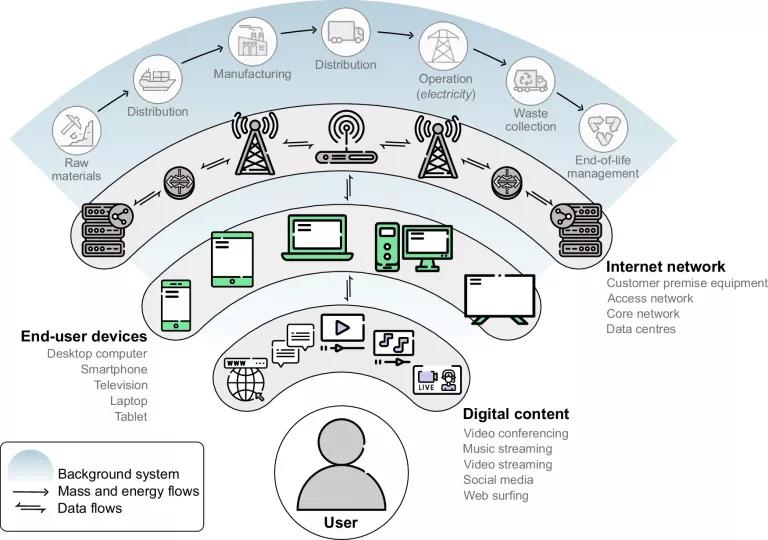
This diagram shows how digital content connects users, devices, Internet networks, and data centers to electricity, raw-material extraction, manufacturing, distribution, and end-of-life management
Source: Robert Istrate et al., “The environmental sustainability of digital content consumption,” Nature Communications 15, 3724 (2024)
A carbon total alone does not show the full set of resource trade-offs or what those resources are being used to deliver. United Nations University (UNU) research shows that AI’s carbon, water, and land footprints are related but not interchangeable. The report projects that, by 2030, the water footprint associated with the electricity used by AI data centers could reach 9.3 trillion liters, equivalent to the basic annual domestic water needs of 1.3 billion people in sub-Saharan Africa. Lower-carbon electricity can reduce emissions, but it does not necessarily eliminate local water or land impacts. Those impacts also depend on the energy source, location, cooling system, and pattern of use.
Where companies disclose environmental data, company-wide totals do not show the pressure created by an individual facility on local communities, electricity systems, or water resources. The European Union’s data center reporting framework, for example, collects information and performance indicators at the facility level. Power usage effectiveness (PUE) and water usage effectiveness (WUE) are useful efficiency ratios: PUE relates total facility energy use to IT equipment energy use, while WUE relates water use to IT equipment energy use. But neither replaces reporting of absolute electricity and water consumption.
As UNU notes, efficiency gains can be overtaken by growth in overall use. Reporting should identify the facility, location, and time period involved and, where relevant, the modeling and computing assumptions behind the estimate.
We may not know exactly where AI is headed. But that uncertainty is no reason to postpone scrutiny of the infrastructure already being planned and built. As the Columbia Center on Sustainable Investment (CCSI) and Hitachi report argues, data center impacts vary by context and should be addressed early in planning and design. Decisions about siting, grid connections, water supplies, and long-term power contracts will shape electricity costs, resource use, and people’s quality of life for years. People living near a proposed project need information and a meaningful voice before approvals are granted and investment narrows the choices available. UNU similarly calls for early community involvement in siting decisions.
What should environmental transparency cover?
Use common methods and independent verification
A useful starting point is the full infrastructure footprint. Disclosure needs to cover electricity demand and supply, including total and peak demand, backup generation, the technologies and fuels used, and associated greenhouse gas emissions and local air pollution. It should also cover total and peak water withdrawal and consumption by source; water discharge, including chemicals in cooling-system blowdown; land use; operational noise; waste heat; and the grid or water system investments needed to serve the facility. Where relevant, the footprint disclosure should address equipment supply chains and end-of-life impacts.
Robust emissions accounting is one part of this picture. Existing processes, including the Greenhouse Gas Protocol’s standards for Scope 2 and Scope 3, provide a useful starting point. But corporate carbon inventories cannot substitute for facility-level information about electricity demand, water use, land impacts, and grid needs.
The information also has to be detailed enough for planning. Facility-level data is particularly important where a new load could affect electricity prices, delay the retirement of fossil fuel capacity, compete for scarce water, or require major transmission or water system investment. Commercial confidentiality is a legitimate concern, but it should not become a blanket reason to withhold information that public authorities and affected communities need to assess public costs and risks.
Different actors control different parts of this system. Data center operators make important infrastructure choices. Cloud providers allocate computing resources. Model developers shape architecture and efficiency. Major customers influence demand through procurement and use. Disclosure should show where these responsibilities sit rather than allowing accountability to disappear between contracts. The recent CCSI-Hitachi report makes the broader point well: AI’s sustainability outcomes are shaped by institutions, governance, norms, and power structures, not by technology alone.
The broader debate over AI safety offers a related caution. Researchers within leading AI companies have warned that development is moving faster than safety efforts. Environmental choices should not be ceded to technology providers on assurances of good intent alone. Transparency should reveal the impacts, who has the power to change them, and who is responsible for doing so.
Information must precede long-term commitments
Environmental disclosure matters most before infrastructure decisions are made. Energy planners require credible demand forecasts before committing to new generation or transmission. Regulators need evidence to determine who should pay for grid connections and system upgrades and to prevent those costs from being shifted unfairly onto households and smaller businesses. Water and land authorities must be able to assess proposed facilities against local resource constraints. Communities need the same information early enough to influence siting, mitigation, and benefit-sharing arrangements.
Once a permit has been granted, a grid connection approved, or a long-term power agreement signed, the scope for changing a project narrows considerably. Disclosure requirements should therefore be built into planning, permitting, procurement, and grid-connection processes, with updated information required as projects and operating conditions change.
These decisions also have development consequences. The World Bank Group’s World Development Report 2026 stresses that countries enter the AI transition with very different levels of reliable electricity, digital infrastructure, skills, and institutional capacity. It also distinguishes between benefiting from AI and investing scarce resources in frontier infrastructure. Data centers can contribute to digital development, but those benefits depend on how infrastructure, investment, and economic gains are structured and shared locally. Governments should examine what a proposed facility will contribute: whether it strengthens the power system, expands skills and services, supports domestic capability, or primarily uses local resources to meet demand elsewhere.
Public participation also has to happen while choices remain open. The appropriate process will differ across countries and communities, but the basic requirements are consistent: usable information, sufficient time to respond, and a clear route for public input to affect the decision. Consultation after the main commitments have been made is too late.
These concerns are not confined to North America and Europe. Communities and civil society groups in South Africa, Chile, and Mexico have pressed for greater scrutiny of data center development over water, electricity, land, transparency, and local benefits. Common international expectations can help reduce the risk that environmental burdens are shifted to places with weaker disclosure requirements or fewer avenues for public participation.
Set global expectations and preserve local decision-making and public consent
International comparability need not come at the expense of local decision-making. A common floor means a minimum set of disclosure requirements and principles that should apply everywhere, not a single model for permitting or public participation. Countries and communities can then determine how those expectations are implemented through their own planning systems, utility rules, environmental laws, and public participation processes.
The Council of Europe’s Framework Convention on Artificial Intelligence offers a useful governance precedent. It establishes common obligations while allowing different routes for domestic implementation. The convention is focused on human rights, democracy, and the rule of law; it does not set environmental rules for AI. Even so, it offers a useful model: shared international expectations with room for implementation that reflects national institutions and local conditions.
The objective is not to standardize every decision. It is to ensure that decision-makers begin with information they can compare, question, and use to advance the public interest.
Plan AI infrastructure as part of the energy transition
AI has real value for the energy transition. It can improve forecasting, support more resilient energy systems, and widen access to expertise. But useful applications do not settle the question of AI’s overall impact. Recent research on AI servers in the United States shows how much their projected carbon and water footprints depend on the scale of deployment, efficiency, location, and pace of grid decarbonization. Those factors are not unique to the United States.
We also have to ask how widely AI is used and for what purposes. Efficiency gains can be overtaken by growth in overall use. And AI is already being used to increase the productivity of fossil fuel extraction.
The choices being made now about data centers, power supply, grids, water, and land will shape the energy transition and determine how its costs and benefits are distributed. Once projects are approved and capital is committed, the room to change course narrows quickly.
Environmental transparency will not make these choices for us. It can make the trade-offs visible while there is still time to act: where the power will come from, whether new clean capacity will be added, who will pay for infrastructure upgrades, and how local constraints and community priorities will shape development.
If AI is to support the energy transition, its infrastructure must be planned as part of that transition, not treated as an exception to it.
This NRDC.org blog is available for online republication by news media outlets or nonprofits under these conditions: The writer(s) must be credited with a byline; you must note prominently that the blog was originally published by NRDC.org and link to the original; the blog cannot be edited (beyond simple things such as grammar); you can’t resell the blog in any form or grant republishing rights to other outlets; you can’t republish our material wholesale or automatically—you need to select blogs individually; you can’t republish the photos or graphics on our site without specific permission; you should drop us a note to let us know when you’ve used one of our blogs.
Related Blogs

The Global AI Buildout Needs Energy Transition Guardrails

U.S. 2035 Climate Target Is Ambitious, Achievable & a Call to Action
