
From Evidence to Action: Protecting Jodhpur’s Vulnerable Residents from Heightened Heat Risks
A new study by NRDC provides a template for improved action and healthier communities when it comes to adapting to and mitigating extreme heat.

Painting roofs with reflective paint creates cool roofs in Jodhpur, India, which help moderate indoor temperatures.


This blog was coauthored by Dr. Ritika Kapoor and Abhiyant Tiwari of NRDC India.
As the city of Jodhpur in northwestern India braces for another season of scorching temperatures over the next four months, the stakes for the health of its residents have never been higher. We know that extreme heat is not an equal opportunity killer. In the arid landscape of Rajasthan, where summer temperatures have previously soared past 51 degrees Celsius (123.8 degrees Fahrenheit), the difference between safety and a life-threatening heatstroke often depends on the ward you live in, the materials of your roof, and your proximity to a health-care center.
For more than a decade, NRDC and our partners have worked across India to pioneer Heat Action Plans (HAPs), which are comprehensive, evidence-based strategies for city and state governments to manage and prepare for intensifying extreme heat events. While the HAP approach has expanded far and wide in India over the past decade, these plans can be further strengthened by including heat-health vulnerability analyses that could help to direct heat adaptation resources toward the most heat-sensitive populations. NRDC’s new Jodhpur heat vulnerability study published in the Journal of Climate Change and Health helps to fill this gap and point the way forward for other cities in improving their heat preparedness to advance heat-health equity.
Living in extreme heat is more than just a physical discomfort—it can impact your livelihood and overall health and well-being. NRDC’s director of cooling and climate resilience, Prima Madan, talks about how India is adapting to rising temperatures and what the rest of the world can learn from them.
From citywide warnings to targeted action
The first generation of Heat Action Plans in India focused on citywide heat forecast alerts—essential early warnings that preliminary research in Ahmedabad, the birthplace of South Asia’s first Heat Action Plan, shows has saved lives, especially on the hottest summer days. However, a city is not a monolith. The climate crisis manifests differently in a dense urban slum than it does in a leafier residential district. Thus, there is a need for heat plans to bring forth a granular understanding of neighborhood-level variation in heat exposure, population sensitivity, and adaptive resources.
The key scientific advance in our new peer-reviewed study is the granularity of its data in characterizing local heat risks through a new heat-health vulnerability index, focusing on the city of Jodhpur as an example. By using a two-step analysis spanning Jodhpur’s 80 wards, our research team integrated 10 different sociodemographic and environmental indicators. This exercise is not just about tracking degrees on a thermometer; it’s about mapping the intersection of high land surface temperatures, areas of elevated population density, and indicators of social marginalization.
Social inequity compounds heat vulnerability
Our study reveals a sobering reality: Heat vulnerability in Jodhpur is concentrated where heat adaptation resources are the thinnest. Overall, our analysis of Jodhpur identified 25 wards as highly heat vulnerable. In these areas, residents face a double burden. They are exposed to the highest temperatures due to the urban heat island effect, yet they possess the lowest adaptive capacity; that is, the ability to access active and passive cooling methods like indoor air-conditioning and cooling centers, shade, and drinking water to find relief from the searing heat.
We see these effects play out in the data through the overlap of areas with relatively lower literacy rates, limited green cover, and a lack of proximity to urban health centers—all of which can compound a person’s lived experience of heat and make them more vulnerable to its most dangerous health effects. Crucially, the heat vulnerability analysis we conducted highlights that sensitivity to heat is deeply tied to social inequity. The study points out that children under six, women, and other marginalized groups are at significantly higher-than-average risk from heat-related health problems.
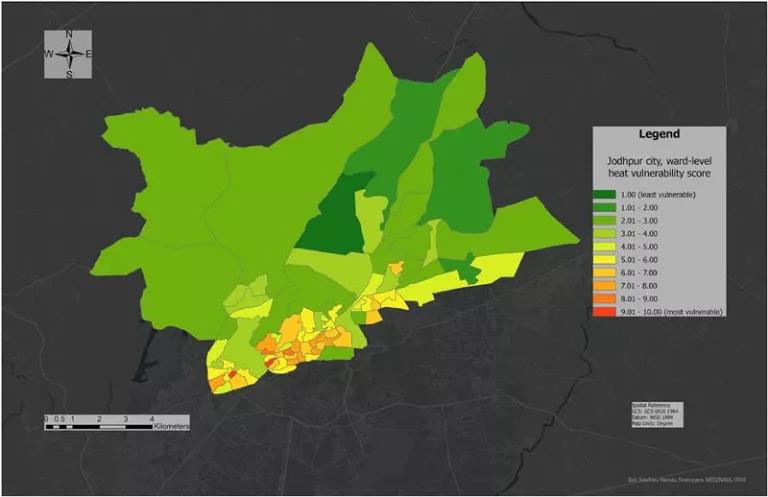
We mapped heat-health vulnerability across each of Jodhpur’s 80 wards and identified 25 especially vulnerable wards (shown in warmer colors here).
Source: Sharma et al., 2026
Turning data into lifesaving policies
Science is most powerful when it is actionable. The expanded heat-health vulnerability analysis we completed is not just an academic exercise; it provides a blueprint for further strengthening Jodhpur’s citywide Heat Action Plan, first launched in 2023. By identifying exactly which wards are at risk, municipal leaders can now progress beyond broad policies to targeted, evidence-based interventions. It will move heat action planning toward a more comprehensive and synergistic approach that is rooted in heat and cooling integration.
What could this more tailored integrated implementation look like on the ground?
- Targeted cooling: Prioritizing cool roof installations and net zero public cooling stations in the 25 high-vulnerability wards identified by the study.
- Infrastructure equity: Using a heat-health vulnerability map (see above) to guide the placement of new water distribution nodes and baoris (traditional stepwells) where they are needed most.
- Precision health care: Equipping health centers in high-risk wards with additional staff and supplies during peak heat months (May–June), in anticipation that these areas will see the highest surge in heat-related illness as the season intensifies.
Alongside our community partners at Mahila Housing Trust, we are working with Nagar Nigam Jodhpur North to advance municipal heat planning efforts that are informed by a new localized understanding of heat vulnerability.
The path forward: Inclusive adaptation in India
As we look toward a future where intense heat becomes even more common, our work in Jodhpur offers a template for other heat-stressed regions to proactively plan and tailor integrated adaptation and mitigation actions to meet the needs of vulnerable residents. By bridging the gap between environmental data and the lived experience of Jodhpur’s residents, heat preparedness is not simply about highlighting local vulnerability—it provides a blueprint for improved action and healthier communities.
Related Blogs

From Planning to Action: How Two Indian Cities Are Building Resilience to Extreme Heat

Solutions at Scale: Advancing Action on India’s Heat Risks
