
Cross-Sector Working Group Releases Embodied Carbon Action Plan for New York State
As state, county, and municipal programs make strides in reducing the operational emissions associated with our buildings, these strategies will enable state entities to also reduce the emissions from materials.

Media Contact
Christina Brown, KPF
In the summer of 2025, the New York Embodied Carbon Working Group was formed to continue the momentum of excellent embodied carbon reduction projects in New York State, amid news of catastrophic cuts to federal programs and funding. A voluntary group, composed of practitioners and technical experts working on embodied carbon in the region, released its high-impact near-term recommendations for policy action in September 2025, along with a 10-year vision for New York State, as the first part of an action plan. The New York Embodied Carbon Action Plan presents a comprehensive set of recommendations, case studies, and precedents to guide development of a coordinated statewide strategy to reduce emissions from building and infrastructure construction. It is intended to spearhead both immediate and long-term statewide embodied carbon reduction efforts and provide practical pathways to achieving New York’s ambitious climate goals—fostering innovation, creating green jobs, and building healthier, more resilient communities.
The plan reflects the collective expertise of diverse industry leaders and subject-matter experts, including architects, builders, engineers, public sector staff, policy professionals, consultants, contractors, academics, and industry associations.
Learn More

Why this is important
Embodied carbon is ever present in the day-to-day lives of New Yorkers. While the direct impacts are not visible, the emissions generated today from our buildings and infrastructure will last far into the future. As state, county, and municipal programs make strides in reducing the operational emissions associated with our buildings, these strategies will enable state entities to also reduce the emissions from materials, many of which are no or low-cost when compared to existing programs. Innovation and project development for these materials support good-paying New York jobs and make the state’s supply chain more resilient to economic shocks outside of the state. Action taken at the municipal level furthers the reach of embodied carbon reductions and encourages a targeted, local approach to addressing embodied carbon emissions.
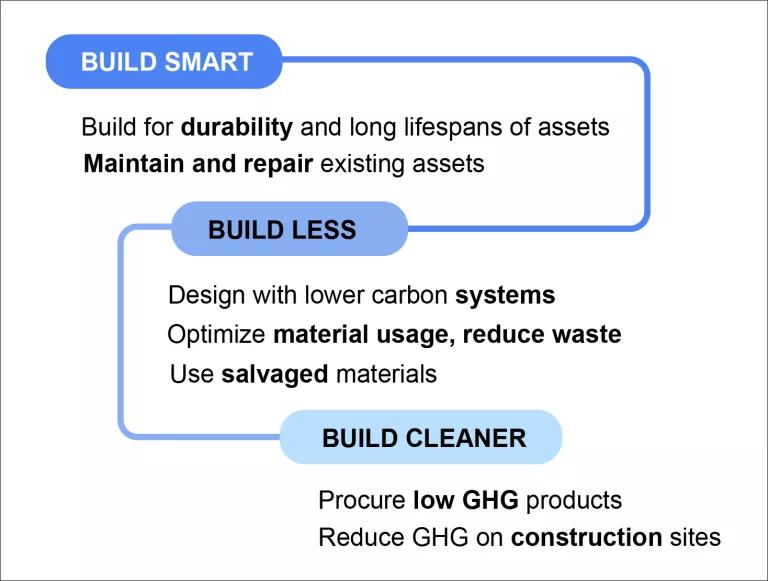
Framework for embodied carbon reduction priorities in the build environment. Inspired by the frameworks from WorldGBC and Just Places Lab.
Christina Brown, KPF
Recommendations
These recommendations address embodied carbon, life cycle emissions, and the environmental impacts associated with the production, transportation, installation, maintenance, and disposal of construction materials.
- Establish statewide embodied carbon reduction targets. Empower state agencies and industries to address the climate challenge by adopting a statutory reduction requirement statewide.
- Set embodied carbon reduction requirements for buildings in codes. Establish a long-term strategy for reducing embodied carbon in public and private building projects by setting three compliance pathways for reducing embodied carbon in building or zoning codes.
- Establish embodied carbon reduction requirements for state agencies’ infrastructure projects. Leverage the large portfolio of the 12 state agencies that oversee construction by requiring them to quantify and track embodied carbon emissions, as well as implementing Envision certification requirements across relevant state agency projects.
- Help manufacturers and suppliers develop low-carbon construction materials. Foster the innovative low-carbon market by implementing a low-carbon product standard, establishing a test center for low-carbon concrete and asphalt mixtures, creating an embodied carbon reduction challenge at the New York State Energy Research and Development Authority (NYSERDA), and expanding financing and incentives available to manufacturers.
- Incentivize the use of low-carbon construction materials. Financially support producers and users of low-carbon construction materials by providing sales tax exemptions for low-carbon materials, establishing an environmental product declaration (EPD) grant program, and expanding eligibility for the Research & Development tax credit.
- Encourage localities to address embodied carbon. Provide resources and incentives to encourage localities to implement or pilot portions of state agency policies at the municipal or county levels.
- Collaborate with industry to drive standardization in the marketplace. Collaborate with industry stakeholders across New York to help reduce embodied carbon by increasing capacity, addressing cost concerns, and coordinating with other efforts to minimize the duplication of efforts—saving the public money and reducing the time and monetary burden on private enterprises.
These recommendations provide a path to realizing those reductions while contributing to New York’s economic growth, leadership, expertise, and resilient communities.
Related Content

New York State Working Group Releases Embodied Carbon Recommendations

Building Codes, Buy Clean, and Beyond: An Embodied Carbon State Policy Playbook
