Building Codes, Buy Clean, and Beyond: An Embodied Carbon State Policy Playbook
States are recognizing the potential for tangible emissions reductions with broad co-benefits when it comes to embodied carbon.

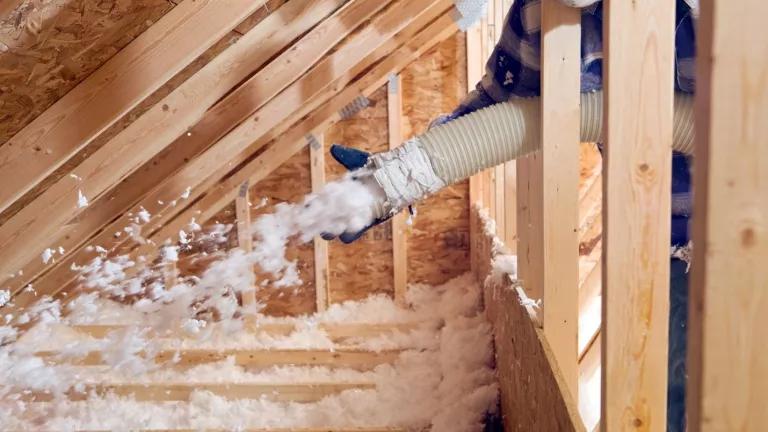
A home reconstruction project in Freeport, New York


The built environment hides more climate-warming pollution than you think, and reducing it is the next frontier of climate action. While policymakers have focused for decades on operational emissions—from heating, cooling, and lighting—they have largely overlooked emissions from construction materials such as concrete and steel. These emissions are commonly called “embodied carbon” and contribute to roughly 17 percent of global emissions. Improving how we make and use construction materials is a powerful yet underutilized lever in the fight against climate change. NRDC’s Embodied Carbon State Policy Playbook offers a road map for meaningful action through interconnected demand-side policies.
States are taking the reins
The idea for this playbook emerged last summer, when NRDC, the Carbon Leadership Forum (CLF), the New Buildings Institute (NBI), the American Institute of Architects New York (AIA New York), and RMI identified the need for a clear vision for the growing number of embodied carbon policies across the United States.
As the federal government rolled back programs incentivizing low-carbon materials over these past two years, states from coast to coast stepped up and carried the baton. Colorado passed financial incentives for low-carbon construction. Washington began exploring embodied carbon requirements for its building code. California began implementing its landmark requirement to reduce emissions from construction materials by 40 percent. Needless to say, states are showing us that they are eager and able to drive down embodied carbon emissions.
The next decade’s playbook
In the Embodied Carbon State Policy Playbook, we provide a vision and near-term, state-level interventions for embodied carbon reductions across three interconnected areas:
- Buildings: Achieve 45 percent embodied carbon reduction by 2035 and 90 percent by 2050 through public project mandates, building code requirements, market incentives, and adaptive reuse.
- Infrastructure: Achieve 30 percent reduction by 2035 and 90 percent by 2050 through department of transportation procurement standards, low-carbon product specifications, demonstration projects, and construction fleet electrification.
- Products: Achieve 45 percent of construction products consumed nationally to be low carbon by 2035, driven by clean procurement requirements, environmental product declaration programs, product standards, and sales tax incentives.
The playbook builds on existing public- and private-sector work, outlines foundational steps—such as labeling, reporting, and standards—and recommends additional actions to deepen emissions reductions.
No two states are starting from the same place. States are unique in their ability to test and develop new concepts for eventual implementation at the national and international levels. Their pilots can influence regional markets and shape business decisions among industry stakeholders. The playbook offers a menu that allows each state to choose approaches that are suited to its circumstances, whether it be to guide existing efforts or those soon to come.
State spotlight: California’s landmark embodied carbon law
Four years ago, Governor Gavin Newsom signed the country’s first law requiring a 40 percent reduction in emissions from construction materials used in California. Before then, states had primarily relied on procurement preferences and building code requirements to reduce embodied carbon. California’s sector-wide construction target pushed the envelope on what states could accomplish.
Since then, the California Air Resources Board has hosted meetings and workshops to develop the new program, which has two components: demonstrating (1) material-level emissions reductions and (2) project-level emissions reductions. Compliance therefore spans the value chain and requires material suppliers, contractors, architects, engineers, building owners, and developers to coordinate their efforts. Current construction methods and materials can achieve these reductions at little to no additional cost and, in some cases, can reduce costs.
The Embodied Carbon State Policy Playbook highlights California’s work to show other legislators and regulators what is possible and how they can achieve it.
Momentum is building—let's turbocharge it
Reducing embodied carbon is a win across the board. Cutting embodied carbon emissions also encourages economic development, creates jobs, strengthens supply chains, and supports healthier communities. States are recognizing the potential for tangible emissions reductions with broad co-benefits. The Embodied Carbon State Policy Playbook maps the path forward to coordinated, ambitious adoption.
This NRDC.org blog is available for online republication by news media outlets or nonprofits under these conditions: The writer(s) must be credited with a byline; you must note prominently that the blog was originally published by NRDC.org and link to the original; the blog cannot be edited (beyond simple things such as grammar); you can’t resell the blog in any form or grant republishing rights to other outlets; you can’t republish our material wholesale or automatically—you need to select blogs individually; you can’t republish the photos or graphics on our site without specific permission; you should drop us a note to let us know when you’ve used one of our blogs.
Related Blogs

We Can't Afford to Slow Down on Climate Action

The Key to Lowering a Building's Carbon Footprint? Embodied Carbon.