
Hitting a Moving Target: Planning for Grid Investments Driven by Load Growth
NRDC analysis shows how to cost-effectively prepare the grid for the electrification of vehicles and buildings.
Author


Media Contact
Planning the electric grid used to be much easier because utilities had a reasonable idea of where electricity demand would grow, when it would grow, and by how much. Electrification, a key strategy to decarbonizing California’s economy, has made distribution grid planning much more complicated because it is now harder to accurately predict how electricity demand will grow and what investments are necessary to support a reliable grid.
Utilities can no longer depend on historic trends to determine which parts of the grid they need to upgrade. As a result, it is difficult for regulators to determine how much money utilities should receive to make grid upgrades.
A recent NRDC proposal helped California regulators figure out how to confidently plan and pay for grid upgrades when the future is inherently uncertain, providing other states with a road map. Although the California Public Utilities Commission (CPUC) gets some things right with this decision, the ways in which it deviates from the NRDC proposal increases the risk of imprudent utility spending.
Tools used in an era of low load growth don’t work well in an electrified future
Typically, a utility presents one scenario of future electricity demand and grid investment needs, stakeholders provide input, and then regulators approve how much the utility can spend. This worked fine during the decades when there was slow load growth, but electrification brings two sources of uncertainty that break this framework.
First, timing uncertainty. We know California will eventually host millions of electric vehicles (EVs) and heat pumps. We don't know exactly how much of that will happen in the next 5 to 10 years. California is standing strong by its electrification goals, but recent federal actions are making it harder and more expensive to electrify.
Second, location uncertainty. People and businesses purchase electric cars and trucks when they want to and charge them wherever it is convenient. Mostly, that means predictable locations where vehicles are parked for a long time, like overnight at homes or in depots, where the vast majority of charging needs can be met when there is plenty of spare capacity on the grid. But public charging is more variable and requires more power in a shorter period of time, resulting in hot spots that require power line upgrades.
Timing and location are especially important because whether a part of the grid needs an upgrade or not depends on the capacity of each piece of equipment, how much load it serves today, and how much load it will serve tomorrow.
Today’s distribution grid realities require proactive planning and investment
Proactive planning and investment—upgrading the grid in strategic locations before it reaches capacity, due to new loads—lowers costs for everyone for three reasons:
Making a large grid upgrade once is much more cost-effective than making multiple smaller investments. Once you plan upgrades, get permits, hire workers, and dig up a street, installing equipment with extra capacity costs only a little more while the other costs remain largely unchanged.
Distribution upgrade projects can take years to complete. According to Southern California Edison (SCE), upgrading substations can take up to nine years. This means utilities need to plan for upgrades well before current equipment reaches capacity. For example, SCE forecasted upgrade needs out to 2031 to determine the work it needs to start before 2028. Without forward-looking investments, the grid may be unprepared to meet customer demand.
Building capacity early means ratepayers pay interest on infrastructure that they may use eventually, especially as more buildings, cars, and industrial processes electrify. Building too little capacity could mean expensive emergency fixes, local power reliability issues, and stalled electrification, which would increase pollution and rates.
Failing to make prudent investments now due to a legitimate concern about affordability only exacerbates that problem in the long run. Although California’s rising electricity rates are a real problem, their main causes are wildfire-related investment and arcane rate design issues. And building the grid needed to electrify vehicles and buildings—which is necessary to improve local air quality and combat climate change—also brings in new revenue that can put downward pressure on rates for all customers. In fact, over the last decade, EV drivers in California contributed $2.2 billion more in new revenue than associated costs; this money is then returned to all utility customers in the form of rates that are lower than they would otherwise be.
NRDC’s proposed solution applies uncertainty analysis to find a sensible way forward
Rather than guess at the future, NRDC modeled the impact of timing and location uncertainties on grid upgrade needs presented in Southern California Edison's (SCE) most recent rate case. We also compared SCE’s assumptions on future load growth with the most updated California Energy Commission (CEC) energy report available at the time. This analysis confirmed that SCE’s request fell within reasonable bounds.
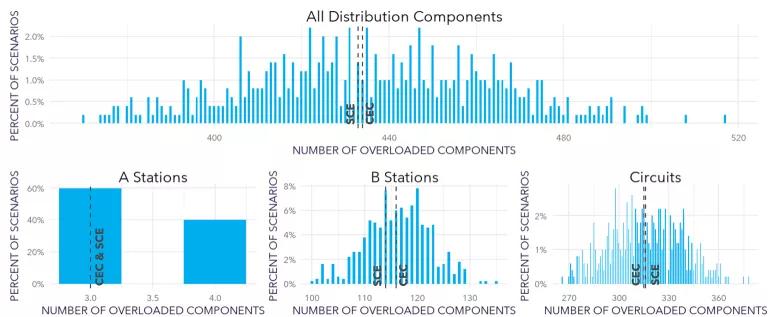
NRDC analysis found that 1) SCE’s forecast was based on older data, and CEC’s most recent forecast that was available at the time resulted in similar numbers of upgrades needed for each type of grid component, and 2) the number of upgrades that SCE forecasted is approximately in the middle of a likely range of needs when timing and location of load were varied.
The number of components that SCE needs to upgrade could vary around 20 percent in either direction from its primary forecast. The old approach—presenting regulators with a single forecast and requesting a fixed budget—no longer works when the range of possible futures is that wide.
Spend too little and the grid is overloaded and unable to reliably serve customers or accommodate electrification. Spend too much and electricity rates increase, which means that fewer people can afford the clean technology that California desperately needs to meet its climate goals.
Our proposal for threading the needle
NRDC recommended that SCE establish a two-way balancing account to fund future grid upgrades to thread the needle between encouraging proactive spending and accommodating uncertainty in how much grid investment is needed. A two-way balancing account provides SCE with an initial reduced budget, allows SCE to collect more money (with limits) if needed, and requires SCE to return unspent money to customers.
There are a couple of ways the CPUC could set the initial approved budget and provide guardrails. For the initial budget, they could go with a conservative approach and approve an amount based on the lower end of future upgrades that are likely needed, or CPUC could approve the amount SCE originally requested, which NRDC found falls in the middle of the range of upgrades we believe are likely necessary.
For both scenarios, SCE would have more rigid limits on the uses of these funds. In past rate cases, SCE would have been given the ability to spend distribution system funding on a wide range of projects. In this case, SCE could only spend that money on distribution grid capacity expansion. Ratepayers are off the hook if these grid upgrade needs don’t materialize. And in either case, CPUC could impose a total spending cap to further protect utility customers, ideally based on the higher end of the likely grid upgrade range.
While other balancing accounts exist, they are a departure from the status quo in California, wherein a utility is approved to spend a set amount for all the near-term investments it can justify; but once this money is approved, the utility can spend it however it wants. Although this model provides utilities with flexibility if investment needs change from the original plan, it can lead to inefficient spending because the utility will aim to spend the full approved budget, even if the projected load growth used to justify the budget does not materialize. The utility could also spend approved money on less urgent grid upgrades or other items entirely, knowing that the CPUC is unlikely to deny future requests for urgent grid upgrades.
A balancing account, with an upper spending limit restricted to distribution grid upgrades, provides the right amount of flexibility in the face of uncertainty and encourages SCE to spend on necessary grid infrastructure in a timely manner.
The commission’s decision gets some things right but misses out on others
The CPUC authorized SCE to spend an initial $532 million on grid upgrades based on a conservative scenario that only includes a fraction of the electrification necessary to meet state policy goals. Additionally, to comply with state law and policy goals, SCE can create a memorandum account through which it can spend up to an additional $100 million on the upgrades necessary to support electric transportation load growth only. SCE could spend even more if it must, but that spending is riskier because SCE will have to spend first and collect the money later—and only if the commission approves of what the utility did.
By guaranteeing some recovery in the typical manner without guardrails and also providing an avenue for additional recovery based on reasonableness review, this well-intentioned proposal has two shortcomings.
First, if SCE thinks it may be denied recovering the money it spends, it may not invest enough to keep the grid reliable, which would affect all electricity use, not just electric cars. It could also pinch pennies today and make smaller upgrades, thereby missing out on long-term savings from economies of scale and leaving ratepayers worse off.
Second, because the $532 million authorized has no guardrails, SCE could spend that money on less important things, knowing that it could always justify additional spending through the memo account as critical needs come up.
The challenge of rightsizing grid investment to enable electrification is important for utilities across the country
Every utility grappling with electrification faces a similar conundrum. The NRDC proposal provides a template that other regulators can adjust and apply to thread the needle between upgrading the grid and keeping utility spending in check.
The good news is that proactive planning and investment in electrification can create a virtuous cycle. A ready grid enables and encourages electrification. More electrification puts downward pressure on rates, and cheaper electricity further encourages electrification.
Related Content
California’s 2026 Legislative Priorities: End-of-Session Wrap-Up

First Half of California Legislative Session Roundup—House of Origin Outcomes