Centering on Communities to Drive Speed and Scale
We have the elements to build things that further justice across our society, provide multiple bottom-line wins, and meet the speed at which we must respond to the urgent crises facing our society.
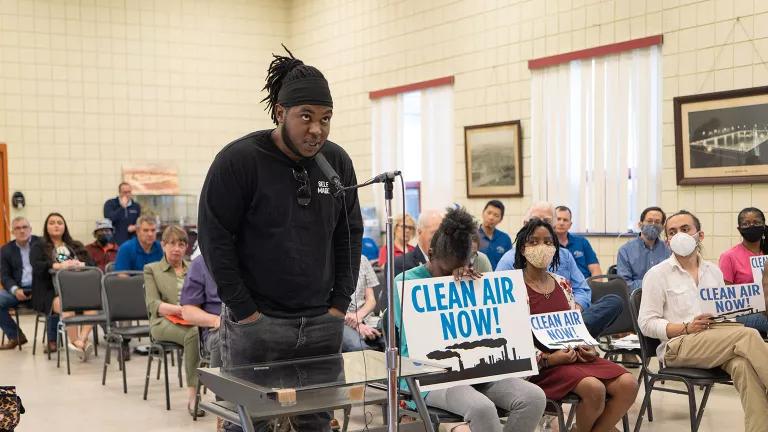
Qiyam Ansari, Mon Valley resident and Valley Clean Air Now board of directors president, testifying during an Allegheny County Health Department public hearing about revised coke oven regulations held in Clairton, Pennsylvania, on May 11, 2022. Ansari suffered a severe asthma attack at age 16 that led to a collapsed lung and a weeklong medically induced coma. He attributes the near-death episode to poor air quality in Allegheny County.
Mark Dixon via Flickr, CC BY 2.0

This essay was originally published in Environment: Science and Policy for Sustainable Development on September 8, 2026.
Our rapidly deteriorating climate reality alongside equally as threatening crises of health protection, preservation of nature, and basic affordability are forcing many across our society to confront tough choices and look for solutions to big problems. Building the infrastructure and systems needed to adapt to climate change is an urgent need. We must simultaneously answer pressing issues of affordability for necessities such as housing, water, food, and electricity. Our efforts to confront these challenges must be pursued in a way that will improve health and environmental quality for all people. At the very least, our efforts in one area should not compound the severity of the other intersecting crises.
Because of all of this, many people—private-sector project sponsors, elected officials, climate advocates, to name a few—are looking for obstacles to remove.
Meaningful community engagement, performing impact analyses, and ensuring that projects benefit host communities are three of the common “obstacles” that are often pointed at as blocking the speed and scale at which we must respond to mounting crises. These practices have varyingly been characterized as costly, ineffective, time-consuming, cumbersome, and even wholly unnecessary.
What if instead of viewing these practices as obstacles, we look at them from a different perspective: When done well and as part of a three-pronged approach, they actually increase the speed at which we deliver improved projects that offer more beneficial outcomes and increase the likelihood of co-benefits for things such as protecting natural spaces and improving public health?1
1This article focuses on a better means for projects and their sponsors to engage positively with potential host communities. It does not address the issue of when communities outright oppose a potential project being sited in their community.

Residents who live across the street from Valero Refinery in Houston, Texas
Engagement
As NRDC’s president and chief executive officer Manish Bapna argues in a recent essay in Democracy Journal, building the good things our society needs—from solar and wind farms to energy-efficient housing and buildings—requires a new kind of community engagement that can achieve goals at speed.
One truth of engagement holds for all communities: Nobody wants to live in a place where things are just done to them. Across our society, there are obvious differences in the abilities and powers of different communities to have a say in what happens in and around their community. Some communities have much greater ability to influence what happens to them. Other communities—typically those with less wealth and greater concentrations of people of color—have little to no ability to influence what happens. The recent trajectory of data center build-out provides a rapidly growing number of examples from all sorts of communities in our country about the anger and opposition with which communities will rally against projects foisted upon them.
Communities have a right to be engaged on matters that affect them. Fortunately, the practice of meaningful community engagement has evolved significantly in the past several decades. The expectation for public decision-making has moved from back rooms of old boy networks toward a democracy-based expectation of transparency, involvement, and accountability. This is not to naively assert that there aren’t still plenty of self-serving handshake deals made under the table across our society. But our society’s expectations and demands have come a long way, as has the practice of engagement.
The first formal public hearing I ever attended was in 2007. It was a U.S. Environmental Protection Agency (EPA) hearing on ozone, held in a swanky hotel in Houston’s ritzy Galleria area on a Wednesday morning. It was stodgy, tense, and artificial. It was focused on an air pollution issue, on the opposite side of town, from what is one of the largest concentrations of heavy industry and related pollution on our planet. It was not good.
Fast-forward a few years, and the EPA was again in the process of updating an air pollution rule; this time, one specifically for pollution from refineries. The administration had changed, and there was a renewed commitment to justice and engagement. Some partners and I requested that the EPA hold another hearing in Houston, but we asked the EPA if we could help them set it up, and the agency agreed. So the EPA held the hearing in a community basketball facility less than a football field’s length from the fence of a refinery on Houston’s Ship Channel. They changed the time so that folks could come around their work schedules. My partners and I canvassed neighborhoods. We grilled hot dogs and had coolers of soda on ice (with maybe a few beers chilling underneath). The EPA officials sat in and with the community the whole day. They not only heard the community’s testimony. They simultaneously saw, smelled, and tasted their testimony (yes, with pollution that bad, you can taste it on the air) because they were right there with them in their community. The entire hearing had a different impact because of how it was arranged.
Engagement must happen in the very earliest phases of ideation and development, where the community’s interests have maximum opportunity to influence everything that flows after.
Today, it has become increasingly common for engagement opportunities that precede public decisions to be held in local schools, churches, and recreation facilities where the community feels greater comfort in walking through the doors. The meetings are often held in the evenings or over weekends to accommodate the realities of most people’s lives. If planned well, the meetings will have refreshments along with childcare, accessibility considerations, document translations, and language interpreters. When deeper participation is needed, community members can rightfully expect to be compensated for their time, efforts, and knowledge. In well-planned engagements, government agencies and project sponsors increasingly know that their due diligence includes the legwork ahead of time to get to know the community and its leaders by engaging educators, the faith community, and local nonprofits. If government officials and project sponsors are really brave—and effective—those community leaders will be invited to co-create the engagement to bolster the likelihood of participation and meaningful feedback.
Several years after the refinery hearing in Houston, I had the chance to serve at the EPA as the head of its environmental justice program, where I could help advance the practice of community engagement from inside the government. It was remarkable to see the real-world benefits that came from a greater focus on listening and responding to communities who were most impacted.
My colleagues in the EPA’s air program, for example, pioneered a new approach that involved engaging communities on potential air pollution rules before the rules even reached the public hearing stage. The EPA’s air program staff would go out to communities that are most impacted ahead of time, identify local leaders to engage, and co-create an educational program for the community that was led by the community’s trusted allies from nonprofits and academia. They spent multiple days in numerous communities providing trainings on the basics of the Clean Air Act, the importance of the rulemaking process, the necessity for strong public comments with role-play on how to be impactful in three minutes of testimony, and the power the community could assert if they engaged in the process. They worked to ensure that the communities built the capacity to engage meaningfully in the decision-making process.
For engagement to be truly meaningful and not merely high-quality performance, all of the efforts to deeply engage a community must then be reflected in what is being proposed. That means engagement must happen in the very earliest phases of ideation and development, where the community’s interests have maximum opportunity to influence everything that flows after. This is not to say that the community can reasonably expect everything raised to be fully and satisfyingly addressed. As mentioned already, few communities can expect to completely dictate the terms. Even if they could, how many communities are there where everyone is in 100 percent agreement about what should happen? There will be differences of opinion, trade-offs, and the need for compromise. Within this, however, community members should be able to expect and demand that their feedback is both sincerely heard and tangibly accounted for in material changes to whatever is being proposed.
This concept is not novel. The EPA, for example, integrated this practice of following up on engagement into the agency’s multiyear strategic plan, crafted in 2021. In that plan, the EPA committed to regularly including in decisional documents, such as rulemakings, a section that reported back on what had been heard and learned through public engagement and how the final decisions did or did not respond to that feedback and why.
This was not an easy commitment for the agency to make, most notably because of internal consternation about how to communicate decisions that, for whatever reason, did not change in light of public feedback and remained unpopular. Ultimately, however, the EPA adopted the policy based on the principle that if individuals take the time and energy out of their days to share the wisdom of their lived experiences, they deserve to hear back from their government on how decisions did or did not take that experience into account.

Northern Virginia has the largest concentration of the world's data centers—which require large amounts of natural resources, including water, to run—managing roughly 70 percent of global internet traffic.
Assessment
Assessing the potential impacts—positive and negative—of a project is another area where there is a foundation of practice that can facilitate turning community engagement and facts on the ground into a meaningful framework for decision-making. Ideally, the impacts of a proposed project or decision will be nested within a full picture of everything surrounding that proposal within the community. That picture will illuminate the relationships between the potential impacts and the conditions on the ground so that decision-makers can clearly see and assess the implications of different options. The well-established practice of health impact assessing provides a ready framework within which to describe these connections, paint that fuller picture, and provide decision-makers with the sort of clarity needed to make informed decisions.
The foundation provided by health impact assessments can be readily built upon to piece together an even richer cumulative impact assessment. What was heard during meaningful community engagement about the lived experiences and realities of a community can be brought alongside available scientific data on environmental conditions and health outcomes. The community members’ relationship to the natural environment, what it means to them culturally, and how it threatens or improves their kids’ health will bring to life what are otherwise abstract numbers on a page. The qualitative will form a relationship to and give meaning to the quantitative. Adding in historical research about a community—the good, bad, and ugly of things, such as past public (dis)investments, economic development and degradation, and oppressive policies such as redlining—builds out the picture of a community and situates it not only in place but in time. The hard sciences will come into conversation with the social sciences. Decision-makers can wrap a rich and full context around their decision to better weigh all of the options.
Engagement that feeds into an assessment that then informs and improves project design and decision-making also gives the entire process some real stakes. If a project wants to avoid community opposition and hopefully gather the winds of community support, there’s hardly a better way to start. The engagement and assessment provide additional tangible benefits to the project sponsor by unearthing things that otherwise are too easily missed: the opportunity to align with and leverage another unrelated but closely situated project; granular information about the realities of a community, such as unofficial land uses and irregular traffic patterns; or awareness of things suppressed or forgotten in the historical record, like unmarked cemeteries or long-buried contamination.
A project cannot be expected to single-handedly solve every challenge faced by the community. It should, however, be part of a long-term commitment to positive change in the community, related to its issues and future plans.
I’ve seen these scenarios unfold throughout my career.
A multibillion-dollar transportation project in its third year of planning finally engaged the local community, who immediately pointed out that the preferred project alternative ran right next to a Superfund site that somehow escaped the planners’ due diligence. The project went back to square one.
A high-rise condominium development that was ready to break ground on one of the last empty blocks near downtown was finally revealed to neighbors, who shared that their ancestors were buried there in unmarked graves and that the city’s long-defunct motor pool lot across the street dumped barrels of used motor oil and other chemicals on those graves back in the 1940s and 1950s. The entire project fell apart.
A large entertainment and mixed-use development struggling with how to manage stormwater runoff from parking lots finally met a local community organization that just so happened to have some plans percolating with the county about flood abatement and river restorations a little over a mile downstream, but they weren’t yet able to make the funding work. Problem solved.
Hearing from more people with more local knowledge in the earliest stages of a process, building those relationships, and pulling everything available into an assessment will maximize the opportunity to achieve multiple bottom-line wins. Finding such wins supercharges local support and buy-in, putting more wind in the sails of the project.
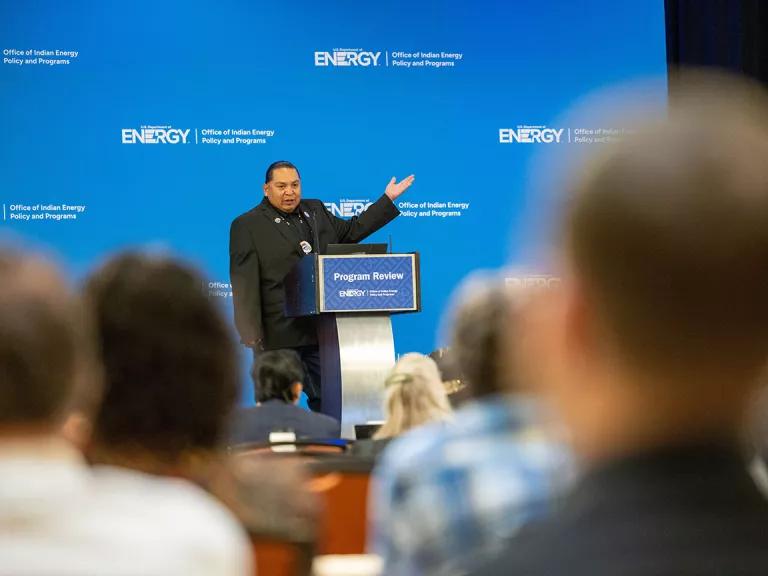
Wayne Yazza, Jr. of the Picuris Pueblo Indian Tribe presents on "Pueblo of Picuris Community Solar System Phase II" at the 2024 U.S. Department of Energy Office of Indian Energy Program Review on November 19, 2024.
Gregory Cooper/NLR
Agreement
Through engagement and assessment, a project or decision can hopefully eliminate, minimize, or mitigate many of the negative aspects of a proposal. In reality, many projects or decisions have negative impacts that are impossible to avoid.
This is where community benefits agreements can come into play. For the project to be truly successful, this agreement must not only offset the negatives of a project but also respond to the needs, realities, and future vision of a community. It must be an important element of how a community works toward achieving a better, safer, healthier future. This is a lot for one agreement to achieve, and a single agreement certainly cannot solve for all of a community’s past harms, present needs, and future desires—but the engagement and assessment provide a foundation to root the benefit agreement in these realities. And if the benefit agreement comes as a deliberate third step in this three-pronged approach, it gives the community a reason to participate in each stage of the process and drives the project sponsor to view the community as a partner instead of an obstacle.
This foundation also solidly moves a benefits negotiation away from being viewed as an exercise in bribery on the part of the project sponsor or extortion on the part of the community. Instead, it gives the community a real seat at the table to make informed choices and trade-offs and provides a defined universe of needs and possibilities to frame the negotiation. Again, a project cannot be expected to single-handedly solve every challenge faced by the community. It should, however, be part of a long-term commitment to positive change in the community, related to its issues and future plans. This will once more add some real stakes for a community to commit to participating in engagement and assessment and to work in partnership to get to a result because of the tangible benefits that align with a community’s desire for where it wants to go.
For a project proposal to build on this commitment and partnership, the benefits agreement should be expansive and future focused. It should bring in the more well-established field of labor agreements to build an agreement that looks out across other domains. Communities should have ready access to such past agreements and other examples to fire their imaginations and broaden their horizons. Project sponsors should enter into negotiations with an open mind and a readiness to move beyond the performative (no more getting away with new jerseys for the local football team) and to support the community’s ambition (job training to work on the project site might be nice, but maybe the community wants support to train for other trades too!). A completed project is going to have a long-term visible presence in a community and, if successful, provide long-term revenues for the project sponsors. The benefits the community receives should likewise be tangible and long-lasting.
It is important to see these three elements (engagement, assessment, agreement) as a three-pronged approach. Worked together, they can bring speed and scale to projects so that they are built faster, better, and in a way that helps—not harms—nearby communities. Committing to their implementation and seeing how they relate to one another shifts them from being seen as barriers into providing a supercharged pathway toward speed and scale that minimizes the increasingly real risk of well-organized opposition and instead generates buy-in and collaboration. They are not, as hopefully described here, options on an à la carte menu. If taken together and done well—with commitment, investment of time and resources up-front, and an open mind by all parties to truly change the nature of the relationship between projects and the communities where they are sited—we have the elements to build things that further justice across our society, provide multiple bottom-line wins, and meet the speed at which we must respond to the urgent crises facing our society.
Read more in this series

How to Build an Affordable Energy Future
To unleash America’s energy potential, we need reforms that are different, and go far deeper, than the permitting proposals Congress is considering right now.

Policy and Political Roadblocks—Not Economics—Are Holding Back America’s Clean Energy Future
A pragmatic roadmap to secure American prosperity.

A Nature-Friendly Clean Energy Future
The rapid buildout of renewables could make the extinction crisis worse. It’s a problem we can—and must—solve.
Related Resources
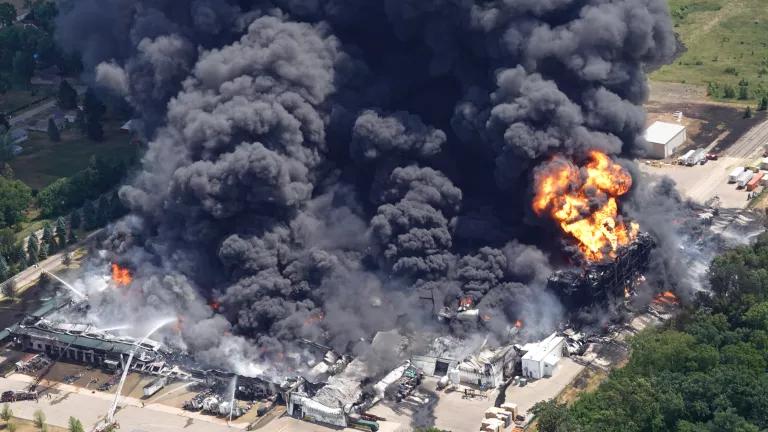
Communities and Workers Deserve Robust Protection from Chemical Disasters

Stolen Futures: Communities Betrayed by Federal Clawbacks